
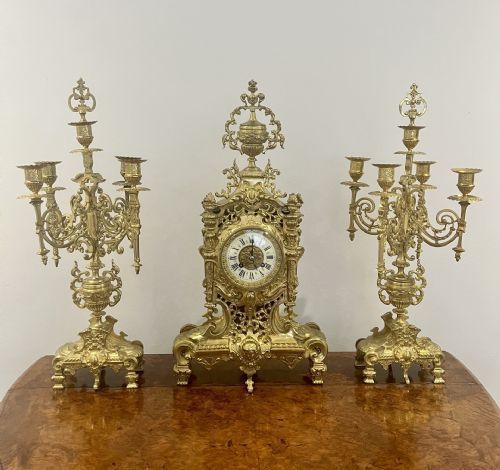


Gilded Ormolu Clock Set
These gilded ormolu clock set pieces bring nineteenth-century French elegance and matching side ornaments straight to your mantelpiece.
Gilded Ormolu Clock Set
When you search for a gilded ormolu clock set, you encounter nineteenth-century French mantelpieces and matching garnitures designed for formal display. These ensembles typically comprise a central clock accompanied by matching side pieces such as urns or vases.
The pieces on this page span the Victorian era, Napoleon III period, and nineteenth-century revivals including French Rococo and Louis XVI styles. Most examples originate from French workshops and incorporate coordinated decorative schemes intended for grand interiors.
What varies in quality
Quality depends upon the crispness of the bronze or ormolu casting and the depth of the original gilding. Finer sets display deeply chiselled surface details and heavier metal gauges rather than light pressed brass.
The integration of secondary materials also defines the tier of a set, with hand-painted porcelain panels and genuine marble bases sitting above simpler metal-only constructions. Retaining the complete matching garniture intact elevates the standard of the ensemble.
Nineteenth-century French clockmakers sometimes hid their signatures deep inside the brass gear trains, leaving secret stamps for future repairers to discover.
Vincenti of Paris·Deniere Paris·Japy Freres
The Gilded Ormolu Clock Set Glossary
- Ormolu
- Gilt bronze produced by applying a mercury and gold amalgam to a bronze base and heating it. This technique creates a durable golden surface seen on nineteenth-century French decorative objects.
- Clock garniture
- A matching set of ornamental pieces designed to flank a mantel clock. These side pieces often take the form of urns, vases, or candelabra matching the clock's style and materials.
- Chamlevé enamel
- A technique where troughs are dug into a metal surface and filled with vitreous enamel before firing. This method produces colourful decorative patterns on clock dials and mounts.
Gilded Ormolu Clock Set: Frequently Asked Questions
What is a clock garniture?
A clock garniture is a decorative set consisting of a central mantel clock accompanied by matching side ornaments, typically two urns, vases, or figures. These pieces were designed to be arranged together on a mantelpiece or console table to create a balanced display.
The fashion for matched sets flourished in nineteenth-century France, where makers produced coordinated suites in Louis XVI and Rococo revival styles to furnish formal drawing rooms.
How do I date an ormolu clock set?
Dating these sets involves examining the styling, materials, and movement signatures. Nineteenth-century French examples often incorporate specific revival motifs, such as neoclassical urns or exuberant rococo scrolls, alongside cast brass and porcelain elements.
Maker signatures stamped on the movement backplates provide the most reliable chronological markers. Comparing the style of the enamel dial and the type of marble or bronze casting helps narrow the period of manufacture.
Where should I place a clock set?
These large three-piece ensembles require a wide, sturdy surface such as a mantelpiece, a large sideboard, or a dedicated console table. Because the central clock is flanked by matching garnitures, the arrangement needs adequate horizontal space to display the full set properly.
Positioning the pieces away from direct heat sources and direct sunlight protects the delicate ormolu finish and keeps the internal mechanical movement running accurately.
Are these clock sets difficult to maintain?
Maintaining a nineteenth-century clock set involves gentle dusting with a soft, dry cloth to protect the gilt ormolu surface. Chemical cleaners must be avoided, as they can strip the gold finish from the bronze and damage surrounding porcelain or marble.
Mechanical clock movements require periodic professional servicing to clean the gears and ensure reliable timekeeping. Handling the side garnitures with care prevents chipping on any integrated enamel or porcelain components.