








Gilded Mount Side Table
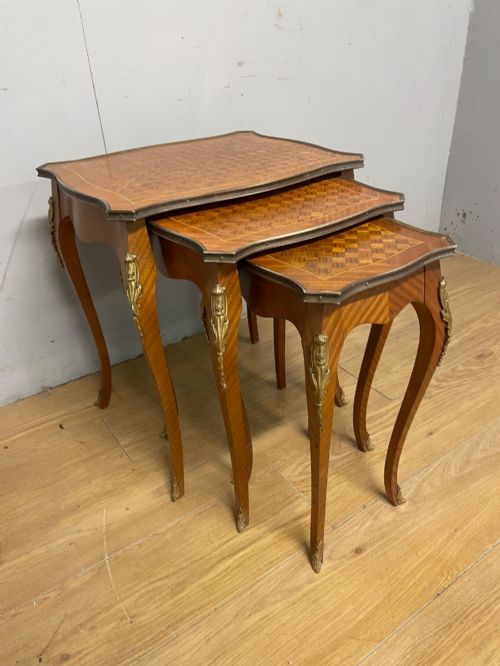
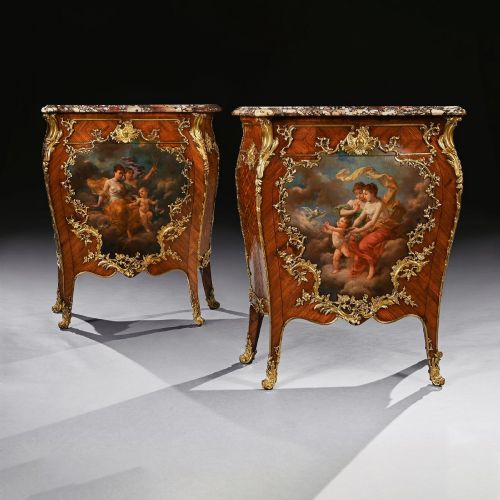
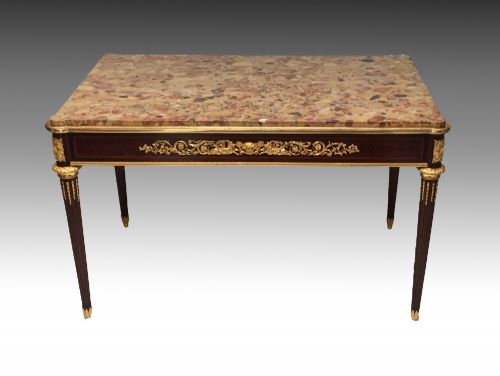
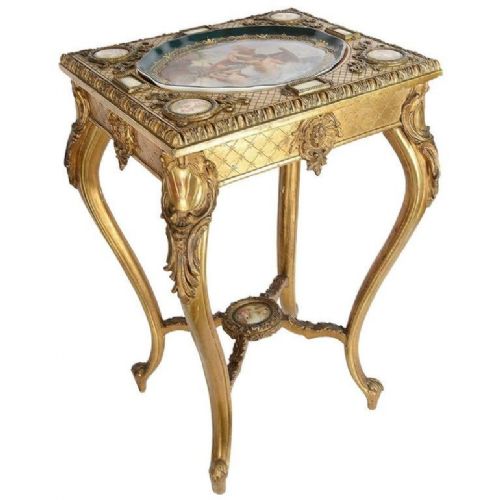
These gilded mount side table examples bring together marble tops and gilt ormolu or brass mountings in French and Italian revivals.
Gilded Mount Side Table
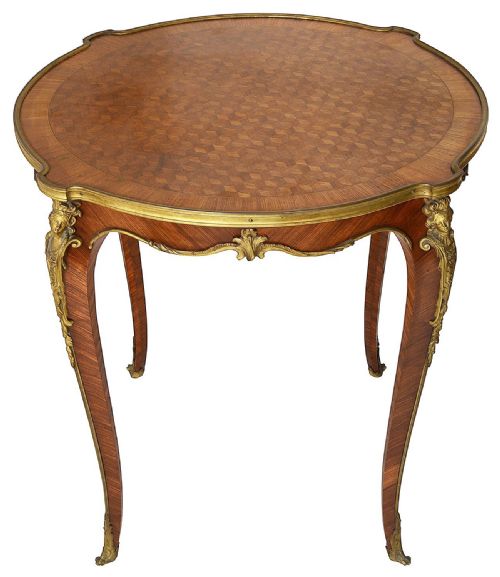
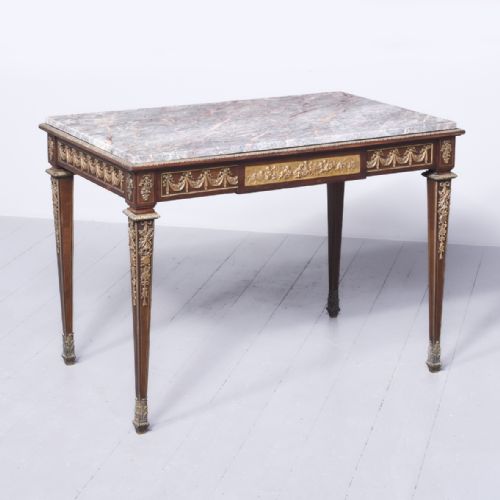
A gilded mount side table combines timber frameworks such as mahogany, kingwood, walnut, and giltwood with cast metal mounts in ormolu, gilt bronze, or gilded brass. These pieces span the eighteenth century through to the 1930s, encompassing console tables, occasional tables, centre tables, and card tables.
The versions most commonly found here follow nineteenth-century French and Italian styles, particularly French Rococo Revival, Louis XVI style, and Louis XV style. They often feature inset marble or onyx tops alongside detailed marquetry, parquetry, or painted finishes.
Makers and designers working in these traditions, such as Zwiener and Jansen Sucesseur, produced works that influenced later twentieth-century interpretations. The form functions primarily as a decorative surface for display or as a console set against a wall.
How they were made
Cabinetmakers constructed the underlying carcase using hardwoods like mahogany, walnut, or kingwood, frequently applying decorative veneers in parquetry or Vernis Martin techniques. Giltwood examples relied on carved timber coated in gold leaf rather than applied metal mounts.
Mounts were cast in bronze, brass, or ormolu, then chased and gilded to accentuate the foliate and scroll motifs characteristic of Rococo and neoclassical designs. Stone tops, including marble and onyx, were slabbed, shaped to fit the frame, and polished smooth.
Several items double as vases when the porcelain element is lifted from its mount.
What varies in quality
The crispness of the chasing on the gilt bronze or ormolu mounts separates standard production from finer examples, as sharp detail requires skilled hand-finishing after casting. Heavy, well-cast mounts integrate smoothly with the timber contours rather than appearing awkwardly attached.
Timber selection and veneer work also dictate grade, with figured mahogany, complex parquetry, and genuine marble or onyx slabs representing superior construction compared to simpler painted or plain wood surfaces.
Zwiener Jansen Sucesseur
The Gilded Mount Side Table Glossary
- Ormolu
- A gilded bronze technique used for decorative mounts on furniture. It involves applying a mercury and gold amalgam to bronze before heating.
- Vernis Martin
- A decorative lacquer technique developed in eighteenth-century France to imitate Asian lacquer finishes. It provides a glossy, layered surface often seen on commodes and tables.
- Parquetry
- Geometric wood inlay patterns assembled from small veneer tiles. It creates patterned surfaces on table tops and cabinet doors.
- Guéridon
- A small round table supported by one or more columns, originating in seventeenth-century France. These often feature marble tops and gilt mounts.
- Console table
- A table designed to stand flat against a wall, frequently supported by brackets or legs at the front only. They often carry heavy marble slabs.
Gilded Mount Side Table: Frequently Asked Questions
What is a gilded mount side table?
A gilded mount side table is a decorative surface featuring timber construction paired with cast metal mounts in ormolu, gilt bronze, or brass.
These pieces draw heavily on French and Italian revival styles from the eighteenth and nineteenth centuries.
How do I identify Louis XVI style?
Louis XVI style pieces typically display neoclassical straight lines, symmetrical proportions, and restrained classical motifs like acanthus leaves and urns.
They contrast with the more flamboyant, asymmetrical curves found in earlier Rococo designs.
Where were these tables used?
These tables served as functional display surfaces in grand reception rooms, hallways, and drawing rooms.
Console variations were fixed against walls beneath mirrors, while occasional and centre tables stood free in the room.
Are the marble tops original?
Many tables retain their original fitted marble or onyx slabs, shaped specifically to follow the contours of the wooden frame.
Replacement tops do occur due to damage over time, which can be identified by examining the fit and edge polishing.