
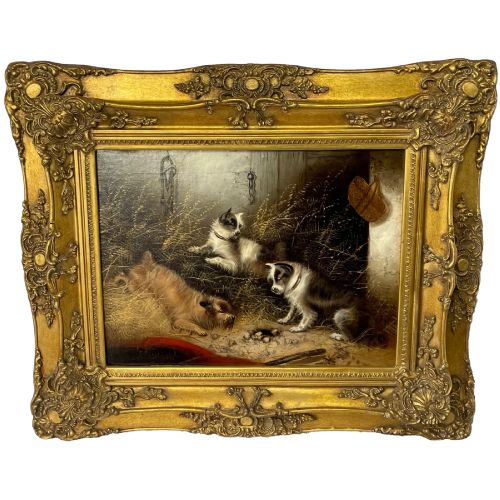

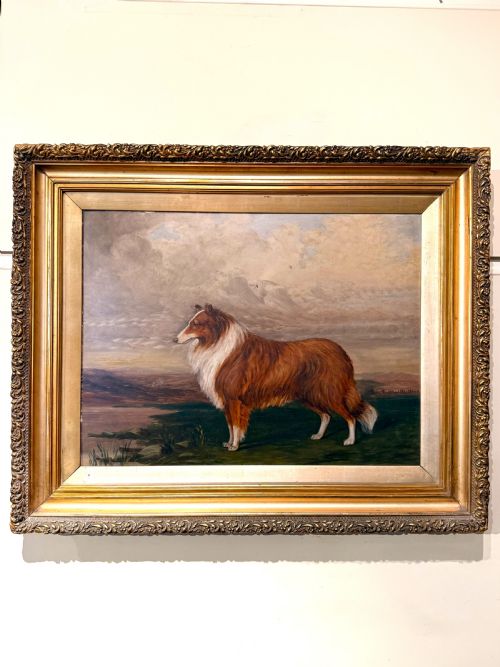



Gilded Frame Dog Art
Gilded frame dog art brings together canine portraiture and period craftsmanship, offering a glimpse into past domestic and sporting life.
Gilded Frame Dog Art
Gilded frame dog art encompasses framed oil paintings, watercolours and etchings depicting dogs from the eighteenth, nineteenth and early twentieth centuries. These works range from intimate studies of spaniels and terriers to grand equestrian and sporting scenes featuring hounds and retrievers.
The version most commonly encountered on this page is the nineteenth century oil painting on canvas or board, housed in a giltwood or gilded wood frame. Victorian and Edwardian examples frequently show dogs alongside owners, livestock or country houses, reflecting the artistic conventions of the period.
How they were made
Artists worked primarily with oil paint on canvas or wooden boards, applying layers of pigment to capture the texture of animal coats and the light of pastoral or domestic settings. Watercolours on paper and original etchings also appear, created through traditional printmaking and drawing techniques.
The frames supporting these works are constructed from wood, finished with gold leaf or giltwood to create a reflective metallic border. Guilds and makers utilised gesso and applied gold leaf over carved wooden mouldings to complement the tonal depth of the paintings.
Materials documented across the collection include oil paint, canvas, wood, gold leaf, and giltwood frames.
What varies in quality
The distinction between standard works and exceptional pieces lies in the precision of brushwork and the anatomical accuracy of the animal subjects. Master painters capture distinct character and lifelike proportions in the dogs, whereas provincial or studio copies display more rigid execution.
Frame craftsmanship also influences the standing of a piece, as hand-carved giltwood mouldings with intact original gilding demonstrate higher artisanal skill than simpler later replacements. The prominence of the artist and the documentation of provenance further elevate the standing of individual artworks.
Valentine T. Garland·David Bates·Herbert Dicksee·George E Sharpe·Edwin Frederic Holt·Robert Cleminson·John Constable·Richard Waitt·Charles Bilger Spalding·Thomas Blinks·Samuel Fulton·Charles Hunt Jnr
The Gilded Frame Dog Art Glossary
- Giltwood
- Wood that has been coated with gold leaf or a gold-coloured finish. This material forms the ornate borders characteristic of period picture frames.
- Oil on canvas
- Pigment mixed with drying oil applied to a stretched canvas support. It is the predominant medium for nineteenth century fine art portraits and landscapes.
- Etching
- A printmaking process where lines are incised into a metal plate with acid before ink is applied and transferred to paper. Herbert Dicksee utilised this technique for detailed animal studies.
- Provenance
- The documented history of ownership surrounding an artwork. A clear record adds context and authenticity to antique paintings.
Gilded Frame Dog Art: Frequently Asked Questions
What periods do these pieces date from?
The selection spans from the early eighteenth century through the Victorian and Edwardian eras up to the early twentieth century. Most examples originate from the nineteenth century.
Paintings from this time reflect shifting artistic styles, moving from formal portraiture to genre scenes and sporting art.
How should I display these frames at home?
Gilded frames suit traditional interiors, studies and living rooms where wood furniture and classic decor predominate. Hang them at eye level on neutral walls to let the metallic frame catch the light.
Keep pieces away from direct sunlight and damp environments to protect both the canvas and the gilt finish.
How do I identify a Victorian dog painting?
Victorian works often feature distinct canine subjects such as terriers, spaniels or hounds, frequently painted with human companions or in pastoral landscapes. Look for period costumes on the human figures and traditional oil on canvas or board substrates.
Signatures, artist attributions and nineteenth century framing techniques help confirm the era of production.
What subjects are common in this art?
Common subjects include individual dog portraits, working gundogs, hunting parties with hounds, and family pets accompanying children or farmworkers. Some pieces depict famous literary or historical scenes involving animals.
Landscapes and country houses frequently appear in the background of these compositions.