





Victorian Terrier Portrait
A victorian terrier portrait captures the keen intelligence and distinct character of the breed in oils or silver.
Victorian Terrier Portrait
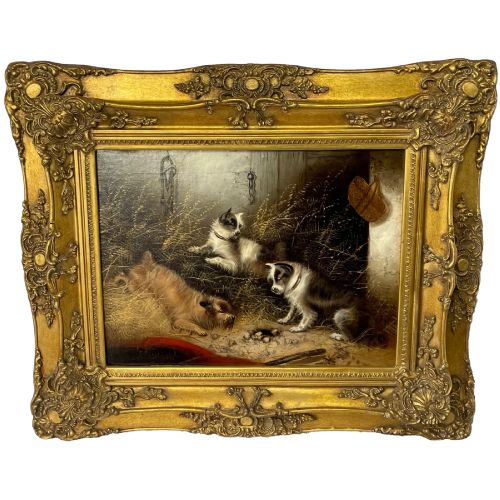
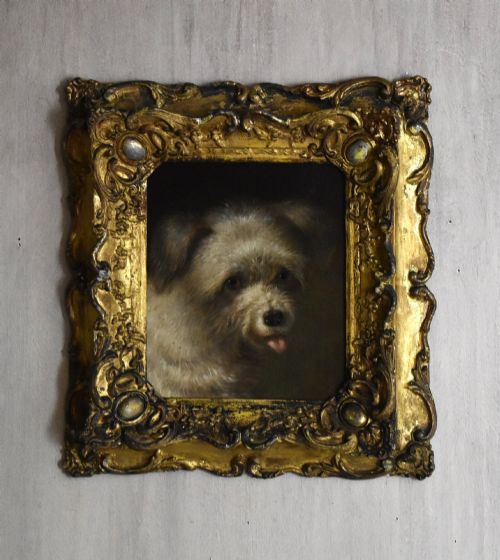
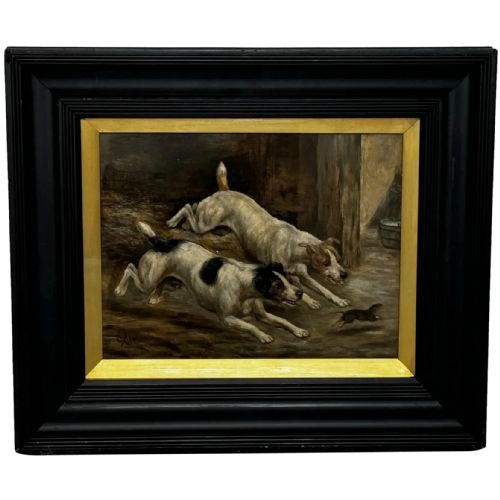
A victorian terrier portrait brings the working dog of the nineteenth century into domestic view through oil paintings and silver vesta cases. These works range from individual studies of fox terriers and Jack Russells to lively scenes of dogs ratting in barns or standing in walled gardens.
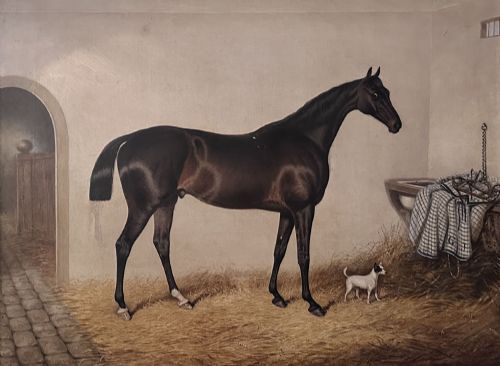
The pieces on this page span the nineteenth century into the early twentieth, connecting the Regency period through to Edwardian interpretations. Paintings depict single subjects as well as pairs and groups, reflecting the varied roles these dogs played.
Beyond traditional canvas works, collectors encounter specialised objects such as silver enamel vesta cases shaped as dog heads. Each item preserves a specific type of terrier, rendered with the realism characteristic of Victorian sporting art.
How they were made
Canvas forms the primary support for these works, prepared with gesso before artists applied oil paint to build texture in the coats of the dogs. Giltwood and gold leaf frequently frame the paintings, enhancing the depth of the composition through traditional framing techniques.
Metalworking techniques are visible in pieces such as silver vesta cases, which combine chased silver with enamel details to shape realistic canine forms. Painters utilised layered brushwork to capture the wiry hair and alert expressions typical of each terrier breed.
Several terriers are caught red-handed mid-ratting, proving that even fine art cannot keep a good working dog from its job.
What varies in quality
The success of a portrait rests upon the artist's ability to render the anatomy and distinct expression of the terrier without stiffness. Stronger works demonstrate a deep understanding of canine movement, particularly in dynamic scenes involving ratting or hunting.
Condition of the canvas, original framing, and the clarity of the oil paint contribute significantly to the standing of a piece. Finer examples display meticulous attention to the texture of the coat and the play of light in settings such as gardens or barns.
Valentine T. Garland·Martin Theodore Ward·Sir Edwin Landseer·John Emms·George Armfield·Edward Armfield·Samuel Fulton
The Victorian Terrier Portrait Glossary
- Sporting art
- A genre of painting focused on animals, hunting, and rural pursuits, highly prominent during the nineteenth century.
- Giltwood
- Wood that has been treated with gold leaf or a gold-coloured finish, commonly used for period picture frames.
- Canvas
- A heavy woven fabric stretched over a wooden frame, serving as the standard support for oil paintings.
- Realism
- An artistic movement focused on depicting subjects truthfully and accurately, without idealisation.
Victorian Terrier Portrait: Frequently Asked Questions
What subjects do these portraits show?
The works depict individual terrier dogs as well as pairs and groups engaged in activities like ratting.
Scenes range from calm garden portraits to dynamic farm settings involving Jack Russells, fox terriers, and Scottish terriers.
Are all the paintings from the Victorian era?
While the majority date to the nineteenth century and Victorian period, the selection extends into the Regency era and the early twentieth century.
Pieces labeled under Edwardian or later dates share stylistic ties with earlier Victorian sporting art.
What materials were used for these items?
Oil paint on canvas forms the basis of the paintings, frequently housed in giltwood frames with gold leaf details.
Non-painting items utilise silver and enamel, particularly in functional objects like vesta cases shaped as dog heads.
How do I care for an oil painting?
Keep paintings away from direct sunlight and fluctuating humidity to protect the canvas and oil paint from cracking.
Dust the surface gently with a soft, dry cloth and avoid using liquid cleaners on the canvas or frame.