




Gilded Bronze Decorative Urns
These gilded bronze decorative urns bring classical presence and warm metallic lustre to a room, spanning nineteenth-century revival styles and grand decorative forms.
Gilded Bronze Decorative Urns
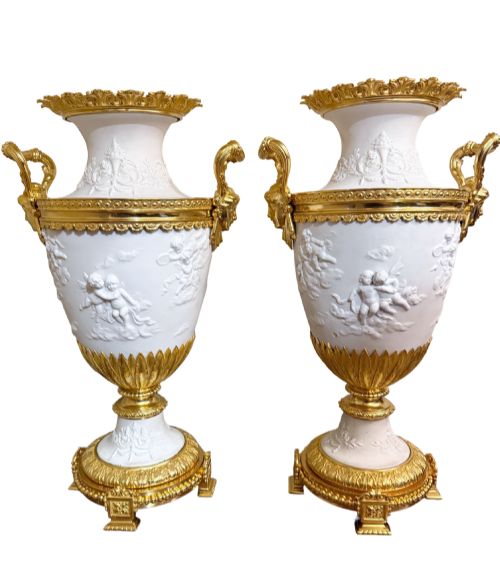
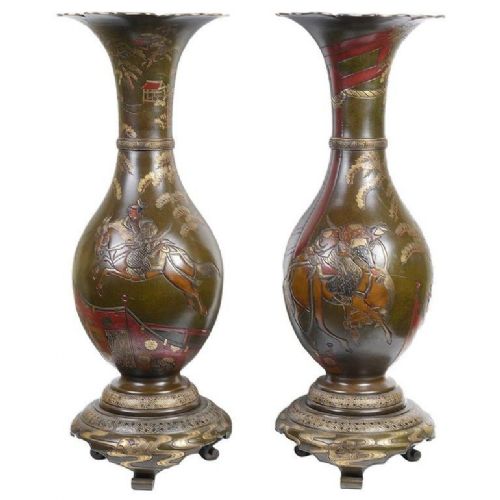
When you search for gilded bronze decorative urns, you encounter ornamental vessels and cassolettes designed primarily for display rather than function. The pieces on this page are predominantly nineteenth-century French works, alongside Japanese Meiji period examples and later interpretations.
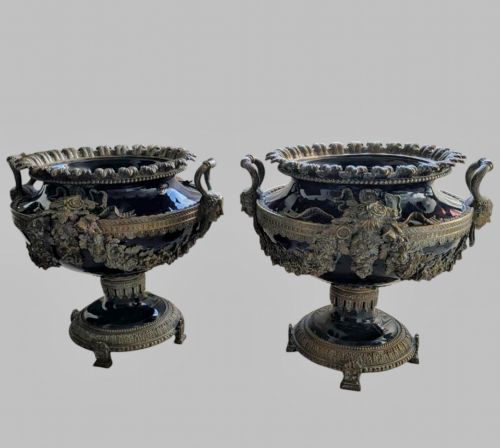
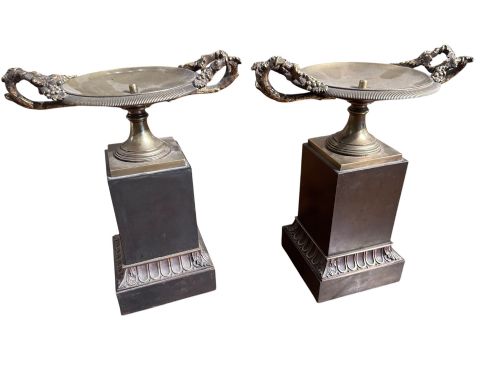
Most frequently, you meet pairs of vases and tazzas combining cast metal with porcelain, marble, or ceramic bodies. These range from heavy architectural forms in the Empire and Restauration taste to lighter, floral-influenced Art Nouveau designs.
How they were made
Maker's workshops cast bronze or brass and applied mercury gilding, known as ormolu, to create durable metallic surfaces with varied matte and burnished finishes. Patinated bronze is often contrasted directly against the bright, warm gleam of gold leaf or gilt metal.
Many objects combine metal mounts with bodies turned from marble, moulded white and blue porcelain, or coloured glass. These diverse materials are joined mechanically with threaded rods and nuts, allowing complex multi-part constructions.
Listings combine nineteenth-century French porcelain and ormolu vessels with Japanese Meiji period bronze works and later twentieth-century interpretations.
What varies in quality
The refinement of the casting and chanterelling dictates the definition within foliage, figures, and architectural details. Sharp, undercut bronze mounts show superior craftsmanship compared to softer, more rounded commercial castings.
The selection of secondary materials further separates standard production from exceptional pieces. High-grade marble veining, hand-painted porcelain panels, and intact fire-gilding denote higher ambition and cost in the original workshop.
Charles Korschann·Henry Dasson·Kizan
The Gilded Bronze Decorative Urns Glossary
- Ormolu
- A term for gilded bronze, produced by applying an amalgam of gold and mercury to a bronze base and heating it. This technique creates a rich, lasting golden surface.
- Cassolette
- A dual-purpose decorative vessel featuring a reversible lid that transforms from a closed urn into a tazza or incense burner. They appear frequently in nineteenth-century French interiors.
- Tazza
- A shallow bowl or cup elevated on a stem and foot, often fashioned from marble and mounted in gilt bronze. These pieces draw on classical forms popular during the Grand Tour period.
- Jardinière
- A decorative container designed to hold plants or floral arrangements, frequently manufactured in ceramic or porcelain with metal mounts. They anchor table centres and mantelpieces.
- Koro
- A Japanese incense burner, typically supported on three or four feet and pierced for the release of fragrance. Examples from the Meiji period utilise high-grade bronze casting.
- Restauration
- A French decorative style bridging the Empire period and the July Monarchy. It favours cleaner lines and restrained gilt bronze ornamentation alongside warm wood tones.
Gilded Bronze Decorative Urns: Frequently Asked Questions
What is the difference between ormolu and gilt bronze?
Ormolu specifically refers to historical mercury gilding applied to bronze, creating a distinctively deep and durable lustre. Gilt bronze is a broader modern descriptor that can encompass various modern plating techniques alongside traditional fire gilding.
Historical pieces from the nineteenth century rely primarily on traditional mercury amalgamation methods. Understanding this distinction helps identify the period and workshop origins of decorative metalwork.
How do I care for marble and ormolu mounts?
Dust bronze and marble components gently with a dry, soft cloth to prevent particulate accumulation. Avoid abrasive cleaners, polishes, or chemical solvents that strip the thin layers of original gilding.
Care should be taken around fitted joints and porcelain bodies, which may be secured with interior hardware. Stable indoor humidity prevents degradation of both the stone and the underlying metallic pins.
Were these urns meant to hold water?
Most ornamental urns and cassolettes served purely decorative functions within nineteenth-century interiors. Their internal cavities were constructed to display dried arrangements, or simply to stand empty as sculptural objects.
Introducing water into antique porcelain or mounted marble vessels risks damaging interior cements and historic materials. Utilising separate glass liners protects the original interior structure if floral displays are desired.
How can I distinguish French Empire from Art Nouveau pieces?
French Empire urns display strict symmetry, classical architectural motifs, and formal geometric proportions. Gilt bronze mounts feature military trophies, palmettes, and Greco-Roman deities.
Art Nouveau pieces abandon rigid symmetry in favour of whiplash curves, organic plant forms, and flowing female figures. Materials like patinated bronze take precedence over the bright, structured symmetry of earlier nineteenth-century works.