
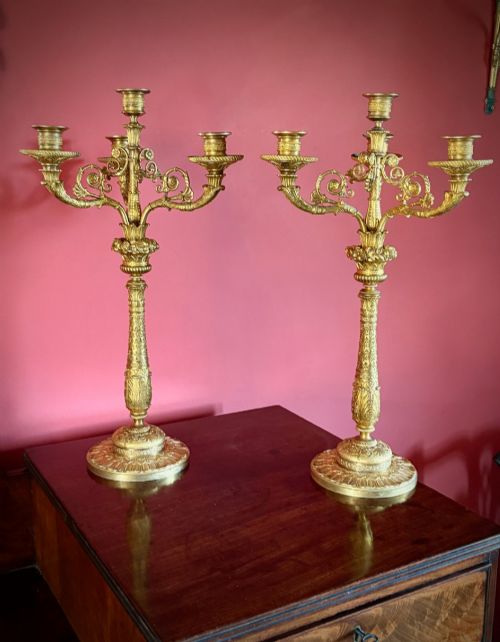
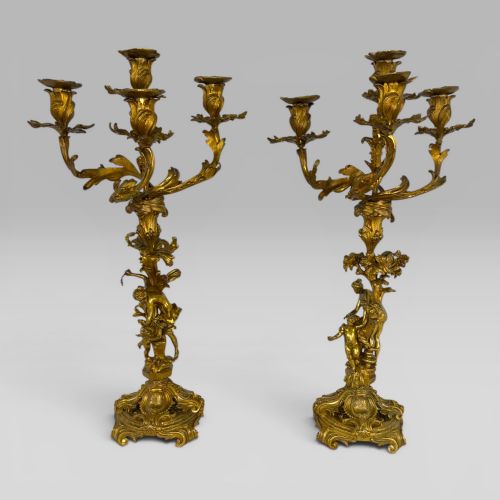


Gilded Brass Candleholders
Gilded brass candleholders bring warmth and presence to a room, catching the candlelight in their polished metal surfaces.
Gilded Brass Candleholders
Gilded brass candleholders encompass pairs of candlesticks and multi-branched candelabra dating predominantly from the nineteenth century. The selection leans heavily towards French Rococo Revival, Victorian, Louis XVI, and Grand Regency styles.
The most common forms on this page are pairs of matched candelabra and candlesticks featuring ornate casting and branch configurations. These pieces frequently incorporate materials such as ormolu, gilt bronze, and occasionally marble or glass components.
Originating largely from French and Victorian workshops, these items reflect the nineteenth-century taste for decorative table and mantel lighting. Buyers will encounter both single-branch candlesticks and substantial three-branch candelabra.
Materials and construction
The foundation of these pieces relies on cast brass or bronze, shaped into elaborate scrolls, figures, and architectural motifs. Artisans applied a layer of gold through fire gilding or ormolu techniques to impart a rich, lustrous finish.
Many examples combine the metallic elements with contrasting bases or stems made of white or coloured marble. Structural joints are typically secured via threaded rods and bolts hidden within the central column.
Materials appearing across the current inventory include ormolu, gilt bronze, marble, brass, iron, and glass.
Assessing quality
The richness and durability of the gilding further distinguish better specimens from simpler production. Ormolu with varied matte and burnished finishes indicates superior craftsmanship compared to uniform, flat metallic coatings.
The Gilded Brass Candleholders Glossary
- Ormolu
- A gilded bronze or brass finish produced by applying a mercury and gold amalgam. This technique creates a deep, warm metallic sheen characteristic of nineteenth-century decorative items.
- Candelabra
- A multi-branched lighting device designed to hold several candles simultaneously. These pieces often feature removable branches to allow conversion into single candlesticks.
- Rococo Revival
- A nineteenth-century design style mimicking the asymmetrical scrolls, shell motifs, and natural curves of the eighteenth-century French Rococo movement. It dominates many of the ornamental pieces found here.
- Louis XVI Style
- A classical revival movement characterised by symmetry, straight lines, and ancient Roman or Greek architectural details. Items in this taste display restrained ornamentation compared to their Rococo counterparts.
Gilded Brass Candleholders: Frequently Asked Questions
How do I clean gilded brass candleholders?
Dust the surface gently with a soft, dry microfibre cloth to remove everyday particles. Avoid using commercial metal polishes or harsh chemical cleaners, as these abrasive substances will strip away the delicate gold gilding.
For stubborn grime, dampen the cloth slightly with plain water and dry the piece immediately. Protecting the metal from excessive moisture preserves the historic finish.
Can I use real candles in these candelabra?
Standard taper candles fit most nineteenth-century sockets, though you should check the diameter before lighting. Ensure the candles are secured upright to prevent wax dripping onto the gilt surfaces.
Clean away any hardened wax using warm water to soften it rather than scraping with metal tools. This protects the soft brass beneath the gilding from scratches.
How do I date a nineteenth-century candelabra?
Examine the casting quality, fastener types, and stylistic indicators such as Victorian or French Neoclassical motifs. Nineteenth-century pieces often use hand-cut threaded screws and heavy sand-cast brass components.
Compare the decorative vocabulary against documented periods like the 1860s or 1890s. Subtle shifts in symmetry and ornamentation help narrow down the decade of manufacture.
What is the difference between ormolu and gilt brass?
Ormolu specifically denotes a high-status mercury gilding technique applied to bronze during the eighteenth and nineteenth centuries. Gilt brass uses similar gold-colouring methods upon a base of copper and zinc alloy.
Both terms describe golden metallic surfaces designed to catch the light. Visual inspection under magnification often reveals the finer chasing typical of traditional ormolu.