

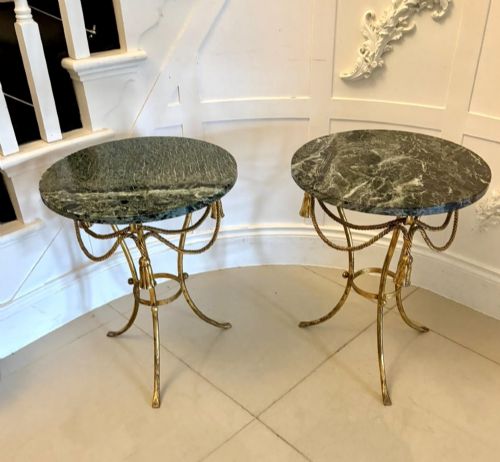


Gilded Accent Tables Pair
These gilded accent tables pair pieces across diverse periods like Regency, 18th Century, and 19th Century, offering matched elegance for your interior.
Gilded Accent Tables Pair
When searching for a gilded accent tables pair, buyers encounter matched items primarily functioning as side tables, occasional tables, petit commodes, or table lamps. These objects span from the 18th Century and Regency periods through the 19th Century, 1910, 1920, 1930, and 1940.
The forms originate from French, Italian, and Japanese traditions, incorporating styles such as French Rococo Revival, Hollywood Regency, Louis XVI Neoclassical, Japonisme, Chinoiserie, and Rococo. Such diversity allows buyers to find pairs suited to formal drawing rooms or eclectic spaces.
Side and occasional tables dominate the furniture selections, whilst lamp pairs provide vertical illumination. Each gilded accent tables pair displays the distinct design idioms of its respective decade or century.
How they were made
Construction relies upon traditional woodworking techniques paired with metals such as bronze, ormolu, and gilt metal. Carved wood foundations receive giltwood finishes or lacquer, whilst specific pieces incorporate kingwood and vernis martin decorative panels.
Surface details often feature verde marble or standard marble tops, alongside fabric elements and blue glazed ceramics. Ormolu and gilt bronze mounts provide structural ornamentation and decorative accents across the pieces.
Gilded Accent Tables Pair Retail Price Guide 2026
Typical asking prices for gilded accent tables pair among the pieces listed under this phrase on Sellingantiques today, from the lower quarter to the upper quarter. They describe what is for sale here now, not the wider market.
Listings feature items from the 18th Century, Regency period, 19th Century, 1910, 1920, 1930, and 1940.
What varies in quality
Quality differences emerge in the execution of the metal mounts, such as finely chased ormolu versus simpler gilt metal castings. The depth and precision of carved wood details and the preservation of lacquer or vernis Martin finishes also dictate the standard of execution.
Materials contribute significantly to distinction, with genuine marble inserts and specialised decorative elements like Satsuma ceramics or Vernis Martin style painting marking the finer examples in the range.
The Gilded Accent Tables Pair Glossary
- Ormolu
- Gilded bronze used widely for decorative mounts on furniture and lamp bases. This technique creates a rich golden finish characteristic of French decorative arts.
- Vernis Martin
- A type of simulated Japanese lacquer developed in France during the 18th century. It utilises multiple layers of varnish to create translucent, painted decorative panels.
- Giltwood
- Wood that has been coated with a thin layer of gold leaf or powder. It provides a brilliant metallic sheen to carved frames and table structures.
- Chinoiserie
- European decorative style inspired by Chinese artistic traditions. It frequently appears in lacquerwork and decorative motifs on furniture and lamps.
- Regency
- British design period spanning the early 19th century known for classical revival forms and refined bronze mountings. Pieces from this era often exhibit clean architectural lines combined with rich patination.
Gilded Accent Tables Pair: Frequently Asked Questions
What periods do these pairs represent?
The selection includes items spanning from the 18th Century and Regency era through the 19th Century, 1910, 1920, 1930, and 1940.
Each period brings distinct stylistic traits, ranging from neoclassical restraint to ornate revivalism.
What materials are commonly used?
Makers utilised wood, giltwood, lacquer, and kingwood alongside metals like bronze, ormolu, and gilt metal.
Additional elements include marble tops, fabric components, and ceramic bodies.
Are these matching pieces functional?
Yes, the inventory encompasses both small side and occasional tables for display and storage, alongside functional table lamps.
Buyers utilise them as balanced decorative accents in pairs across various rooms.
Which styles influence these items?
Styles include French Rococo Revival, Louis XVI Neoclassical, Hollywood Regency, Chinoiserie, and Japonisme.
These diverse influences reflect European interpretations of classical and Asian aesthetics.