




Georgian Weather Barometer
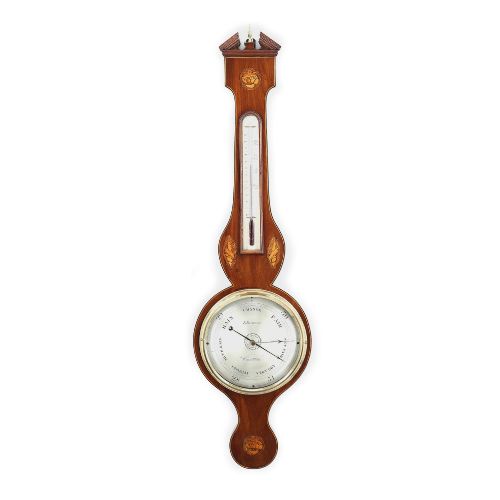
A georgian weather barometer brings precise atmospheric measurement into domestic spaces through rich mahogany, rosewood and intricate brass dials.
Georgian Weather Barometer
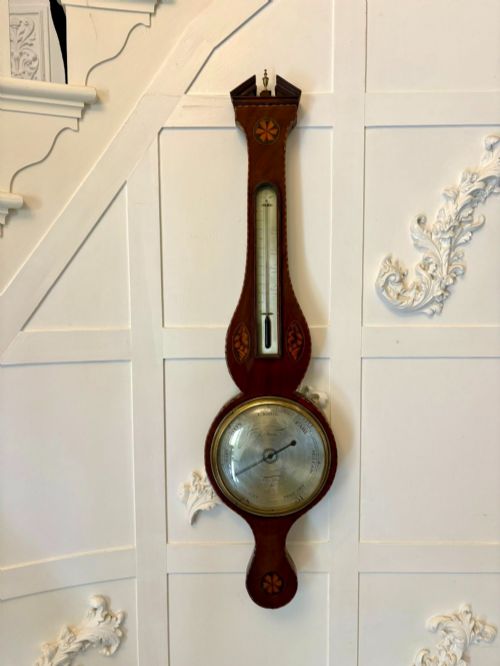
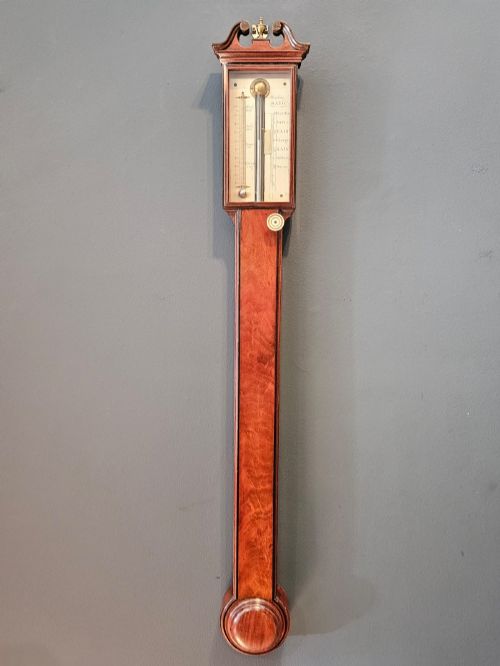
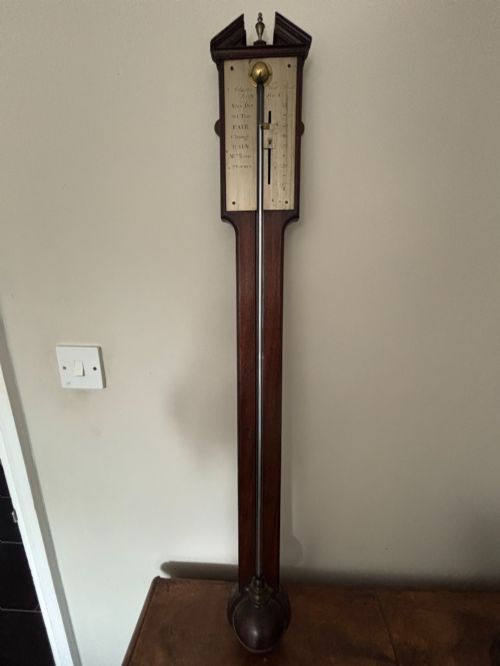
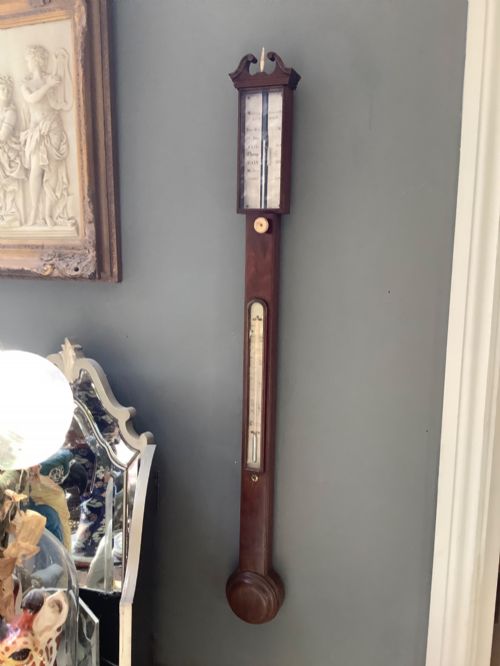
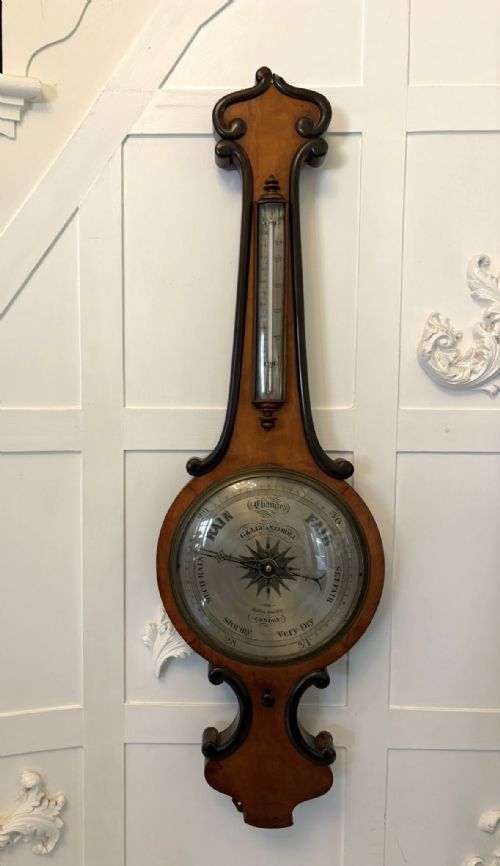
A georgian weather barometer measures atmospheric pressure to forecast meteorological changes, appearing primarily in tall stick formats or expansive banjo shapes. These instruments hang on domestic walls, combining scientific utility with polished cabinetmaking.
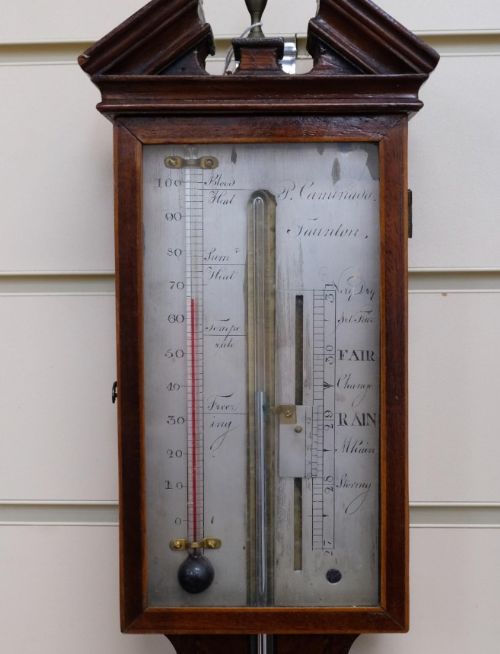
Makers from the eighteenth and nineteenth centuries constructed these pieces predominantly in mahogany and rosewood cases, frequently incorporating boxwood stringing, shell marquetry and mother of pearl inlay. Silvered brass dials display the barometric scales, often accompanied by subsidiary spirit thermometers and hygrometers.
Examples on this page span the Georgian, Regency and Victorian periods, including George III designs and later revivals. Buyers encounter both provincial makers and prominent London instrument houses within the listings.
Materials and construction methods
Cabinetmakers utilised dense timbers such as mahogany, rosewood and walnut, shaping them into slender trunks for stick barometers or expanding frames for wheel and banjo variants. Veneering techniques allowed craftsmen to display symmetrical grain patterns across the front panels.
The delicate inner mechanics relied upon sealed glass tubes containing mercury, housed securely behind glazed bezels. Metal components such as silvered brass dials and brass indicators provided clear legibility for atmospheric readings.
Decorative detailing involved boxwood stringing, floral marquetry and shell inlays embedded directly into the wooden surfaces. Many pieces integrated bone or ivory adjustment knobs alongside engraved brass scales signed by the maker.
Several instruments were built by travelling Italian instrument makers who walked the roads of Britain carrying barometers on their backs.
Distinctions in craftsmanship
The refinement of the cabinetwork separates standard production from superior pieces, particularly in the crispness of the shell inlay and the depth of the mahogany grain. Makers who invested time in matched veneers and precise marquetry produced visually commanding instruments.
Engraving quality on the silvered brass dial indicates the original workshop standard, with crisp, deep lettering outlasting faint machine stamping. The presence of subsidiary instruments like thermometers or level indicators enhances the scientific complexity of the piece.
P. Caminada·George Adams·B. Besozzi·G & L Guanziroli·Blunt·Dollond·Ganthony·JB Bergna·Prada·Molton·Luisetti·Fagioli·Giana·Bate·Jenkins·Ronchetti·L Casatelli·Watkins·Roncoroni·H Marks·Sandrino·Hayward·Vecchio & Co
The Georgian Weather Barometer Glossary
- Stick barometer
- An instrument featuring an exposed or partially enclosed vertical glass tube of mercury alongside a linear scale. This form provides direct readings of atmospheric pressure.
- Banjo barometer
- A large dial barometer characterised by a bulbous lower body and a slender upper neck resembling the stringed instrument. These often feature hygrometers and thermometers.
- Silvered brass
- A metallic alloy treated with silver powder to create a bright, reflective surface for engraved weather scales. It offers high legibility against dark wooden backdrops.
- Marquetry
- The art of applying decorative pieces of wood veneer to a structure to form geometric or pictorial designs. Craftsmen utilised contrasting timbers like boxwood and mahogany.
- Mercurial
- Pertaining to or containing liquid mercury, the element utilised within the barometric tube to respond to changes in atmospheric pressure.
Georgian Weather Barometer: Frequently Asked Questions
What is the difference between stick and wheel barometers?
Stick barometers display a direct vertical column of mercury with a simple height scale, focusing purely on precise measurement. Wheel barometers translate the mercury movement through a mechanical pulley system to drive a pointer around a circular dial.
Circular dials often accommodate additional instruments like thermometers and hygrometers within the wider wooden case. Stick versions remain favoured for their architectural minimalism and early origins.
How do I read a mercury barometer safely?
Observing atmospheric pressure involves checking the position of the mercury column or the circular pointer against engraved weather descriptions on the dial. Tapping the glass gently before reading ensures the indicator overcomes friction.
Changes in the height of the mercury or the movement of the needle indicate rising or falling pressure. Original mercury tubes require careful handling if the instrument is relocated.
Are these barometers still accurate for weather forecasting?
Historical instruments retain their mechanical sensitivity to atmospheric pressure changes, provided the internal glass tube remains sealed and intact. They track weather patterns just as reliably as when they were first constructed.
Many pieces include calibrated scales that record historical barometric ranges. Modern digital comparison can assist in setting the adjustable pointers correctly.
How do I identify the period of a barometer?
Cabinet proportions, dial shapes and timber choices help distinguish between eighteenth-century Georgian designs and later Victorian interpretations. Early pieces often feature understated mahogany stick cases without excessive ornamentation.
Signature styles and maker signatures engraved on the brass dials provide definitive chronological markers. Marquetry patterns and pediment shapes also evolve noticeably across the decades.