
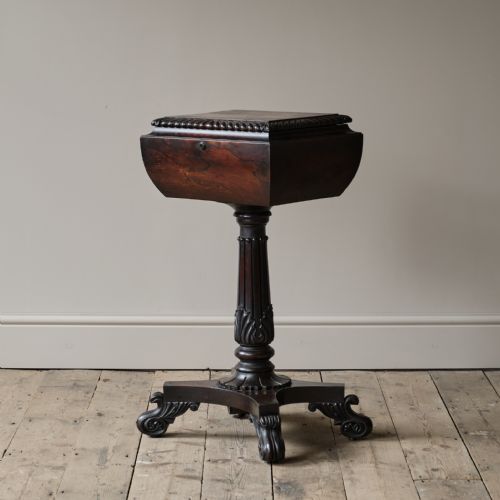
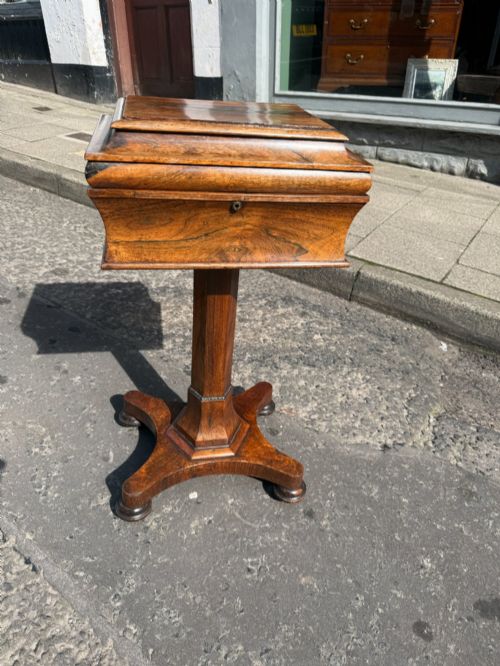


Georgian Tea Caddy Pedestal
A georgian tea caddy pedestal is a fitted box for dry leaf storage elevated on a column or stand, offering stable elegance for the drawing room.
Georgian Tea Caddy Pedestal
A georgian tea caddy pedestal combines the secure storage of tea leaves with an elevated architectural support, sitting on a central column and base or four carved feet. These pieces serve as substantial display items in period interiors, often taking the form of a sarcophagus shaped box or a rounded tea poy.
The versions most commonly met on this page date from the Georgian, Regency, and William IV periods, spanning the late eighteenth century into the nineteenth century. Makers constructed them from dense tropical timbers to house precious tea reserves safely away from damp air.
Materials and Construction
Cabinetmakers utilised figured timbers such as mahogany, flame mahogany, rosewood, and walnut to build the primary boxes and stands. These surfaces often received fine brass inlay or contrasting stringing to accentuate the grain of the wood.
Internal arrangements frequently incorporated sterling silver fittings, mixing metalwork with cabinetry. Structural support came from turned or carved pedestals resting upon robust platforms or feet.
Distinctions in Quality
The refinement of the timber selection marks the primary difference across examples, with highly figured flame mahogany and richly patterned rosewood commanding attention. Master workshops applied precise brass inlay and meticulous joinery that remained stable over centuries.
Proportion and architectural presence dictate the standing of a piece, where a balanced pedestal and refined box elevate the object far beyond a standard utility container.
Gillows
The Georgian Tea Caddy Pedestal Glossary
- Sarcophagus
- A coffin-like shape with a domed or sloping lid used for the box portion of certain tea caddies. This neoclassical form became popular during the Regency period.
- Flame mahogany
- A decorative veneer cut from wood where the branch meets the trunk, displaying a flamy, rippling grain pattern. Cabinetmakers prized this figure for principal display surfaces.
- Jardiniere
- A decorative container or stand used to hold plants or flowers. Some specimens from the period served dual functions as tea stoves or plant holders.
Georgian Tea Caddy Pedestal: Frequently Asked Questions
What is a teapoy?
A teapoy is an elevated box designed to hold tea leaves and blending ingredients safely in the drawing room. These pieces usually stand on a central pillar or dedicated legs.
They emerged when tea was an expensive commodity requiring secure storage and polite presentation away from domestic staff.
Were these stands used for anything besides tea?
While primarily built for dry tea leaves and mixing bowls, some variants doubled as work tables or plant holders. Surviving pieces occasionally record hybrid functions such as tea stoves and jardinieres.
Interior uses evolved as households adapted decorative furniture for multiple genteel pursuits.
How should I care for rosewood and mahogany?
Maintain these timbers by keeping them away from direct sunlight and sudden temperature shifts that dry out old polish. Gentle dusting with a dry cloth preserves the original finish without stripping historical patina.
Avoid commercial silicone sprays and excess moisture, which damage nineteenth-century French polish and veneer.