
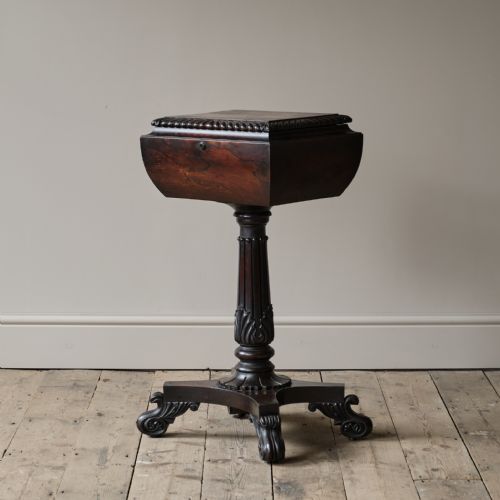


Carved Mahogany Caddy Table
A carved mahogany caddy table, often known as a teapoy, brings Georgian and Regency elegance to any room as a refined tea-storage box on a stand.
Carved Mahogany Caddy Table
A carved mahogany caddy table, frequently designated as a teapoy, is a container designed for holding tea leaves during periods when tea was a costly and heavily guarded commodity. These pieces predominantly date from the Georgian, Regency, and Victorian eras, alongside related forms such as canterburys and desktop bookcases.
The versions most commonly met on this page include sarcophagus-shaped boxes mounted on stands, featuring solid or flame mahogany construction. Makers often set these boxes on four carved feet, and some items originate from notable workshops in Dublin or regional centres of cabinet making.
How they were made
Cabinet makers utilised solid mahogany and striking flame mahogany veneers to build the main bodies and stands of these containers. Artisans applied carved details directly to the timber, creating decorative elements on feet, columns, and edges.
Metal components such as brass hardware and iron fittings served functional roles inside and outside the boxes, securing lids and compartments intended for dry leaf storage.
Some nineteenth-century tea containers required lock and key because tea was once valuable enough to justify locking up the parlour.
What varies in quality
The grade of timber selection largely dictates the distinction between standard and superior pieces, particularly the presence of richly figured flame mahogany veneers. Higher tier examples display crisper hand carving on the feet and supports rather than mechanical or simplified shaping.
Attribution to documented workshops or makers introduces another layer of distinction, as does the survival of original internal fittings and brass mounts. Proportion and balance within the Regency and William IV idioms separate master cabinet work from simpler vernacular production.
Strahan of Dublin·Gillows
The Carved Mahogany Caddy Table Glossary
- Teapoy
- A freestanding container or box on a stand used for storing tea, evolving from a table-mounted tea chest into a substantial piece of furniture during the Georgian and Regency periods. These objects often include internal canisters and mixing bowls.
- Flame mahogany
- A highly figured veneer cut from where branches join the main trunk, showing a distinctive flickering pattern. Cabinet makers favoured this material for the primary display surfaces of luxury furniture.
- Sarcophagus
- A box shape with a domed or peaked lid and sloping sides, reminiscent of ancient stone coffins. Regency designers adapted this classical form for tea caddies and teapoys.
- Canterbury
- A low stand with partitions for holding sheet music or books, occasionally grouped alongside teapoys in nineteenth-century interiors. It shares the domestic utility and mahogany construction typical of the period.
Carved Mahogany Caddy Table: Frequently Asked Questions
What is a teapoy used for?
A teapoy served as a secure repository for loose tea leaves when tea was an expensive household commodity requiring strict rationing.
Inside the box, compartments held different varieties of tea alongside a glass bowl for blending infusions.
How do I identify a Regency teapoy?
Regency examples typically feature classical motifs, sarcophagus-shaped bodies, and sophisticated turning on the central pedestal or support legs.
Makers of this era frequently employed flame mahogany veneers and crisp carving to reflect fashionable classical tastes.
Are all these pieces from the nineteenth century?
The listings span the Georgian, Regency, William IV, Victorian, and Edwardian periods, covering the late eighteenth through the early twentieth century.
While the nineteenth century provides the majority of the mahogany teapoys, related items such as revolving bookcases extend into the Edwardian era.
How do I live with a teapoy today?
These pieces function well as accent tables beside seating, utilising the flat top surface while offering internal storage for small items.
Keeping the mahogany conditioned and placing the furniture away from direct heat sources helps preserve the timber and veneer.