

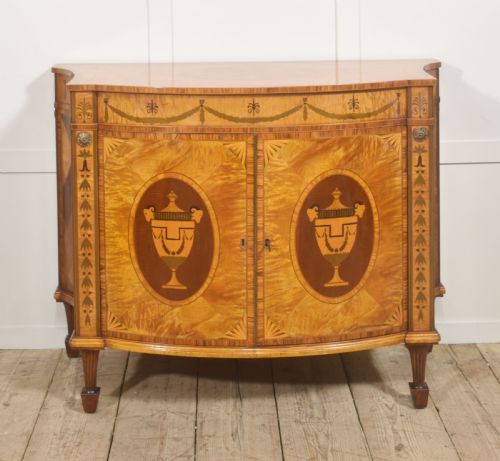


Georgian Style Satinwood Credenza
A georgian style satinwood credenza brings neoclassical refinement and pale timber elegance to a formal dining room or drawing room.
Georgian Style Satinwood Credenza
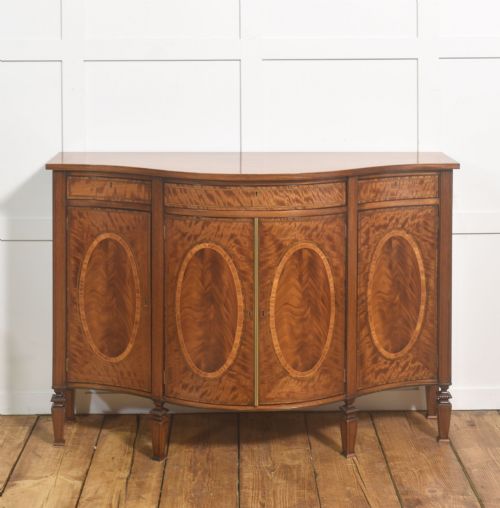
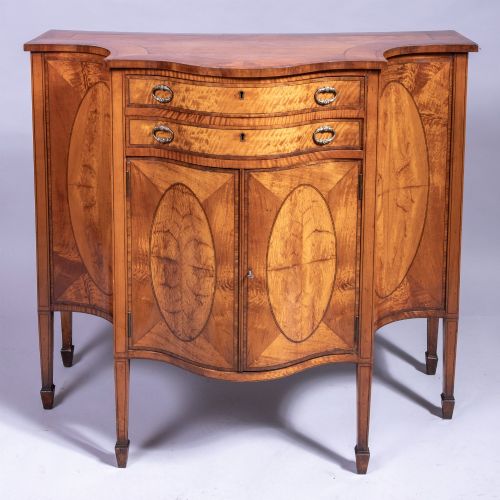
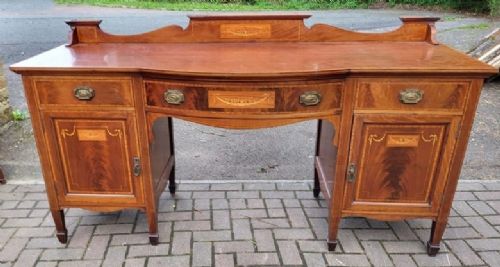
Makers on this page favour satinwood veneers enhanced by mahogany carcases and contrasting stringing. Forms range from compact side cabinets to large breakfront sideboards designed for display and storage.
The aesthetic draws heavily on Sheraton, Adam, and Neoclassical vocabularies. Expect symmetrical panel layouts, painted classical motifs, and geometric marquetry.
Materials and construction methods
Workshops construct carcases from sturdy timbers such as mahogany or maple, applying figured satinwood veneers to visible exterior surfaces. Boxwood, ebony, and rosewood are used as contrasting stringing and inlay borders.
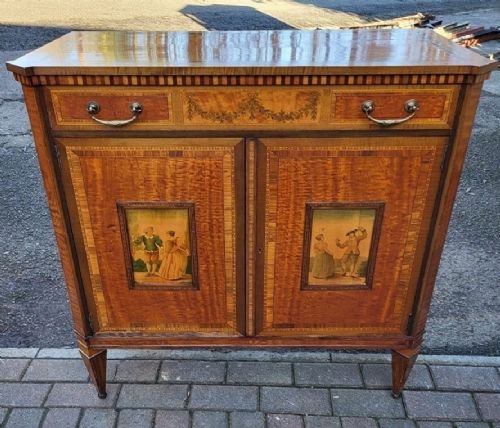
Marquetry and painted panels supply the classical ornamentation characteristic of these revival pieces. Craftsmen cut intricate floral and architectural motifs into the timber veneers or paint panels directly onto the wood surface.
Materials recur across multiple decades, pairing satinwood with mahogany, rosewood, boxwood, ebony, and painted panels.
Evaluating craftsmanship and visual depth
Quality rests in the selection of the timber figures and the precision of the inlay work. Finer examples display tightly grained satinwood paired with crisp, well-aligned boxwood and ebony stringing rather than printed simulations.
The sophistication of the painted panels and marquetry distinguishes standard production from exceptional pieces. Superior items feature hand-painted classical figures and detailed floral scrolls that retain their pigment and definition.
Maple & Co·Kaufman·Gillows
The Georgian Style Satinwood Credenza Glossary
- Satinwood
- A pale, lustrous hardwood prized for its golden sheen and smooth grain. It forms the primary visible veneer on revival cabinets and sideboards.
- Marquetry
- The art of applying small pieces of veneer to a structure to form decorative patterns. Artisans use contrasting woods to create pictorial designs.
- Demi-lune
- A half-moon shape characteristic of certain side cabinets and commodes. This curved profile allows the furniture to sit flush against a wall.
- Sheraton Revival
- A late nineteenth and early twentieth-century movement reviving the light, neoclassical designs of Thomas Sheraton. Pieces feature inlaid borders and tapered legs.
- Stringing
- Thin strips of contrasting wood inlaid into grooves in the carcase. This technique outlines drawers, doors, and tabletops.
Georgian Style Satinwood Credenza: Frequently Asked Questions
What is the difference between a credenza and a sideboard?
A sideboard traditionally serves a dining room function for storing china and serving food. A credenza often implies a lower, cabinet-style storage piece with doors.
In revival furniture terminology, these terms occasionally overlap depending on the specific configuration of drawers and cupboards.
How do I distinguish eighteenth-century originals from later revivals?
Eighteenth-century originals exhibit specific timber ageing, hand-cut secondary woods, and construction marks typical of period workshops. Most pieces matching this phrase date from nineteenth and early twentieth-century revival movements.
Examination of the drawer linings, backboards, and fastener types reveals the true period of manufacture.
Where should I place a satinwood cabinet in my home?
The pale, reflective quality of satinwood suits principal reception rooms, dining spaces, or hallways where natural light can illuminate the grain. These pieces function well against darker wall colours that accentuate the golden timber.
Avoid placing antique veneer furniture in direct sunlight to prevent fading of the delicate polished surfaces.
What does bow-front mean in furniture design?
A bow-front describes a cabinet or sideboard facade that curves outward in a convex arc. This shape softens the room's geometry while increasing internal storage capacity.
Craftsmen bent the timber or shaped the solid carcase frames to achieve this smooth, continuous curve.