


Georgian Silver Table Hollowware
Georgian silver table hollowware comprises sauce boats, cream jugs, and meat domes designed for formal dining.
Georgian Silver Table Hollowware
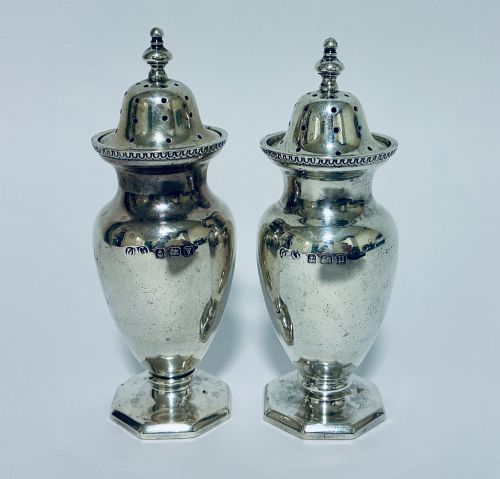
When you search for georgian silver table hollowware, you encounter vessels used for serving food and drink at the dining table. These pieces span sauce boats, cream jugs, pepper casters, meat domes, tea caddies, condiment vessels, and tureens.
The selection here includes items originating across the Georgian, Victorian, Edwardian, and later revival periods. Alongside sterling silver examples, you will find pieces fashioned from silver plate, Sheffield plate, and Old Sheffield plate.
The forms range from small mustard pots and pepper pots to substantial meat domes and sauce tureens. Makers working in various centres contributed to this diverse group of dining table utensils.
Materials and construction
Silversmiths shaped sterling silver and silver plate into hollowware forms through hammering, raising, and soldering techniques. Some vessels incorporate internal elements like cobalt blue glass liners within condiment pots.
Old Sheffield plate pieces utilise a fused layer of silver over a copper base, often finished with applied silver wire borders. Interiors of certain jugs and pots feature a gold wash finish applied to the silver surface.
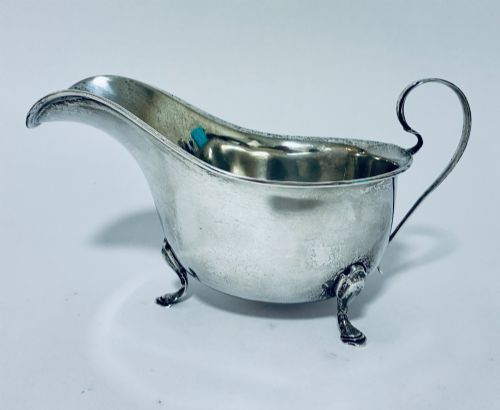
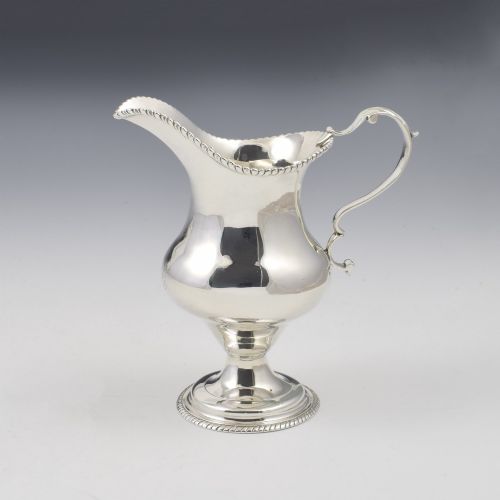
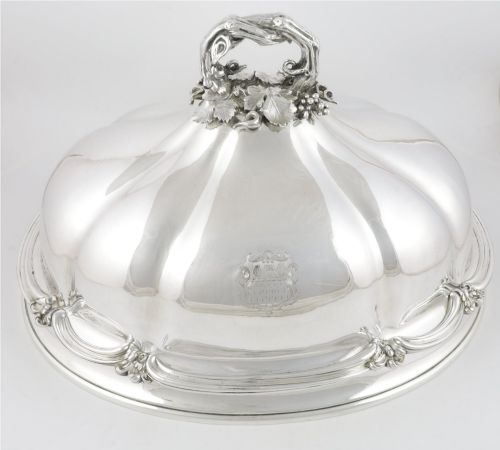
Object forms represented in this category include sauce boats, meat domes, mustard pots, cream jugs, and tea caddies.
Distinctions in standard
The weight of the metal and the crispness of chased or embossed ornamentation determine the calibre of a piece. Heavier gauges of silver and sturdy plate resist denting and maintain structural integrity during daily use.
Mastery in construction shows in the seamless joining of handles, legs, and bodies on items like sauce boats and cream jugs. Pieces bearing clear hallmarks or attributed to recognised makers command greater interest.
Stalker and Mitchison·Roberts Cadman·Charles Stuart Harris·William Bennett
The Georgian Silver Table Hollowware Glossary
- Hollowware
- Table vessels such as jugs, pots, tureens, and sauce boats that possess interior volume. This category excludes flatware like spoons and forks.
- Old Sheffield Plate
- A composite material made by fusing a thin sheet of silver to a thicker copper core. It was widely used for dining vessels before electroplating was invented.
- Argyle
- A specialised vessel designed to keep gravy warm at the table through the use of an internal hot water compartment. These are also known as gravy warmers.
- Hallmark
- A stamp or series of marks applied to precious metals indicating the standard of purity, the assay office, and the year of manufacture.
- Vermeil
- Sterling silver that has been plated with a thin layer of gold on the interior or exterior surface, sometimes referred to in older pieces as a gold wash.
Georgian Silver Table Hollowware: Frequently Asked Questions
What is table hollowware?
Table hollowware refers to hollow vessels used for serving food and liquids, including jugs, tureens, sauce boats, and tea caddies.
These items formed an essential part of formal dining arrangements across the eighteenth and nineteenth centuries.
How do I clean old silver?
Clean silver gently using a non-abrasive polish specifically formulated for precious metals or silver plate to preserve the surface.
Avoid harsh scrubbing that can wear down thin silver plating, particularly on Old Sheffield plate items.
What is Old Sheffield plate?
Old Sheffield plate is an early form of composite metal created by thermally fusing silver onto a copper base.
You can often spot the copper edge showing slightly where the sheet was cut or joined.
How are periods identified?
Periods are identified through a combination of style, manufacturing technique, and official hallmarks stamped directly onto the metal.
Design motifs such as Neoclassical lines or later revivals also offer strong clues to the date of creation.