
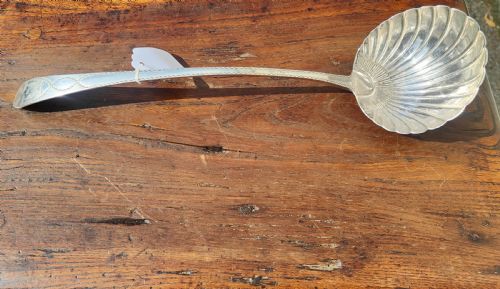
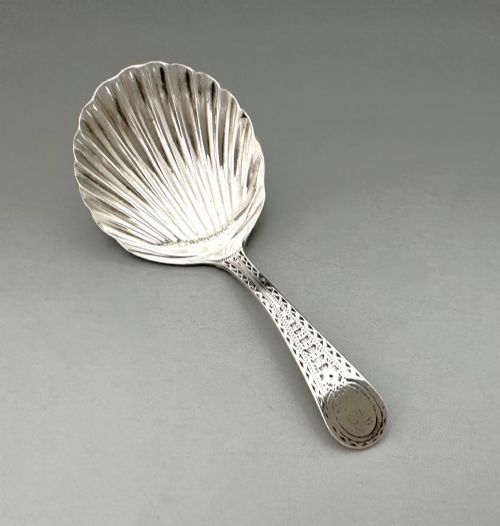
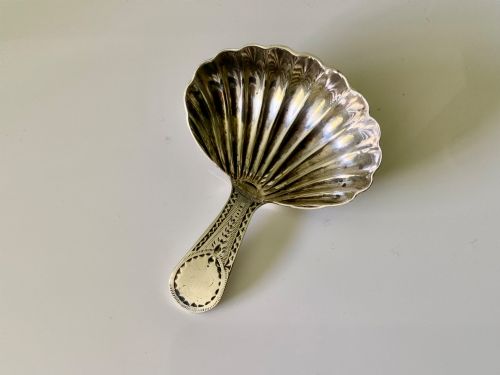


Georgian Shell Bowl Spoon
These georgian shell bowl spoon examples are fine silver serving utensils and tea collectables designed to grace the dining table and tea service.
Georgian Shell Bowl Spoon
The selection encompasses English and Irish silver pieces, including specific dates such as 1768, 1772, 1788, 1796, 1799, 1800, and 1824. These utensils reflect the domestic dining and tea-drinking habits of the late eighteenth and early nineteenth centuries.
Makers and assay offices from London and Ireland contributed to this range of silverware, employing styles characteristic of the Georgian and Regency eras. Buyers will find both plain utility pieces and those with intricate Onslow patterns or feather edge engraving.
Materials and construction
Silversmiths constructed these pieces primarily using sterling silver, supplemented by parcel-gilt finishes that added contrasting golden highlights to the bowls or handles. The metal was hammered, shaped, and chased to form the characteristic fluted shell bowls.
Handles often featured hand-engraved detailing, feather edging, or specialised forms such as the Onslow pattern. Construction techniques combined functional durability with ornamental refinement suited to polite tea service and dining.
An eighteenth-century Irish soup ladle on display comes complete with a family crest and a hefty weight of two hundred grams.
Judging quality in silver spoons
Quality in a georgian shell bowl spoon rests upon the crispness of the shell bowl's fluting and the depth of the engraving on the handle. Sharply struck hallmarks and well-preserved crests or feather edges indicate superior craftsmanship.
Proportion and balance between the bowl and the stem also distinguish finer pieces from simpler utilitarian examples. The thickness of the silver gauge dictates the substantial feel and longevity of the spoon.
Michael Smith
The Georgian Shell Bowl Spoon Glossary
- Caddy Spoon
- A small spoon specifically designed for measuring tea leaves from a caddy into the teapot. These often feature decorative bowls shaped like leaves or shells.
- Parcel-Gilt
- A silver object that is partially gilded with gold on specific areas such as the interior of the bowl. This technique creates a striking two-tone effect.
- Onslow Pattern
- A distinctive scroll-terminal handle design popular on eighteenth-century spoons and ladles. It provides a comfortable grip and a sculptural termination.
- Feather Edge
- A decorative border technique featuring fine, short engraved lines resembling bird feathers along the rim of the handle. It was labour-intensive and denotes quality.
- Sifter Spoon
- A pierced spoon used for dusting sugar over food or beverages. The bowl contains perforations to filter out larger sugar lumps.
Georgian Shell Bowl Spoon: Frequently Asked Questions
How do I date a Georgian silver spoon?
Dating relies heavily upon the hallmarks stamped into the silver, which typically include a date letter, a maker's mark, and a standard mark.
Stylistic elements like feather edge engraving or the Onslow pattern also help narrow down the period of manufacture.
What does parcel-gilt mean on silver?
Parcel-gilt refers to silver objects that have been selectively coated with a thin layer of gold, usually on the interior of the bowl.
This method protected the silver from corrosive elements in tea or food while providing an attractive visual contrast.
Why are some spoons shaped like shells?
Natural motifs were exceptionally popular among silversmiths during the Georgian and Regency periods.
Using a shell shape for the bowl added texture, rigidity, and decorative flair to everyday utilitarian tableware.