




Georgian Revival Bedside Cabinets
Georgian revival bedside cabinets bring classical proportions to the bedroom, offering enclosed storage crafted in mahogany, satinwood and walnut.
Georgian Revival Bedside Cabinets
Georgian revival bedside cabinets represent a revival of eighteenth-century elegance, produced predominantly during the early decades of the twentieth century. These compact items take the form of bedside chests, small cupboards, and occasional tables designed to sit neatly beside a bed.
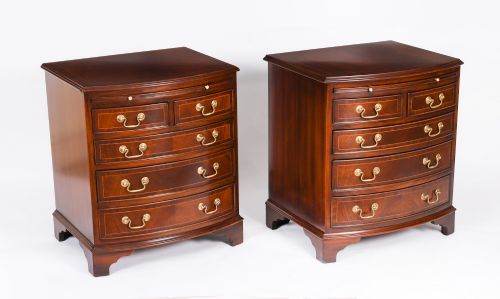
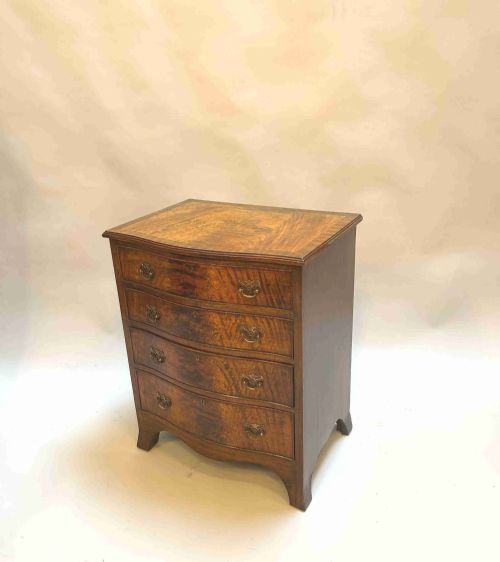
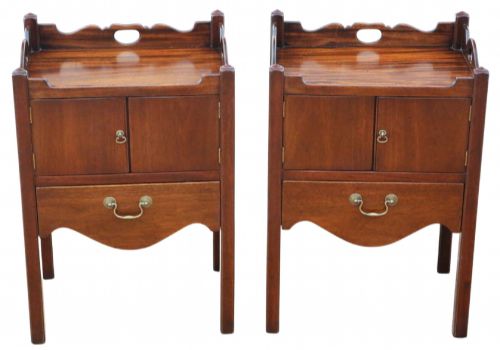
The version most commonly met on this page is constructed from mahogany, often featuring flame mahogany veneers or subtle inlaid detailing. Makers drew heavily on established eighteenth-century designs, resulting in pieces that range from straightforward cupboards to refined chests with slide extensions.
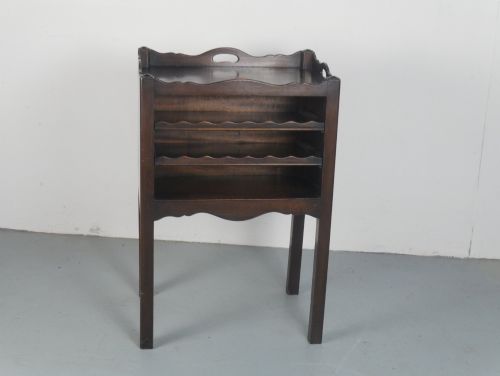
Origins span the Edwardian era through to the mid-twentieth century, capturing successive waves of revivalist taste. While some pieces adhere closely to classic Georgian lines, others incorporate Sheraton or Gothic revival motifs.
How they were made
Construction relies heavily on solid timber and carefully matched veneers, with mahogany and flame mahogany forming the primary structural and visual surfaces. Artisans applied thin sheets of highly figured wood to drawer fronts and door panels to create rich, symmetrical grain patterns.
Brass hardware, including decorative handles and hinges, provides functional contrast to the dark wood tones. Hand-painted detailing and delicate satinwood inlay appear on selected examples, adding a layer of surface ornament executed by specialist craftspeople.
Georgian Revival Bedside Cabinets Retail Price Guide 2026
Typical asking prices for georgian revival bedside cabinets among the pieces listed under this phrase on Sellingantiques today, from the lower quarter to the upper quarter. They describe what is for sale here now, not the wider market.
Listings feature mahogany, satinwood, and walnut across Edwardian and mid-century revival periods.
What varies in quality
The distinction between standard examples and the finest pieces rests upon the selection of timber and the precision of the cabinetwork. Superior items utilise highly figured flame mahogany veneers and crisp, well-defined mouldings that catch the light cleanly.
Proportion and execution of revival details dictate overall merit, with master workshops delivering sharper carving and more balanced forms. The integration of functional elements, such as smooth-sliding trays and well-fitted doors, separates basic utilitarian items from high-grade cabinetmaking.
Edwards and Roberts
The Georgian Revival Bedside Cabinets Glossary
- Flame mahogany
- A veneer cut from timber where the grain creates a flickering, flame-like pattern. This decorative wood was favoured for principal display surfaces.
- Satinwood
- A pale, hard wood with a satiny sheen, often used for banding and inlay work on dark mahogany carcasses. It provides sharp visual contrast.
- Slide
- A pull-out shelf housed above drawers or cupboards, historically used for placing a candle or holding items temporarily. It operates on wooden runners.
- Gothic revival
- An architectural and decorative movement that reinterprets medieval pointed arches, tracery, and heavy forms. In cabinetmaking, this translates to pointed panels and architectural mouldings.
Georgian Revival Bedside Cabinets: Frequently Asked Questions
What is a georgian revival bedside cabinet?
A georgian revival bedside cabinet is a small storage piece made in the twentieth century, styled after eighteenth-century furniture.
These items usually feature enclosed cupboards or drawers, designed to hold personal items next to a bed.
How do I date these cabinets?
Dating relies on timber preparation, construction methods, and revival styles associated with the Edwardian period and mid-twentieth century.
Makers often combined traditional joinery with the specific aesthetic tastes of their own era.
Are these pieces made of solid mahogany?
Many examples use a combination of solid timber frames and applied mahogany or flame mahogany veneers.
This technique allowed makers to display dramatic wood grain patterns across flat surfaces while maintaining structural stability.
How do I use a bedside cabinet with a slide?
The pull-out slide acts as an auxiliary shelf, historically intended for resting a candlestick or small object.
In daily use, it provides a convenient temporary surface without permanently altering the footprint of the cabinet.