



Georgian Period Wall Furniture
Georgian period wall furniture comprises hanging shelves, corner cupboards and mirrors built to occupy vertical space efficiently.
Georgian Period Wall Furniture
Georgian period wall furniture encompasses pieces designed to be fixed to walls or fitted into room corners, making practical use of interior space. Buyers searching for georgian period wall furniture encounter items such as hanging shelves, wall mirrors, corner cupboards and hanging racks.
The selections available span the eighteenth century and the Regency era, taking the form of corner cabinets, bow front cupboards and display pieces. Oak and mahogany dominate the structural forms, while specific examples incorporate glass, burr oak and sycamore.
Origin points across the entries include English country workshops and Welsh examples, alongside items dating precisely to the seventeen-fifties and seventeen-nineties. Hanging shelves and two-door corner cupboards represent the standard configurations met on this page.
How these pieces were made
Cabinet makers utilised solid timbers alongside veneers, applying mahogany and oak for structural integrity while employing burr oak and sycamore for decorative surfaces. Craftspeople built corner cupboards and wall cabinets with fitted doors, frequently incorporating glass panels for display purposes.
Fretwork techniques appear on wall mirrors, which also feature gilt slips and Rococo styling. Brass hardware provides functional detailing on hanging shelves and cabinets, while cabinet work utilises specific dating indicators such as circa seventeen-eighty to seventeen-ninety.
Georgian Period Wall Furniture Retail Price Guide 2026
Typical asking prices for georgian period wall furniture among the pieces listed under this phrase on Sellingantiques today, from the lower quarter to the upper quarter. They describe what is for sale here now, not the wider market.
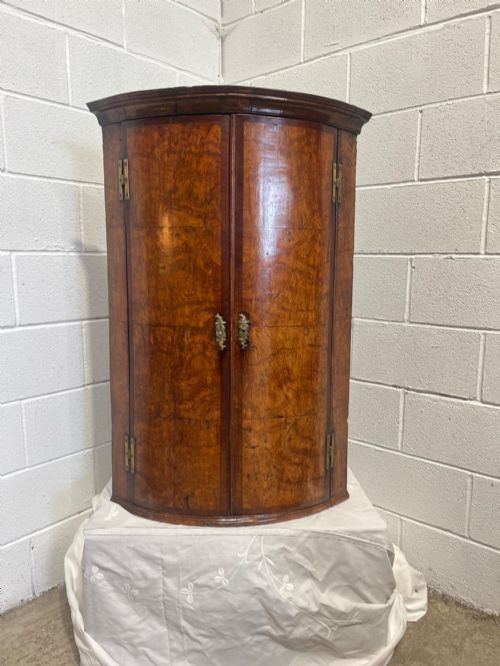
Several corner cupboards possess curved bow fronts designed to catch the eye while dodging sharp room corners.
What varies in quality
The standard of timber selection separates simpler country pieces from refined urban cabinet work, evident in the choice between plain oak and figured mahogany or burr oak veneer. Grain patterning and the matching of veneers demonstrate the maker's skill and ambition.
Execution of detail defines the upper tier, seen in delicate fretwork carving on mirrors, precise glazing bars on display cabinets and the integration of brass fittings. Construction methods, from straightforward pegged joints to sophisticated framing, reflect the original workshop context.
The Georgian Period Wall Furniture Glossary
- Corner cupboard
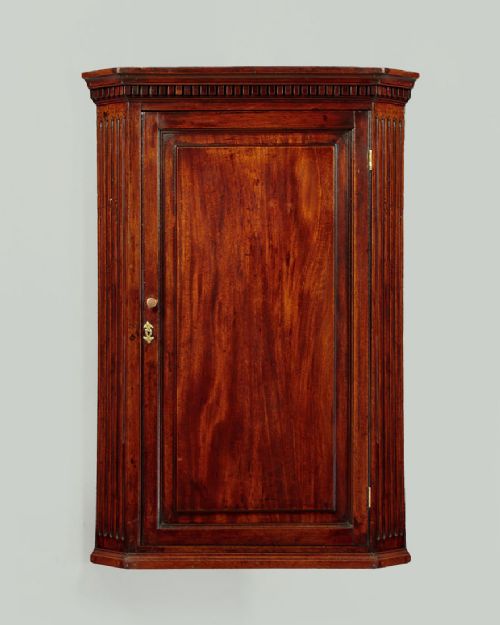
- A cabinet designed specifically to fit into the ninety-degree angle of a room. These pieces maximise floor space and appear in both hanging and standing formats.
- Hanging shelves
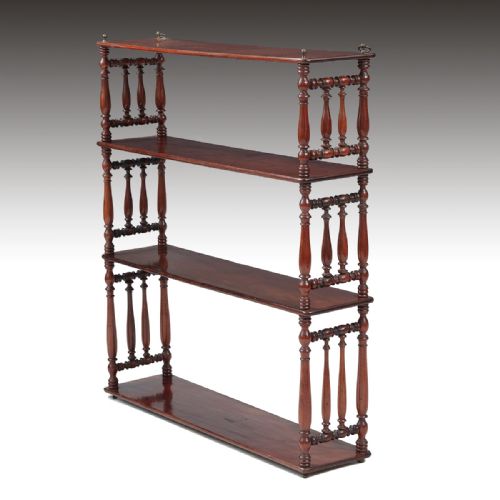
- Open shelving units intended to be mounted directly onto a wall. They display books or ceramics without taking up floor space.
- Bow front
- A convex curved cabinet front that projects outward from the corners. This shape softens the geometry of wall-mounted furniture.
- Fretwork
- Thin wood pierced with decorative patterns using a fretsaw. This technique decorates the frames of eighteenth-century mirrors.
- Gilt slip
- A narrow gilded wood moulding placed inside a mirror frame next to the glass. It reflects light and separates the glass from the outer frame.
Georgian Period Wall Furniture: Frequently Asked Questions
Where were corner cupboards placed?
Corner cupboards filled unused room angles to store tableware and provisions.
Their triangular footprint allowed them to sit flush against two intersecting walls.
What is the difference between oak and mahogany pieces?
Oak pieces typically originated in regional workshops such as Wales and reflected sturdier country tastes.
Mahogany items appeared more frequently in refined urban settings utilising imported tropical timber.
How do hanging shelves attach to walls?
Hanging shelves use integrated brackets or rear suspension points fixed directly to wall studs.
Their lightweight construction allowed secure mounting without floor support.
What distinguishes Regency wall furniture?
Regency wall furniture incorporates neoclassical influences with clean lines and contrasting brass details.
Mahogany remains the preferred timber during this nineteenth-century transition period.