



Georgian Mahogany Quartetto Tables
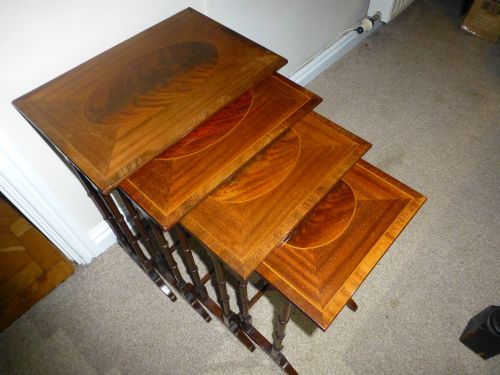
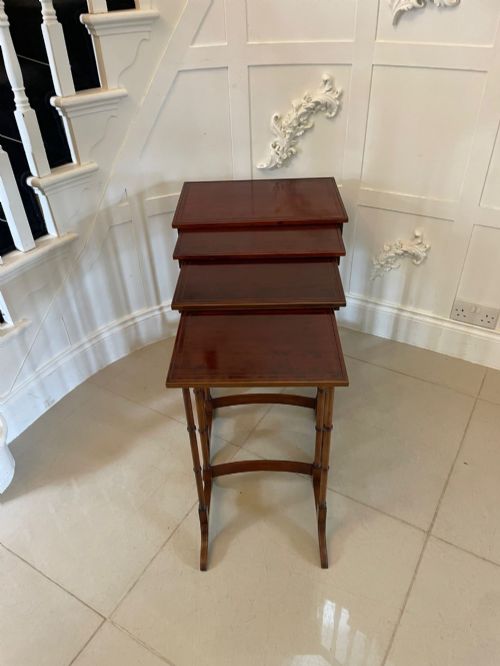
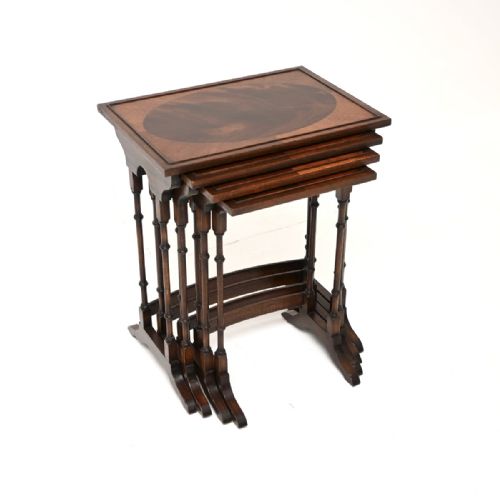
Georgian mahogany quartetto tables are nests of four graduated stacking tables designed to slide neatly beneath one another, offering versatile surface space with minimal footprint.
Georgian Mahogany Quartetto Tables
Georgian mahogany quartetto tables comprise sets of four freestanding occasional tables built to nest sequentially in descending order of height and width. A buyer searching this phrase seeks a clever space-saving design that combines period elegance with practical utility.
The examples found here range from nineteenth century pieces and Victorian interpretations to Edwardian and later twentieth century reproductions built in the Georgian style. Most pieces take the form of occasional, coffee, lamp or wine tables that deploy easily around a room when entertaining.
How they were made
Construction relies primarily on mahogany timber, chosen for its rich grain and durability, frequently enhanced with delicate boxwood inlay and satinwood banding. Workshops shaped these woods into slender frames and tabletops designed to slide smoothly within one another without binding.
Veneer techniques feature prominently alongside solid timber construction, allowing makers to display figured grain patterns across the primary surfaces. Fine stringing and boxwood details define the edges and perimeters of the tables.
Georgian Mahogany Quartetto Tables Retail Price Guide 2026
Typical asking prices for georgian mahogany quartetto tables among the pieces listed under this phrase on Sellingantiques today, from the lower quarter to the upper quarter. They describe what is for sale here now, not the wider market.
Listings feature mahogany, satinwood, and boxwood inlay across periods spanning the nineteenth century, Victorian era, Edwardian period, and twentieth century.
What varies in quality
Quality in these nests rests upon the precision of the joinery and the snugness of the fit as the four tables slide together. Superior examples maintain structural rigidity and smooth alignment across all sizes without excessive play in the joints.
The choice of secondary timbers and the crispness of the boxwood inlay and satinwood veneers distinguish finer workshops from standard production. A well-balanced set retains its finish and structural integrity through repeated nesting and unnesting.
The Georgian Mahogany Quartetto Tables Glossary
- Quartetto tables
- A set of four tables designed to nest together. They gained popularity in the nineteenth century as adaptable furniture for the drawing room.
- Nesting tables
- Multiple tables engineered to fit one beneath another to save floor space. Sets typically comprise four graduated sizes.
- Satinwood
- A durable hardwood with a lustrous yellow or golden sheen. It is frequently employed for contrasting inlay work and banding on mahogany furniture.
- Boxwood inlay
- Narrow lines or decorative motifs set into the surface of the timber. Boxwood provides a bright, pale contrast against darker woods like mahogany.
Georgian Mahogany Quartetto Tables: Frequently Asked Questions
What are quartetto tables used for?
Quartetto tables serve as flexible occasional surfaces for drinks, books or lamps in principal rooms. When not in use, the four tables stack tightly together to occupy the floor space of just one.
Their graduated sizing allows them to be pulled out individually or deployed around a room as guests require additional table space.
How do I date a nest of tables?
Dating relies on examining timber selection, construction methods, and decorative motifs such as inlay or veneer. Pieces span from the nineteenth century through the Edwardian era and later Georgian revivals.
Subtle differences in edge profiles and secondary woods help distinguish Victorian production from Edwardian or later twentieth century revivals.
Are all quartetto tables solid mahogany?
Many examples combine solid mahogany frames with veneered tabletops to display attractive grain patterns. Satinwood and boxwood inlay often decorate the top surfaces.
The use of veneer allowed makers to utilise figured timber effectively while keeping the overall frame light enough for easy movement.
How do the four tables fit together?
The tables are built in four distinct graduations of height and width. Each smaller table slides neatly beneath the frame of the next size up.
This stepped construction ensures the entire nest occupies a minimal footprint when stored together against a wall or beside a chair.