
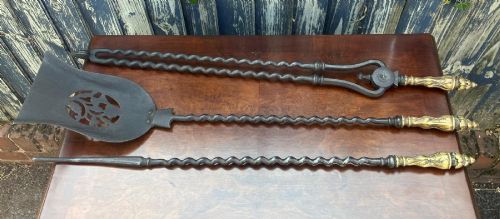


Georgian Fireplace Tools Set
These georgian fireplace tools set pieces combine brass, steel, and iron to bring period fireside utility into contemporary rooms.
Georgian Fireplace Tools Set
A georgian fireplace tools set brings together essential hearth implements like pokers, shovels, and tongs, alongside companion sets featuring brushes and stands. These groupings span the 18th century, Regency, and George III periods, reflecting the domestic routines of historic British homes.
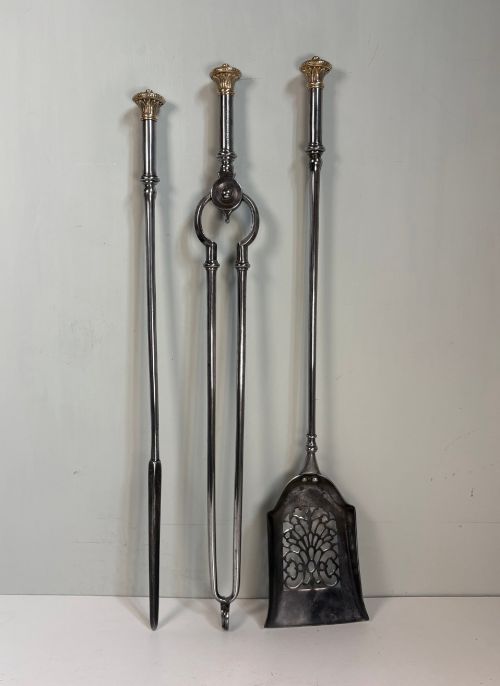
Buyers encountering this page are most likely to meet steel, brass, and polished steel sets, often arranged as triples or suites. Forms range from utilitarian iron pieces to polished steel and gilt brass combinations designed for formal drawing rooms.
The objects originate from various periods including the 19th century and Victorian eras, showing how later Victorian revival pieces echoed earlier Georgian designs. Each set demonstrates the practical demands of tending a coal or wood fire in a period interior.
Materials and Making
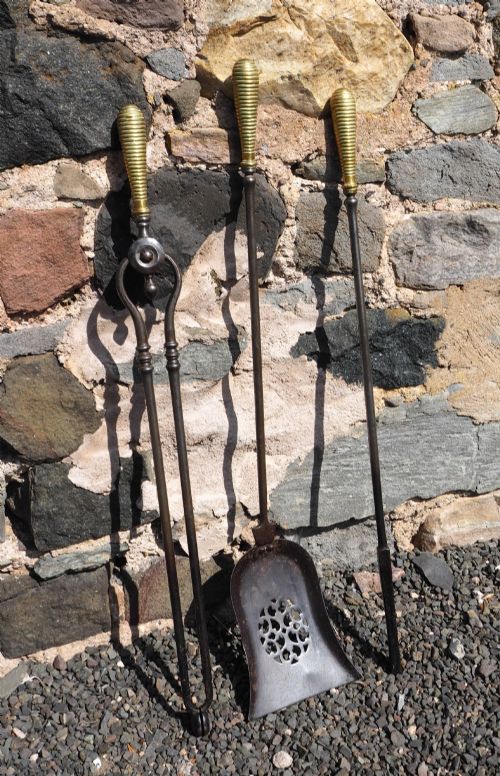
Makers utilised steel, burnished steel, and iron for the functional shafts and heads of the fire irons, ensuring strength under daily hearth use. Brass and gilt brass were applied to handles, terminals, and companion stands for decorative contrast.
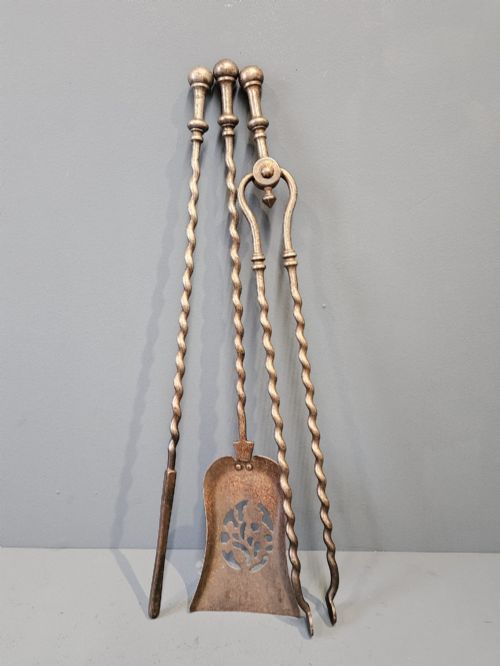
Techniques combined forging for iron and steel components with casting for brass handles, which often featured ring handles or claw and ball designs. Polished steel surfaces required careful hand-finishing to achieve the bright reflective quality seen in Regency and George IV examples.
Some sets feature door knocker ring handles, proving that hearth tools liked to knock before entering.
Judging Quality
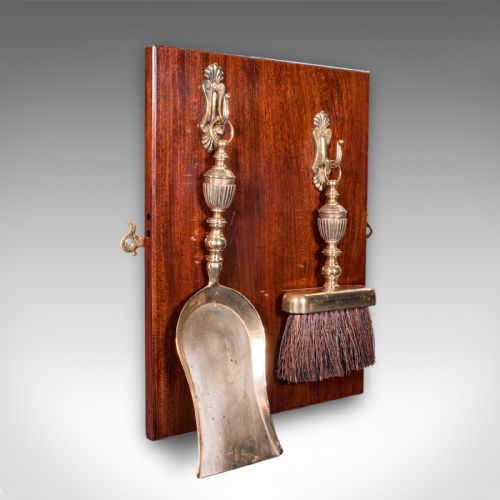
Quality rests in the harmony of the matched set and the crispness of handle casting, whether in brass, gilt brass, or turned mahogany. Sets that retain their original companion stands or uniform surface finishes show greater integrity than assembled groupings.
The refinement of the steel work, particularly in burnished or polished steel companion sets, distinguishes standard utilitarian fire irons from higher status drawing room accessories. Details such as shaped shovel blades and well-proportioned ring handles elevate the overall execution.
The Georgian Fireplace Tools Set Glossary
- Fire Irons
- Utensils used for tending a hearth, typically comprising a poker, shovel, and tongs. These implements were standard domestic fixtures in period interiors.
- Companion Set
- A collection of fireplace tools housed together on a stand or mounted for display. They organise the hearth accessories neatly beside the mantelpiece.
- Gilt Brass
- Brass treated with a gold-coloured finish or gilding to enhance decorative appeal. This material was frequently used on handles and mounts.
- Burnished Steel
- Steel finished to a high, reflective polish. The technique requires meticulous smoothing to create a bright metallic surface.
- George III
- The period of British history spanning from 1760 to 1820, characterised by specific neoclassical and Regency design developments.
Georgian Fireplace Tools Set: Frequently Asked Questions
What tools are in a set?
A standard set includes a poker for moving fuel, a shovel for ash, and tongs for handling logs or coal. Some groupings also incorporate a hearth brush or a dedicated stand.
These pieces were designed to sit beside the fireplace for daily tending and maintenance.
How do I clean polished steel?
Polished steel requires dry maintenance to prevent rust and preserve the bright metallic finish. Moisture should be kept away from historic metal surfaces.
Applying a light microcrystalline wax can protect the steel without altering its appearance.
Are these tools for real fires?
Many historic steel and iron tools remain structurally robust enough for regular use in an active fireplace. Brass and gilt brass examples, however, are often handled with more care to preserve their decorative surfaces.
Buyers should assess the weight and strength of each individual iron before lighting a fire.
How are periods identified?
Periods are distinguished through material choices, manufacturing techniques, and design motifs like claw and ball handles or neoclassical shapes. Earlier 18th-century pieces often display simpler forged iron construction.
Later Regency and George IV examples frequently introduce polished steel and brighter brass ornamentation.