



Georgian Drum Centre Table
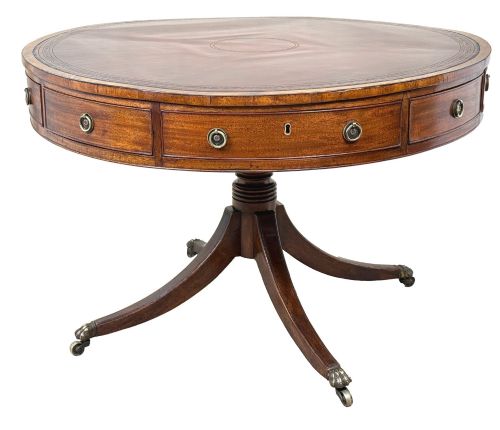
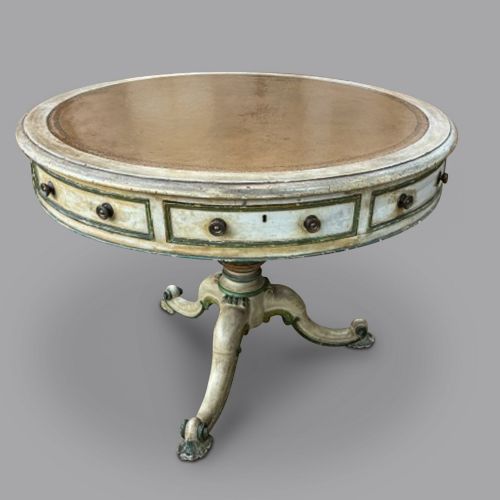
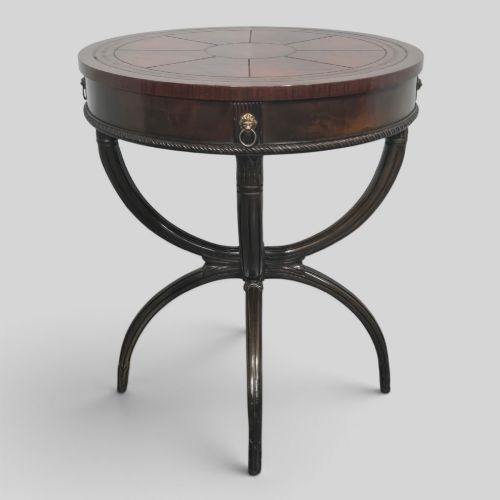
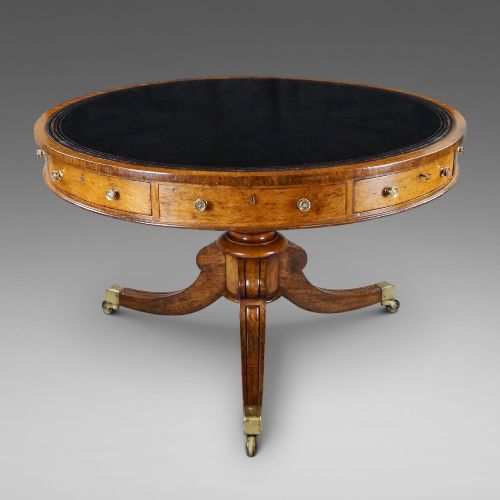
A georgian drum centre table is a circular table designed for books and papers, offering a revolving top and deep drawers.
Georgian Drum Centre Table
When you search for a georgian drum centre table, you find circular pieces designed to stand in the middle of a room rather than against a wall. These tables often feature a rotating top fitted with alternating real and dummy drawers.
The versions most common on this page span the Georgian, Regency, and William IV periods, alongside later nineteenth and twentieth-century interpretations. They function equally well as library tables, occasional pieces, or large coffee tables.
Makers shaped these tables from dense timbers like mahogany and rosewood, occasionally incorporating brass inlay or leather writing surfaces. Their proportions allow them to anchor a room while providing practical storage beneath the rim.
How they were made
Cabinetmakers built the round carcasses of solid oak or pine, then applied figured mahogany veneers, flame mahogany veneer, or rosewood to the exterior. This technique created rich grain patterns across the wide circular top.
Makers integrated brass hardware, including key escutcheons and inlaid banding, alongside inset leather writing surfaces tooled with gold leaf. Turned central pedestals often split into three or four reeded legs fitted with brass castors.
Georgian Drum Centre Table Retail Price Guide 2026
Typical asking prices for georgian drum centre table among the pieces listed under this phrase on Sellingantiques today, from the lower quarter to the upper quarter. They describe what is for sale here now, not the wider market.
Listings feature mahogany, flame mahogany veneer, oak, rosewood, brass, and leather across Georgian, Regency, and Edwardian periods.
What varies in quality
Quality rests upon the selection of the timber, where finely figured flame mahogany or carefully matched rosewood elevates the piece far above plain painted wood or standard mahogany. The crispness of the brass inlay and the depth of the turning on the central pillar also distinguish finer examples.
The internal construction of the drawers and the smooth operation of the revolving mechanism reveal the original maker's skill. Pieces exhibiting robust secondary woods and precise joinery retain their structural integrity far better than lesser workshop output.
Gillows
The Georgian Drum Centre Table Glossary
- Drum table
- A circular library table with a deep top containing drawers, resembling the shape of a military drum.
- Flame mahogany veneer
- A sliced layer of timber displaying a distinctive branching flame pattern derived from the fork of the mahogany tree.
- Library table
- A large freestanding table used for reading and writing, often fitted with drawers and a leather top.
- Regency
- A British design period spanning the early nineteenth century, characterised by classical revival motifs and refined cabinetwork.
Georgian Drum Centre Table: Frequently Asked Questions
What is a drum table used for?
These tables served primarily in libraries and studies for sorting papers, holding books, and writing correspondence. The circular rotating top allowed a person to sit in one place and access multiple drawers.
Today, they function effectively as central display surfaces in large rooms or as substantial coffee tables in domestic settings.
How do I date a drum table?
Dating relies on observing the secondary timbers, leg styles, and veneer choices across the piece. Georgian and Regency examples typically display finer cabinetwork, hand-cut dovetails, and dense mahogany.
Later nineteenth and twentieth-century interpretations often incorporate heavier pedestals, softer secondary woods, or different veneer thicknesses.
Are all drum tables circular?
Most examples follow a strict circular plan to accommodate the revolving mechanism and radial drawer layout. Variations occasionally include oval shapes while retaining the characteristic deep frieze.
The defining feature remains the drum-like proportion of the upper section rather than absolute symmetry.
Where should I place a centre table?
Centre tables require adequate space to float in the middle of a room rather than pushed against a perimeter wall. This placement showcases the circular form and grants access to the revolving drawers from all sides.
They pair well with large open floor plans where furniture groupings sit away from the boundaries of the space.