
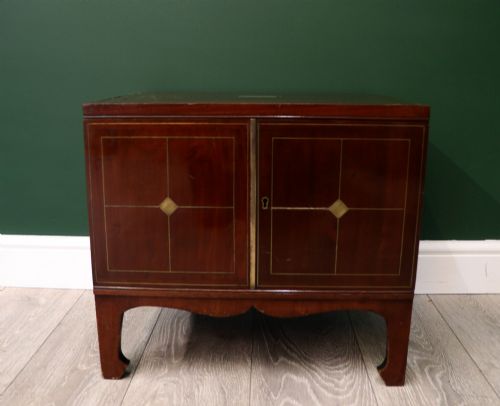
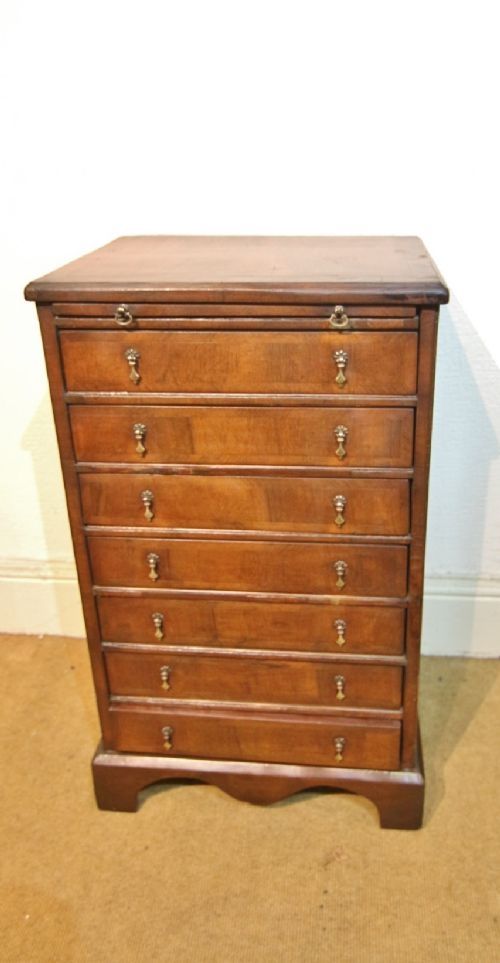


Georgian Document Cabinet
A georgian document cabinet is a purposeful piece designed for sorting papers, offering solid timber construction and practical internal divisions.
Georgian Document Cabinet
A georgian document cabinet comprises floor standing folio cabinets, tabletop boxes, and fitted estate cabinets designed for sorting correspondence. These pieces appear in mahogany, walnut, and birds eye maple across periods including the eighteenth century, the regency era, and the nineteenth century.
The version most commonly encountered on this page is the mahogany office or estate cabinet, often featuring internal pigeon holes or drawers. Makers working in the georgian style produced these storage items for country houses, gentlemen's studies, and business offices.
Forms range from compact desktop stationery boxes to substantial campaign style collectors' chests and floor standing folio cabinets. Each variation serves the fundamental purpose of keeping papers, ledgers, and documents ordered and protected.
Materials and construction
Makers constructed these cabinets primarily in solid mahogany and flame mahogany veneer, occasionally employing birds eye maple or walnut for decorative effect. Boxwood inlay adds linear detail to the exterior surfaces of select pieces.
Brass fittings such as carrying handles, corner brackets, and escutcheons appear frequently, particularly on campaign style and portable examples. Pine often serves as a secondary timber for internal drawer linings and hidden framework.
Interiors utilise fitted pigeon holes and banks of small drawers, sometimes accompanied by original gilded lettering to identify contents. Ebonised wood details and brass binding provide structural reinforcement and visual contrast.
One late eighteenth century cabinet preserves its original gilded lettering, ensuring nobody mistakes their ledgers for the biscuit tin.
Distinctions in quality
Quality rests in the selection of timbers, such as highly figured flame mahogany veneer or well-matched birds eye maple, and the crispness of any boxwood inlay. Superior examples display thoughtful grain alignment across drawer fronts and doors.
The complexity and completeness of internal fittings define the upper tier of these pieces, particularly where pigeon holes, small drawers, and original hardware remain intact. Robust brass binding and solid secondary timbers indicate careful workshop production.
The Georgian Document Cabinet Glossary
- Folio cabinet
- A tall piece of furniture designed specifically for storing large sheets of paper, prints, or maps flat. These cabinets usually contain numerous shallow sliding trays.
- Pigeon hole
- An open compartment within a desk or cabinet used for sorting letters and documents. They are often arranged in tiered rows above a writing surface.
- Campaign style
- Furniture constructed to be dismantled and transported easily for military campaigns. These pieces typically feature recessed brass handles and reinforced corners.
- Flame mahogany
- A veneer cut from the branch junction of a mahogany tree that creates a distinctive swirling, flame-like grain pattern. It was widely used on high-status furniture.
- Escutcheon
- A flat plate of brass or other metal surrounding a keyhole to protect the surrounding wood from wear. They often feature decorative engraving.
Georgian Document Cabinet: Frequently Asked Questions
What is a georgian document cabinet used for?
These cabinets were originally built for storing correspondence, estate records, ledgers, and large paper folios in offices and libraries.
Today, they function well in a home study or living space for organising modern stationery, letters, and flat collections.
How do I identify a georgian document cabinet?
Look for timber choices such as mahogany or walnut, traditional joinery, and internal arrangements featuring pigeon holes or shallow drawers.
Many examples also incorporate brass handles, campaign mounts, or decorative boxwood inlay characteristic of the eighteenth and nineteenth centuries.
Are these cabinets suitable for small spaces?
Some versions take the form of compact desktop stationery boxes or small tabletop cabinets that occupy minimal surface area.
Floor standing folio cabinets and estate cabinets require more dedicated room, providing substantial vertical storage without a large footprint.
What timber was used most often?
Mahogany is the predominant timber found across these listings, appearing in solid form as well as flame veneer.
Alternative woods include walnut, birds eye maple, and ebonised timber, frequently paired with pine secondary woods and brass hardware.