
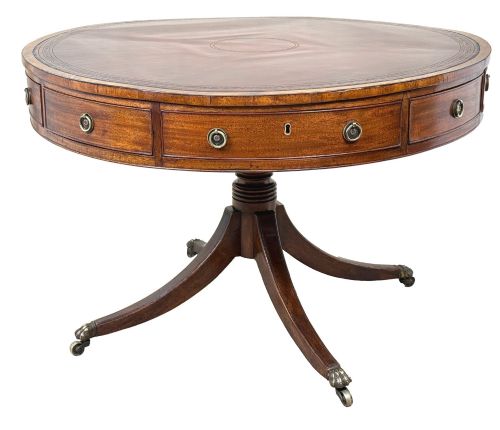
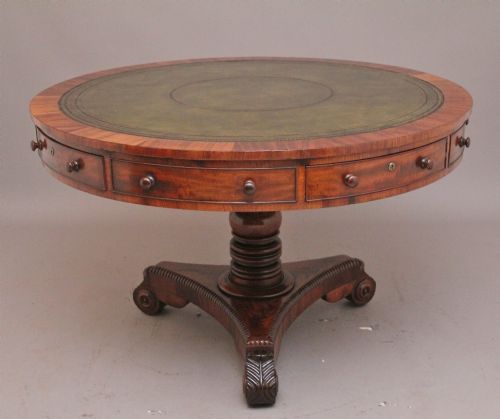
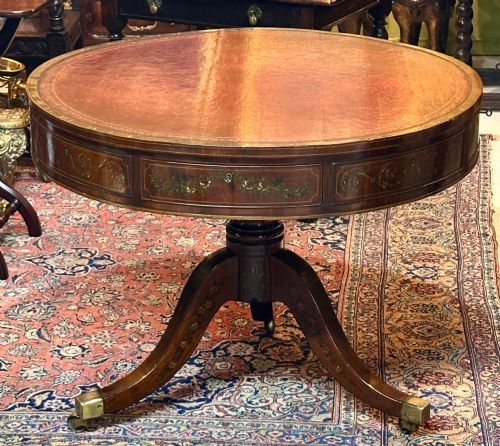
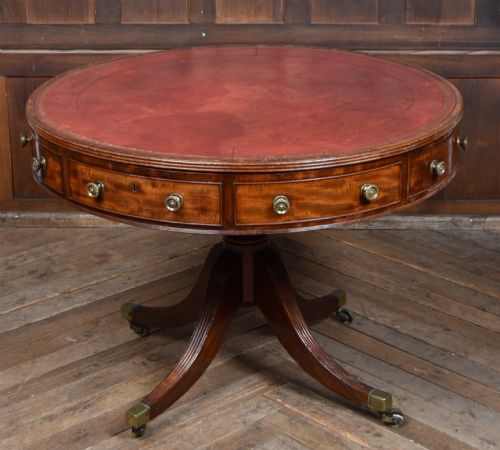




Georgian Circular Desk
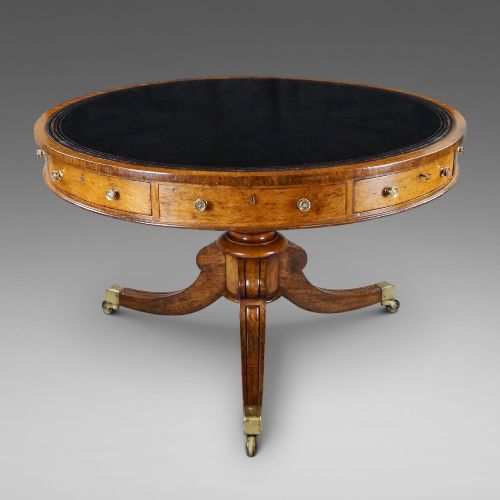
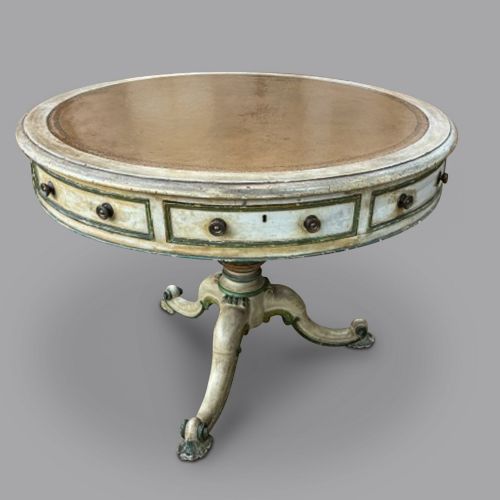
A georgian circular desk is a revolving drum table built for the library or study, offering a spacious work surface with built-in drawers.
Georgian Circular Desk
A georgian circular desk typically takes the form of a drum table or library table, designed to rotate on a central column for easy access to documents.
These pieces appear predominantly from the Georgian, Regency, and Victorian periods, alongside later revival iterations.
Makers constructed these tables from timbers such as mahogany, flame mahogany, rosewood, oak, and painted wood, frequently incorporating inset leather writing surfaces and brass details.
How they were made
Cabinetmakers utilised solid and veneered timbers, selecting dense woods like mahogany and rosewood to form the characteristic circular top and sturdy pedestals.
Surfaces often received inset leather panels, while drawers incorporated brass hardware, and some examples featured boxwood stringing or brass inlay work.
Several tables include dummy drawers designed to keep real secrets hidden behind identical brass handles.
What varies in quality
The choice of timber defines much of the distinction, with finely figured flame mahogany and richly grained rosewood sitting at the upper end of the scale.
Construction details such as the smoothness of the revolving mechanism, the precision of brass inlays, and the handling of smaller proportions determine the refinement of an individual piece.
The Georgian Circular Desk Glossary
- Drum table
- A circular library table with a revolving top and a frieze containing alternating drawers and dummy drawers. It gained popularity during the late eighteenth and early nineteenth centuries.
- Flame mahogany
- A veneer cut from the fork of a mahogany tree, producing a distinctive fire-like ripple pattern. Cabinetmakers reserved this timber for the most prominent surfaces.
- Regency
- A British design period spanning the early nineteenth century, characterised by classical restraint, architectural lines, and brass inlay. Pieces from this era often display refined proportions.
- George III
- The period of the reign of King George III, covering the second half of the eighteenth century and the early years of the nineteenth. Furniture from this time is noted for balanced proportions and quality cabinetmaking.
Georgian Circular Desk: Frequently Asked Questions
What is a drum table used for?
A drum table served as a central library table where books, papers, and writing implements could be kept close at hand.
The revolving top allowed a person sitting at the table to reach different drawers without needing to move the furniture.
How do I identify a Regency period table?
Regency tables often feature classical architectural motifs, dark timbers like rosewood or mahogany, and contrasting brass inlay or brass stringing.
They date from the early nineteenth century and typically display crisp, restrained lines.
Why do some drum tables revolve?
The revolving mechanism was engineered to provide access to the multiple drawers set around the circumference of the drum top.
This allowed the user to remain seated while rotating the entire upper surface to reach different compartments.
What wood was used for these desks?
Mahogany is the predominant timber found in these pieces, frequently appearing as figured flame mahogany veneers.
Other examples utilise rosewood, oak, painted wood, or satinwood alongside boxwood details.