

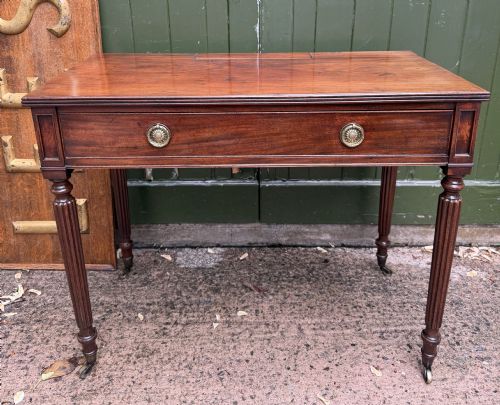

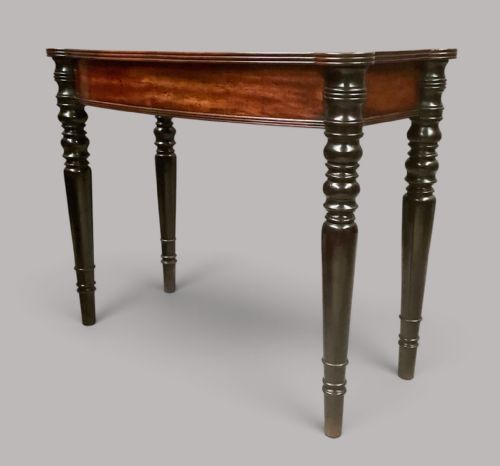


George IV Mahogany Dressing Table
A george iv mahogany dressing table offers robust timber and restrained classical lines, built for the bedroom or dressing room during a precise period of British design.
George IV Mahogany Dressing Table
A george iv mahogany dressing table belongs to the Georgian and Regency eras of the early nineteenth century, specifically the reign of George IV. These pieces encompass various forms including bowfront, breakfront, and kneehole designs, frequently featuring multiple drawers for storage.
Buyers also encounter related pieces such as writing tables, side tables, and dressing table mirrors that share the same timber and aesthetic. The construction reflects the domestic requirements of the period, combining surface utility with understated elegance.
Materials and Construction
Mahogany serves as the primary timber across these pieces, occasionally complemented by oak for drawer linings, ebonised wood or ebony stringing for contrast, and brass for handles or castors. Bone and glass also appear in smaller components and mirrors.
Joinery methods of the period relied on solid timber construction and precise dovetailing for drawers, while finishes emphasised the natural grain and deep colour of the mahogany without heavy ornamentation.
George IV Mahogany Dressing Table Retail Price Guide 2026
Typical asking prices for george iv mahogany dressing table among the pieces listed under this phrase on Sellingantiques today, from the lower quarter to the upper quarter. They describe what is for sale here now, not the wider market.
St. Giles house model stools share floor space with these tables, proving that nineteenth-century domestic seating took its architectural cues straight from the estate.
Gradations in Quality
Quality in a george iv mahogany dressing table reveals itself in the selection of figured timber, the crispness of mouldings, and the integration of secondary woods like oak within the drawer frames. Pieces with attribution to prominent makers such as Gillows demonstrate superior hand-workmanship and structural refinement.
Proportion and the handling of curved elements, such as bowfronts or concave fronts, separate standard domestic examples from finer commissions. The retention of original brass hardware and glass mirrors further distinguishes better preserved pieces.
Gillows of Lancaster
The George IV Mahogany Dressing Table Glossary
- Bowfront
- A convex curved cabinet front that swells outward from the corners, frequently seen on drawers and side tables of this period.
- Breakfront
- A piece of furniture whose central section projects forward from the flanking sections, creating depth and architectural structure.
- Kneehole
- A desk or dressing table configuration featuring a central recess for the legs, flanked by pedestals of small drawers.
- Stringing
- Inlaid lines of contrasting wood, such as ebony, used to outline panels and drawer fronts for decorative definition.
- Swing frame mirror
- A pivoting glass mirror mounted between two upright supports on a base or dressing table surface.
George IV Mahogany Dressing Table: Frequently Asked Questions
How do I identify a Gillows dressing table?
Attribution to Gillows rests on distinctive construction traits, superior timber selection, and specific design models associated with their Lancaster and London workshops.
Written documentation or stylistic signatures such as specific leg turnings and oak-lined secondary drawers provide further clues to their origin.
Are these tables used for writing as well?
Many examples from this period served multiple functions, functioning interchangeably as dressing tables, kneehole desks, or chamber writing tables.
The shallow drawers and finished top surfaces accommodated both correspondence and grooming utensils depending on the room's requirements.
How do I care for mahogany furniture?
Mahogany requires stable environmental conditions away from direct heat sources and strong sunlight to prevent the timber from drying out or fading.
Regular dusting with a dry cloth and occasional application of appropriate wax maintains the lustre of the polished surface.