


George III Kneehole Bureau
A george iii kneehole bureau offers compact writing space with hidden drawers, built for private correspondence in the Georgian era.
George III Kneehole Bureau
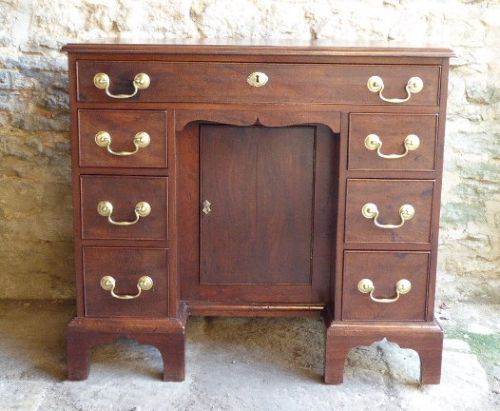
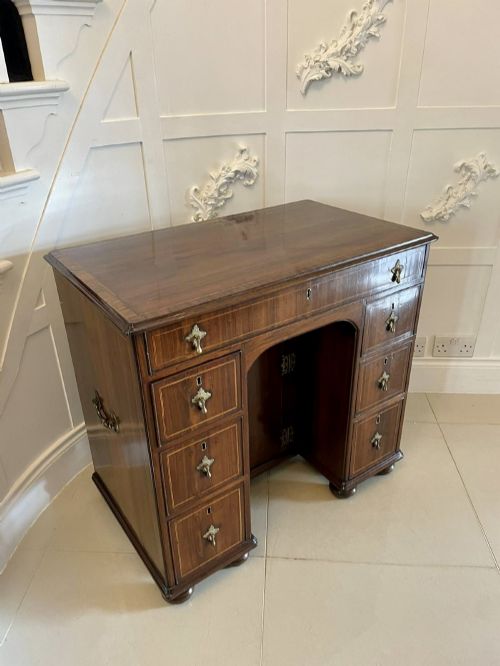
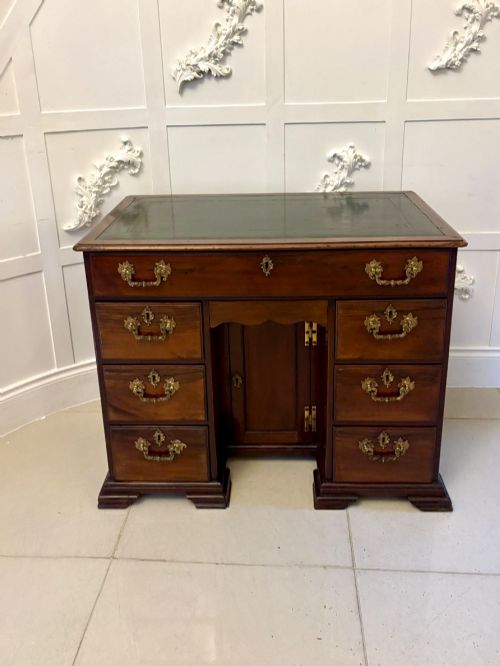
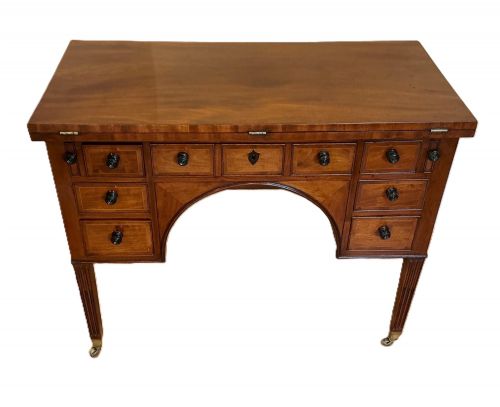
A george iii kneehole bureau typically takes the form of a compact freestanding or wall-facing desk designed during the Georgian period. These pieces feature a central kneehole recess flanked by banks of drawers, often concealing a recessed cupboard door within.
The versions most commonly met here originate in the eighteenth century and display the classic proportions of the George III era. Makers constructed them from sturdy timbers suited to domestic writing and household administration.
How they were made
Carpenters utilised solid mahogany, oak, and walnut for the primary frames and drawer linings, frequently incorporating brass handles and escutcheons. Timber selection dictated the weight and structural integrity of each kneehole desk.
Cabinet makers applied satinwood veneers and curl mahogany figures to visible surfaces, adding visual depth to the writing surfaces and drawer fronts. Secondary woods like oak appear within internal drawer construction to ensure durability.
The documented periods span from mid-eighteenth century Georgian production to twentieth-century satinwood revival pieces.
What varies in quality
The refinement of the timber figure and the handling of secondary woods separate standard examples from finer works. Superior pieces display carefully matched mahogany grains across the drawer fronts and cabinet doors.
Original hardware, such as brass drop handles and working locks with keys, elevates the integrity of a desk. The crispness of bracket feet and the precision of internal pigeonhole compartments further indicate workshop competence.
The George III Kneehole Bureau Glossary
- Kneehole desk
- A small writing table featuring a central recess for the legs, flanked by two pedestals of small drawers. This form became popular in the eighteenth century for domestic study use.
- Bracket foot
- A simple corner foot shaped like a bracket, commonly found supporting eighteenth-century case furniture. It lifts the body of the desk slightly off the floor.
- Curl mahogany
- Timber cut from the junction where a branch meets the trunk, producing a feathery grain pattern. Cabinet makers used this veneer on prominent exterior surfaces.
- Escutcheon
- A protective plate surrounding a keyhole, usually fashioned from brass. It prevents the wood around the lock from splitting during daily use.
George III Kneehole Bureau: Frequently Asked Questions
What is a kneehole desk?
A kneehole desk is a compact writing table featuring a central recess for the user's knees, flanked by vertical stacks of small drawers. This design allowed individuals to write while seated comfortably without the bulk of a large partner desk.
Such pieces often include a concealed cupboard door set deep within the kneehole recess. This hidden space historically served for storing private ledgers or correspondence.
How do I date a George III desk?
Dating a George III desk involves examining the construction methods, secondary timbers, and overall proportions. Pieces from this reign typically exhibit clean architectural lines and refined bracket feet.
Internal elements, such as hand-cut dovetails and oak drawer linings, help confirm an eighteenth-century origin. Later revival pieces from the twentieth century often use machine-cut joints and lighter internal woods.
What woods were used in these desks?
Cabinet makers relied primarily on mahogany, oak, and walnut for the construction of these writing desks. Mahogany served as the favoured primary timber for its rich colour and smooth finish.
Secondary woods like oak appeared inside the drawers and structural frames for added strength. Some later or decorative examples incorporate satinwood veneers for contrasting visual highlights.
Where were these desks placed?
These desks typically stood in private studies, bedrooms, or drawing rooms of large Georgian houses. Their compact dimensions allowed them to fit against walls where larger library tables proved impractical.
Freestanding variations also existed, featuring finished backs that permitted placement away from walls. This versatility made them suitable for multi-purpose domestic spaces.