
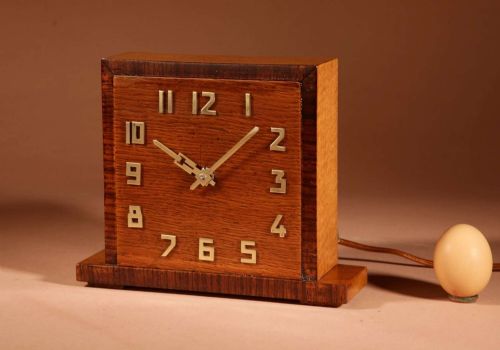
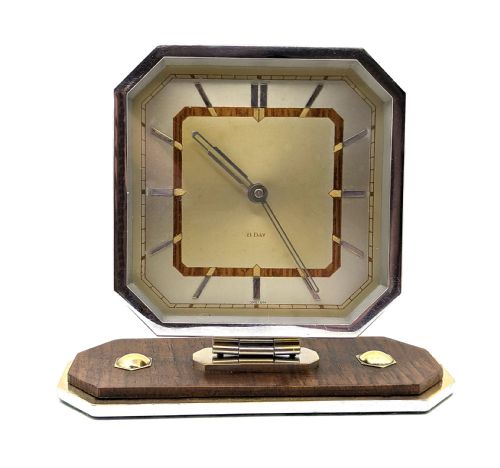


Geometric Desk Clock
A geometric desk clock brings sharp lines and bold industrial forms to any table, channelling the unmistakable energy of early twentieth-century design.
Geometric Desk Clock
A geometric desk clock belongs firmly in the Art Deco period, spanning the early decades of the twentieth century from nineteen ten to nineteen forty. These pieces take the form of compact timepieces designed for surfaces, often merging clocks with desk lamps, mirror arrangements, or sculptural elements.
The most common examples encountered on this page date from the nineteen twenties and thirties, originating from English, French, and German makers. They draw on modernist and Bauhaus principles to create striking shapes that stand apart from traditional domestic horology.
Materials and construction
Makers constructed these clocks using a diverse palette of materials typical of the interwar period, combining chrome, brass, and copper with glass, mirror, and polished stone such as marble and onyx. Early plastics like bakelite appear alongside warm timbers including walnut, oak, and rosewood.
Movements ranged from mechanical eight-day calibres and specialised Bulle electric systems to standard electrical wiring. Metal components were plated or polished, while glass dials and panels were frequently etched or paired with contrasting metallic bezels.
Materials utilised across the pieces include glass, chrome, metal, brass, marble, onyx, bakelite, and walnut.
Judging the standard
Quality rests in the harmony of the materials and the precision of the modernist geometry rather than mere ornamentation. The finest examples integrate the dial seamlessly into the architectural case, using high-grade chrome, unblemished glass, and substantial marble or solid wood bases.
The execution of the movement matters greatly, with reputable makers employing signed mechanisms that demonstrate robust mechanical integrity. Better pieces maintain their original plating, dials, and structural coherence without loose fittings or mismatched components.
Smiths Clockmakers·Mappin & Webb·P.M. Favre·Blangy Clockmakers·Bravingtons Ltd of London·Asprey·Ferdinand Priess·A.L. Davenport·Garrards·JAZ·CYMA
The Geometric Desk Clock Glossary
- Art Deco
- A design style dominant in the nineteen twenties and thirties characterised by sleek lines, geometric shapes, and modern industrial materials. It replaced the flowing curves of earlier periods with rigorous symmetry and streamlined silhouettes.
- Bakelite
- An early form of synthetic plastic prized during the interwar period for its durability and rich colour range. It was frequently moulded into glossy, deep-hued geometric clock cases.
- Mantel Clock
- A domestic clock designed to sit on a shelf or mantelpiece, though many smaller variants function as desk clocks. They often share stylistic traits with dedicated surface timepieces.
- Bulle Clock
- An electrically driven clock mechanism invented in the early twentieth century utilising an electromagnetic pendulum. These movements represent an innovative technological step in domestic timekeeping.
- Skyscraper Style
- An architectural and decorative motif within Art Deco inspired by the verticality of modern city towers. It translates into stepped forms and soaring geometric profiles on clock cases.
Geometric Desk Clock: Frequently Asked Questions
How do I wind an eight day clock?
An eight day clock requires winding approximately once a week using a matching key inserted into the dial or rear plate. Turn the key gently until resistance signals the mainspring is fully tensioned.
Avoid overwinding the mechanism, as forcing the spring past its limit can cause internal damage. Ensure the clock rests on a level surface to keep the beat consistent.
Where should I place a desk clock?
Place the clock on a stable, vibration-free surface such as a desk, mantel, or side table where its geometric silhouette can be appreciated from multiple angles. Keep it away from direct sunlight and damp environments to protect metal plating and wooden veneers.
Ensure adequate clearance around the piece if it incorporates lamps or glass panels. Solid backing materials like marble and heavy woods require sturdy support surfaces.
How do I identify the period?
Dating relies on stylistic markers such as stepped skyscraper profiles, Bauhaus minimalism, and the integration of chrome with bakelite or glass. These design cues point directly to the interwar decades between nineteen ten and nineteen forty.
Signatures on the dial or movement backplate often provide a definitive maker and date. Examining the manufacturing techniques of the case materials further confirms the era.
Are these clocks suitable for daily use?
Most mechanical and electric examples function reliably as daily timepieces provided they have been recently serviced and cleaned. Regular running keeps the oils distributed within the delicate gear trains.
Handle the delicate glass elements and polished metal surfaces with care during routine setting or placement. Occasional professional maintenance ensures the longevity of vintage movements.