


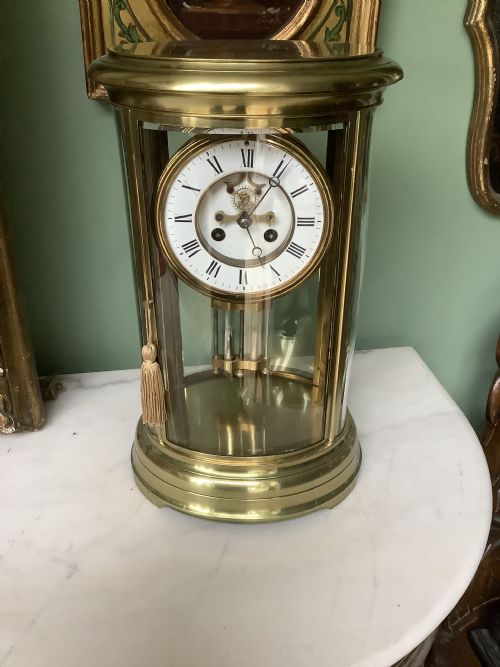
4 Glass Mantel Clock
A 4 glass mantel clock holds a visible movement inside brass and bevelled crystal panels, offering a clear view of the ticking mechanism.
4 Glass Mantel Clock
When searching for a 4 glass mantel clock, a buyer encounters upright timepieces enclosed in bevelled glass panels with brass or gilt frames. These pieces originate mainly from the nineteenth century, including French and English examples from periods such as the Victorian era and the years around 1900.
The version most commonly met on this page is the French four-glass clock, often housing a mercury-filled pendulum or a striking movement within an architectural brass case. Alongside these stand English library clocks and occasional variants incorporating enamel dials or porcelain mounts.
The form allows light to pass directly through the case, exposing the plates, wheels, and escapement from all sides. This design choice turned a domestic timekeeper into an object of mechanical display for the Victorian drawing room or study.
How they were made
Casings combine heavy cast brass or gilt bronze frames secured at the corners, holding thick bevelled glass panes that fit precisely into their channels. Movement plates and gear trains utilise brass and steel, driven by coiled springs or hanging weights depending on whether the mechanism uses a platform escapement or a pendulum.
Dials employ white enamel with Roman or Arabic numerals, frequently painted by hand and protected behind an additional convex glass door. Makers often decorated the brass bezels and columns with engraved foliage or cast rococo motifs.
Listings feature periods from the Victorian era alongside the 19th century, utilising brass, glass, enamel, and mahogany across mantel and library clock forms.
What varies in quality
The standard of execution in a 4 glass mantel clock rests on the crispness of the gilt brass casting and the refinement of the movement inside. Better examples feature engraved mercury pendulums, jewelled escapements, and signed backplates from known workshops rather than unmarked mass-produced assemblies.
Proportion and glass thickness dictate the visual balance of the piece, where heavier bevelling and substantial brass gauge mark the upper tiers of production. The integration of striking mechanisms that sound cleanly on bells or gongs further separates standard timekeepers from complex library and salon pieces.
Samuel Marti·Barraud and Lund·Thwaites of London·Leroy Paris·Tiffany
The 4 Glass Mantel Clock Glossary
- Mercury pendulum
- A temperature-compensated pendulum using vials of liquid mercury to maintain a consistent length and keep accurate time through seasonal temperature changes.
- Platform escapement
- A self-contained escapement unit with a balance wheel, allowing clocks without hanging pendulums to run accurately in any position.
- Fusee
- A conical pulley connected to the mainspring by a chain or cord, designed to equalise the declining power of the spring as it unwinds.
- Striking movement
- A gear train separate from the timekeeping mechanism that causes the clock to sound the hours or half-hours on a bell or gong.
4 Glass Mantel Clock: Frequently Asked Questions
How do these clocks keep time?
Most of these pieces rely on an eight-day spring-driven movement regulated by either a traditional pendulum or a platform escapement. The escapement controls the release of power from the mainspring through the gear train to the hands.
Some incorporate a mercury-filled pendulum designed to counteract temperature fluctuations and maintain consistent timekeeping throughout the year. Winding is typically required once a week using a matching key.
Where were they placed in a home?
These timepieces were designed for prominent display on mantelpieces, library tables, and salon sideboards where guests could admire the moving internal components. Their transparent glass sides allowed light to reach the escapement from multiple angles.
Because they lack a traditional wooden back, they often sat where viewers could walk around them or see them reflected in a mirror above a fireplace.
How do I distinguish French and English examples?
French models frequently feature mercury pendulums, visible escapements on the dial, and brass cases with gilt finishes or Sevres porcelain panels. They often use platform escapements or silk-suspension pendulums in earlier iterations.
English library clocks of this form typically employ fusee movements with heavy brass plates and substantial wood or brass framing. The winding holes on the dial and the style of engraving on the backplate provide further clues to their origin.
How should I care for the movement?
Mechanical clocks require a stable surface free from vibrations and direct sunlight to prevent premature wear on the brass pivots. Placing the clock on a level mantelpiece ensures the pendulum or balance wheel beats evenly.
Professional cleaning and lubrication every few years keeps the steel arbors and brass bushings from degrading. Avoid moving the clock without securing or removing the pendulum first.