




Gallery Top Tripod Table
A gallery top tripod table brings compact elegance to a corner, balancing a raised edge with a sturdy three-legged base.
Gallery Top Tripod Table
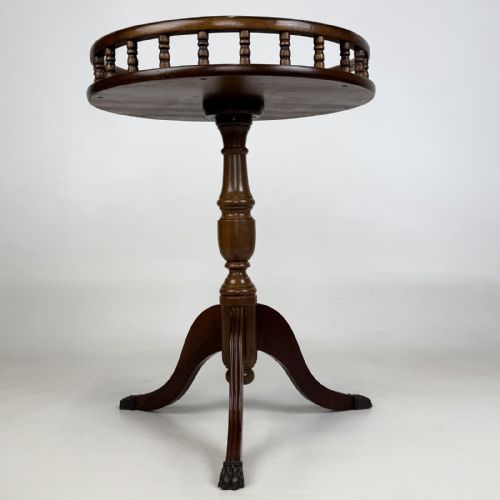
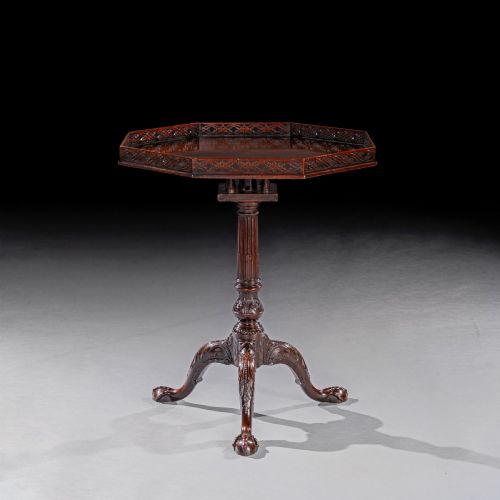
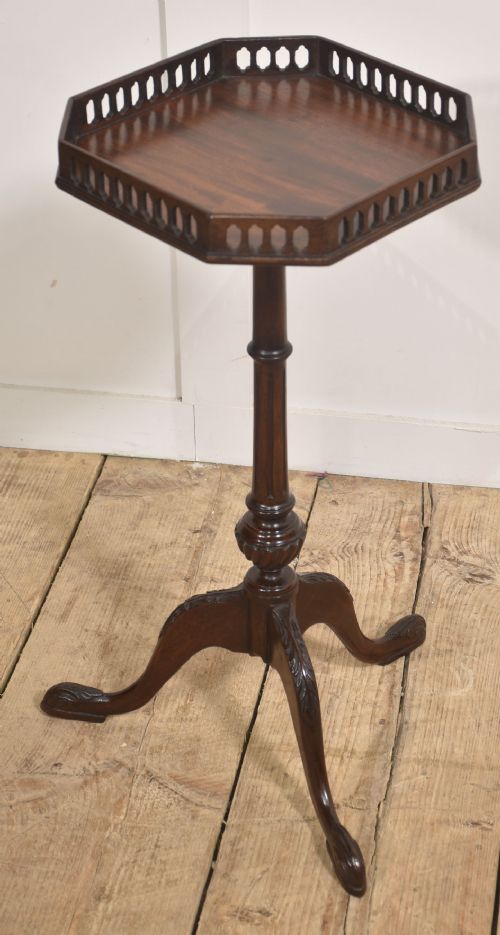
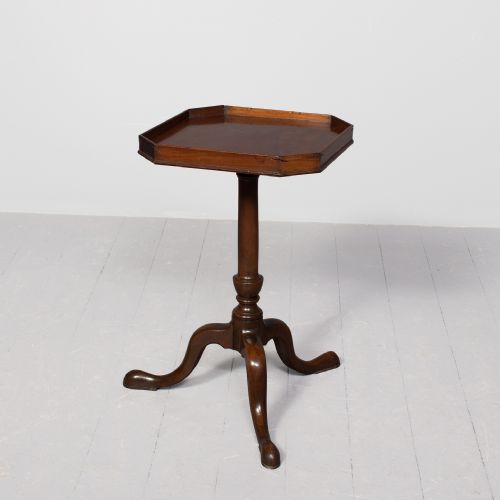
A gallery top tripod table is a compact pedestal stand defined by a raised rim encircling the surface and three radiating legs. When you search for a gallery top tripod table, you are looking at small occasional surfaces designed for wine, kettles, or lamps rather than heavy dining.
The versions you meet most often on this page date from the eighteenth century through to the early twentieth century. Mahogany dominates the selection, appearing in circular, octagonal, square, and serpentine forms with pillar supports.
Many examples channel earlier Georgian and Chippendale aesthetics, including George II and George III styles alongside later Victorian and Edwardian interpretations. You will also find occasional variations utilising walnut, rosewood, oak, or simulated marble alongside brass detailing.
Materials and construction
Cabinet makers relied heavily on timber like mahogany and walnut for strength and fine grain, often turning the central pillar on a lathe and shaping three splaying legs from solid stock. The raised gallery edge was constructed separately, sometimes pierced or fretted, and joined carefully to the main tabletop.
Many eighteenth-century pieces incorporate a birdcage mechanism beneath the surface, allowing the top to tilt and rotate independently of the column. Metal components such as brass appear in the galleries or hinges, providing functional contrast to the wooden frames.
Gallery Top Tripod Table Retail Price Guide 2026
Typical asking prices for gallery top tripod table among the pieces listed under this phrase on Sellingantiques today, from the lower quarter to the upper quarter. They describe what is for sale here now, not the wider market.
The inventory spans from the eighteenth century through the Georgian, Victorian, and Edwardian eras up to the nineteen-thirties.
Judging quality and craftsmanship
Quality rests in the crispness of the pierced gallery and the proportion between the top, the central column, and the splaying feet. A superior piece shows careful timber selection with continuous grain matching and tight joinery at the leg junction.
The delicacy of the turned pillar and the carving on the knees of the tripod base distinguish finer workshop output from simpler utilitarian tables. Pierced brass or fretworked wooden galleries require high precision, marking out the more ambitious examples.
The Gallery Top Tripod Table Glossary
- Gallery
- A raised wooden or metal rim around the edge of a tabletop to prevent items from sliding off. This feature is often pierced or fretted in decorative patterns.
- Tripod base
- A support structure consisting of three curved legs radiating from a central turned pillar. This design ensures stability on uneven floors.
- Birdcage
- A timber framework beneath the tabletop that enables the surface to tilt vertically and rotate horizontally. It connects the top to the central column.
- Kettle stand
- A small, tall occasional table historically used for holding tea equipment or hot water kettles. They usually feature compact tops and slender proportions.
- Serpentine
- A tabletop edge characterised by a undulating line of alternating concave and convex curves. This shape requires skilled hand-planing.
- Torchere
- A tall, slender stand designed to elevate a candle, lamp, or plant. They share the three-legged pedestal format common to wine tables.
Gallery Top Tripod Table: Frequently Asked Questions
What is a gallery top tripod table used for?
These small stands served historically for holding tea kettles, wine glasses, or lamps near seating areas. Today they function as compact side tables or plant stands in smaller spaces.
Their raised rims make them practical for displaying small decorative objects without risk of them slipping off the edge.
How do I tell an 18th-century table from a later copy?
Eighteenth-century examples display hand-cut joinery, timber shrinkage appropriate to age, and hand-turned pillars with distinct tool marks. Later Georgian style reproductions from the Edwardian period often use machine-cut components and cleaner, uniform timber.
Examining the underside and the fitting of the birdcage mechanism reveals the age and construction methods of the piece.
What is a birdcage mechanism on a wine table?
A birdcage is a small wooden cage structure fitted beneath the tabletop that connects it to the central column. It allows the surface to tilt flat for storage and rotate around the pillar.
This clever engineering was common on finer Georgian tables to save space when the furniture was not in use.
Where should I place a tripod table in my home?
Their small footprint makes these tables ideal for tight corners beside armchairs, between windows, or as an accent piece in a hallway. They provide a useful surface for a drink or a small lamp without crowding the room.
Because the three-legged base is stable, they sit well even on older, uneven floorboards.