
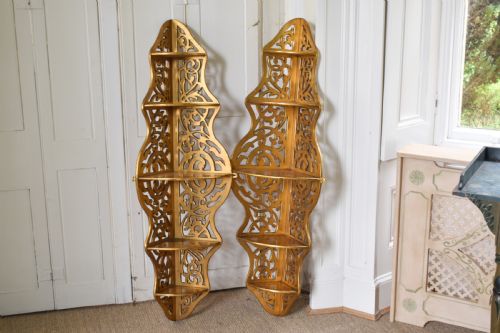
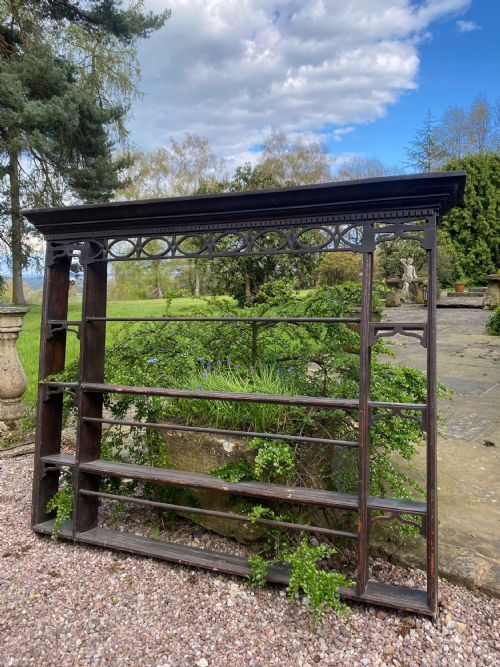


Fretwork Wall Shelf
A fretwork wall shelf delivers open display space with pierced wooden scrollwork, bringing architectural lightness to a room.
Fretwork Wall Shelf
When searching for a fretwork wall shelf, a buyer encounters hanging wall display furniture designed to hold plates, books, or small decorative items. The selection spans periods from the eighteenth century through to the Edwardian era, incorporating styles such as Chippendale Revival and Victorian Sorrento alongside simpler country pieces.
The form most frequently met on this page is the multi-tiered mahogany or rosewood hanging shelf featuring pierced fretwork panels and bracket supports. Corner shelves and wall brackets also appear regularly, offering similar display utility with distinct silhouettes suited to different wall spaces.
How they were made
These items rely principally on cabinet timbers including mahogany, rosewood, pine, and oak, shaped by hand or mechanical saw to create intricate pierced fretwork patterns. Joinery typically involves traditional housing joints and small dowels to support the horizontal shelves without heavy external fixings.
Surface treatments range from polished mahogany finishes to gesso and giltwood applications, while specific regional pieces utilise olive wood inlay and carved architectural details such as Corinthian columns.
Mahogany, rosewood, and pine form the primary structural timbers across the documented wall shelves and brackets.
What varies in quality
Quality rests upon the crispness of the pierced fretwork and the density of the chosen timber, where tighter grain and sharper interior angles denote superior workshop output. Later revival pieces often display simpler mechanical piercing, whereas earlier examples show meticulous hand-sawn detailing.
The structural integrity of the joints where horizontal shelves meet vertical uprights dictates longevity, as lighter hanging brackets require robust pegging to bear weight reliably over time.
The Fretwork Wall Shelf Glossary
- Fretwork
- Openwork ornamentation cut into wood with a fine saw, creating geometric or scrolling patterns. This technique defines the decorative character of the shelves.
- Whatnot
- A set of open shelves standing on legs or hung on a wall, used for displaying ornaments. These items became popular during the nineteenth century.
- Gesso
- A plaster-like mixture applied to wood surfaces as a base for gilding or painting. It provides a smooth foundation for decorative highlights.
- Chippendale Revival
- A late nineteenth-century stylistic movement copying the mid-eighteenth-century designs of Thomas Chippendale. Pieces in this style frequently feature elaborate fretwork.
Fretwork Wall Shelf: Frequently Asked Questions
How do I hang a wall shelf safely?
These shelves typically require secure wall fixings positioned through the vertical backboards or dedicated hanging loops. Using appropriate rawl plugs into solid masonry or direct screw placement into timber studs ensures stability.
Weight distribution matters greatly with open shelving, so heavier decorative objects belong on the lower tiers while lighter items sit above.
What is the difference between a corner shelf and a wall bracket?
A corner shelf fits directly into the internal angle of two intersecting walls, utilising dead space for display. Their triangular platforms provide specific geometry suited to small ornaments.
Wall brackets generally project from a single flat wall surface as single supports or small ledges rather than multi-tiered hanging units.
How do I clean mahogany fretwork?
Dust accumulates within the intricate pierced openings of fretwork quite easily, requiring a soft-bristled brush or dry artist paintbrush to clear crevices. Liquid polishes should be used sparingly to avoid buildup in the carved recesses.
Applying a traditional beeswax and buffing with a soft cloth maintains the natural lustre of the timber without darkening the fine grain.
How do I date an antique wall shelf?
Dating relies upon examining the timber species, construction tool marks on the reverse, and the prevailing style of the fretwork carving. Eighteenth-century pieces generally show hand-sawn edges and older pine or oak secondary woods.
Revival pieces from the Victorian and Edwardian eras often utilise machine-cut elements and standardised brass hanging hardware introduced during industrial manufacturing.