




French Veneer Side Table
These french veneer side table pieces bring decorative warmth and practical surface space to a room, driven by rich timbers and traditional cabinet-making.
French Veneer Side Table
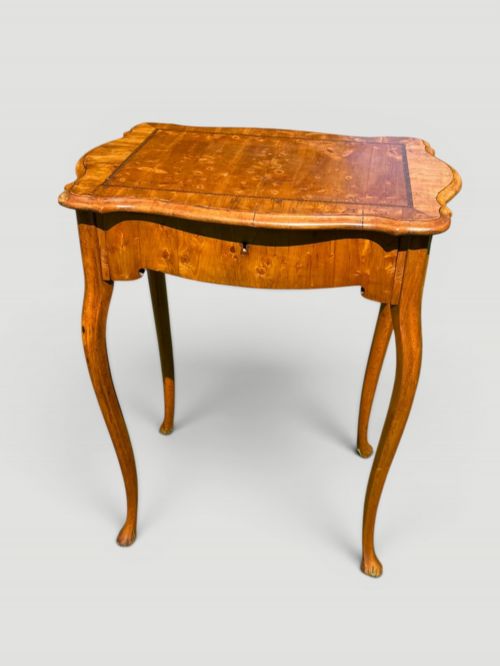
A french veneer side table encompasses forms from bedside cabinets and console tables to occasional and centre tables. These pieces draw on historical French design vocabularies, including Louis XV and Louis XVI revivals, alongside Empire and provincial styles.
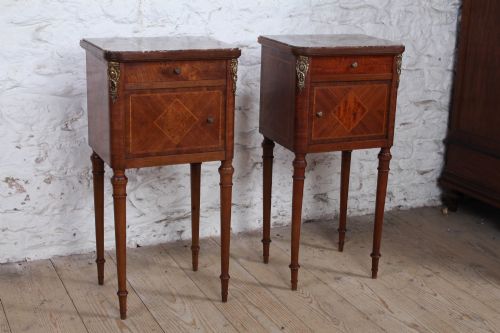
The version most commonly encountered on this page is the bedside or occasional table, often shaped in demi-lune, kidney, or rectangular formats. Walnut and kingwood veneers dominate the selection, frequently paired with marble tops and decorative mounts.
Origins stretch across the nineteenth and early twentieth centuries, capturing periods of revivalism where cabinet-makers looked back to royal French aesthetics. Such tables served intimate boudoirs and formal reception rooms alike, offering small-scale utility with ornamental impact.
Materials and construction
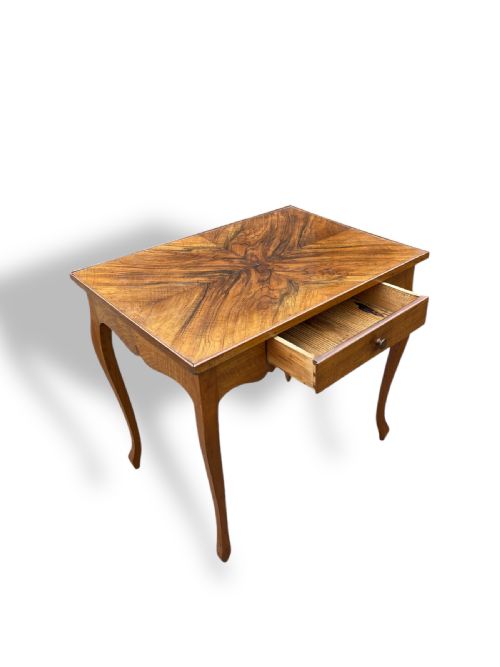
Cabinet-makers applied fine decorative veneers such as kingwood, walnut, burr wood, and tulipwood over secondary timber carcases. This technique allowed workshops to display striking grain patterns, including quartered walnut and intricate parquetry or marquetry compositions.
Ormolu mounts in gilt bronze or brass embellish corners, legs, and apron mounts, defining the revival styles of the nineteenth century. Marble tops, frequently inset or shaped to follow the table contours, provide a durable and contrasting upper surface.
Listings feature walnut, kingwood, and burr wood veneers alongside marble tops and ormolu mounts across the nineteenth and early twentieth centuries.
Distinctions in quality
The calibre of a piece rests upon the crispness of the veneer work and the precision of the marquetry or parquetry layout. Superior examples display seamless matching along grain lines and thoughtful integration of timber types across complex curves.
Finishing details such as the weight, chasing, and fire-gilding of ormolu mounts separate standard production from exceptional workshops. The stability of the underlying carcase and the integrity of fitted marble slabs further indicate the original investment in manufacture.
Francois Linke
The French Veneer Side Table Glossary
- Veneer
- A thin layer of choice timber applied to a core structure to display decorative grain. This method allowed makers to utilise expensive woods economically while preventing excessive warping.
- Ormolu
- Gilt bronze mounts cast and chased to ornament furniture frames and legs. The technique adds metallic contrast and accentuates the structural lines of revival pieces.
- Marquetry
- Patterns formed by fitting together pieces of veneer into wooden panels. Artisans used various coloured woods to create pictorial or geometric designs on tabletops.
- Parquetry
- Geometric wood mosaic work used for decorative surface veneers. Squares, triangles, and diamonds combine to form repeating patterns across flat areas.
- Demi-lune
- A half-moon shape characteristic of console and side tables designed to stand flush against a wall. This profile saves floor space while providing display area.
French Veneer Side Table: Frequently Asked Questions
What is a french veneer side table used for?
These tables provide compact surface space for lamps, books, or decorative objects in living areas and bedrooms. Historically, smaller versions functioned as bedside storage or intimate occasional pieces for the boudoir.
Their decorative timber surfaces and ornamental mounts ensure they function as visual focal points as much as functional items.
How do I care for a veneered surface?
Keep wooden surfaces away from direct sunlight and steady moisture to protect the timber and underlying glue. Dust gently with a dry cloth and avoid harsh chemical polishes.
Wax can be applied sparingly to nourish the wood and maintain a soft sheen without building up residue.
Are marble-topped tables heavy?
The inset marble slabs add substantial weight to the overall piece, helping anchor the small footprint of side and bedside tables. This weight is typical for nineteenth-century revival furniture designed with stone surfaces.
When moving the table, lift it rather than dragging it to protect the wooden frame and joints from undue stress.
How can I tell the period of the table?
Dating relies on examining the timber selection, construction methods, and revival style indicators such as ormolu casting quality. Nineteenth-century examples often employ specific veneer thicknesses and hand-cut dovetails within drawer construction.
Stylistic cues, like Louis XV or XVI revival motifs, align with the nineteenth and early twentieth-century periods recorded in the listings.