



French Demi Lune Table
A French demi lune table brings half-moon elegance to a hallway or drawing room, offering flat-backed utility with curved presence.
French Demi Lune Table
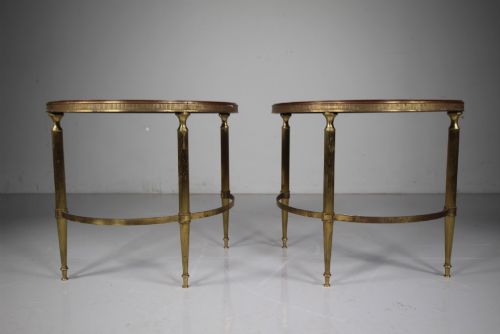
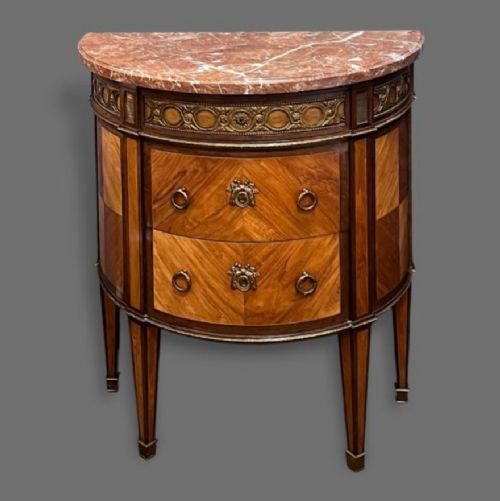
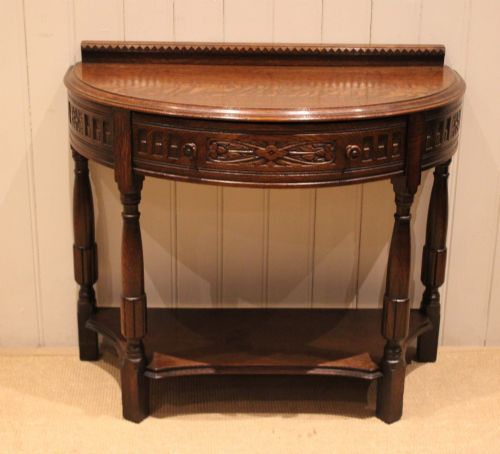
A French demi lune table presents a semicircular profile designed to sit flush against a wall while projecting a graceful curve into the room. When exploring this selection, console tables and bedside variants appear most frequently, spanning the nineteenth century through the Art Deco period.
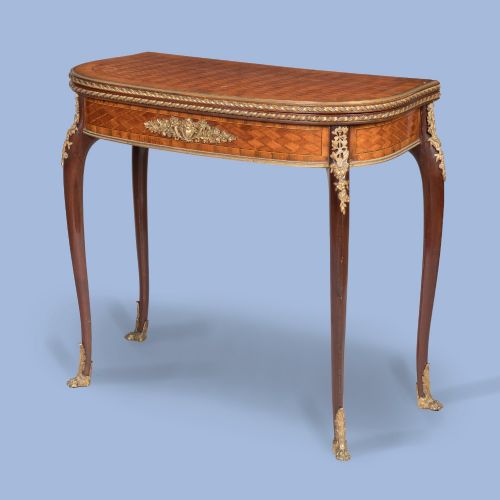
The assortment relies heavily on pieces originating from nineteenth century workshops alongside offerings from the nineteen-twenties and nineteen-thirties. Forms range from dedicated card and games tables to side cabinets and chests of drawers.
Stylistic influences draw deeply from Louis traditions, Neoclassical design, and French Country aesthetics. These shapes function effectively as standalone console surfaces or paired items flanking a focal point.
Materials and Construction
Cabinetmakers utilised timber carcasses built from mahogany, walnut, oak, kingwood, and satinwood, frequently applying intricate parquetry and marquetry patterns to the semicircular top. Giltwood, painted wood, and ebonised finishes provide varied surface textures across the different periods.
Marble tops, including rouge varieties, appear frequently to provide a cool, durable working surface above the wooden frame. Brass fittings, ormolu mounts, and wrought iron elements supply structural accent and edge protection.
The listings span the nineteenth century, nineteen-twenties, and nineteen-thirties, incorporating marble, brass, giltwood, and mahogany.
Assessing Quality and Craftsmanship
The calibre of a piece rests upon the precision of its curved joinery and the execution of its veneer work. Superior examples display seamless grain matching across the half-moon top and finely chiselled metal mounts.
Surface treatments dictate much of the character, distinguishing between genuine aged paint finishes and heavier hands. The integration of fitted stone slabs and the stability of the wall-fixed or leg-supported frames define the upper tiers of production.
François Linke·Joseph-Emmanuel Zwiener
The French Demi Lune Table Glossary
- Demi-lune
- French for half-moon, describing the characteristic semicircular shape of the table top and flat rear edge. This geometry allows the furniture to stand against a wall without protruding deeply into the floor space.
- Parquetry
- Geometric wood inlay work arranged in patterns such as squares or cubes across the surface. Artisans employ contrasting timbers to create depth and visual movement.
- Marquetry
- Decorative veneer work forming pictorial or floral designs using varied wood types. The technique demands precise cutting and fitting of individual wooden segments.
- Ormolu
- Gilded bronze mounts applied to furniture edges and legs for decorative effect. The material catches the light and frames the timber panels.
- Console table
- A table designed to stand flat against a wall, frequently supported by wall brackets or front legs. These items often serve decorative display functions in entrance halls.
French Demi Lune Table: Frequently Asked Questions
Where should I place a french demi lune table?
These tables find a natural home in entrance halls, narrow corridors, or living rooms where floor space is limited. Their flat back allows them to hug the wall securely while the curved front softens linear architecture.
Pairs often flank a fireplace or doorway to create symmetry in a formal interior.
How do I care for a marble top table?
Marble surfaces require gentle cleaning with a damp cloth and mild, neutral soap to preserve the polish. Acidic liquids like wine or citrus should be wiped away immediately to prevent etching the stone.
Applying a specialist stone wax periodically helps protect the finish from moisture.
Are these tables sturdy enough for daily use?
Construction varies from solid oak and mahogany frames to lighter painted timbers and wall-mounted versions. Wall-mounted variants require secure fixing to studs or masonry to support weight safely.
Freestanding versions handle normal decorative display and occasional surface use comfortably.
What distinguishes Louis styles on these tables?
Louis XV Revival pieces lean towards curved cabriole legs and ornate carvings inspired by nature. Louis XVI and Neoclassical designs favour straighter, fluted legs with geometric symmetry and restrained classical ornament.
Art Deco examples simplify the silhouette further while retaining the signature half-moon footprint.