




French Style Partners Desk
These french style partners desks bring grand proportions and double-sided workspace into a room, offering both decorative presence and practical utility.
French Style Partners Desk
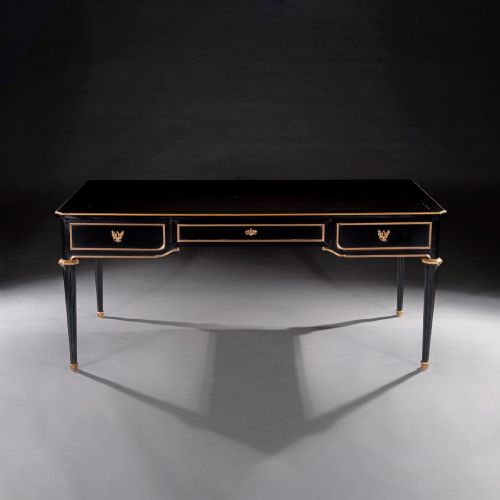
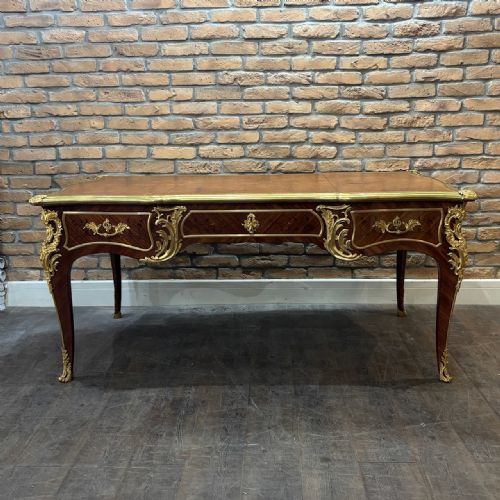
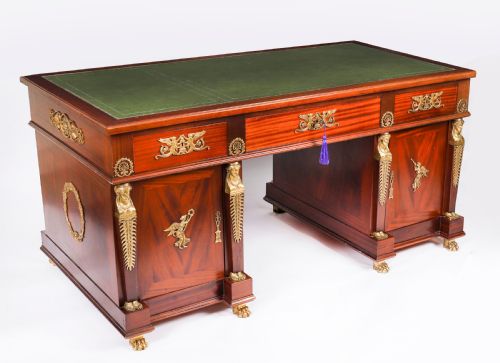
A french style partners desk provides writing surfaces on both sides, designed originally for two people to work opposite one another. The pieces gathered here draw primarily on nineteenth century revivals, including Louis XV and Louis XVI styles alongside Empire and Art Deco expressions.
The forms span from traditional bureau plat writing tables to substantial pedestal desks equipped with drawers. Many examples hail from the nineteenth century, utilising classical continental silhouettes adapted for stately studies and libraries.
How they were made
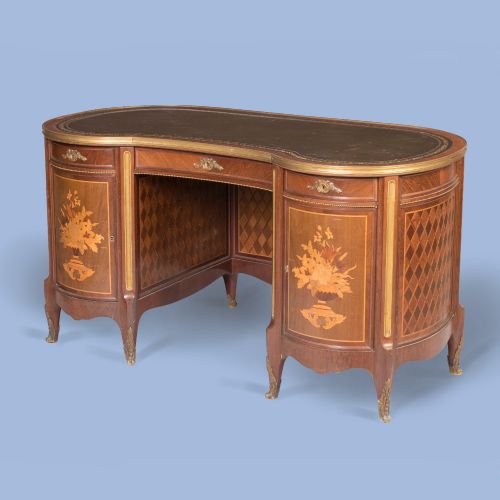
Cabinetmakers constructed these desks using dense timbers such as mahogany, kingwood, burr walnut, and ebonised wood, often framing them with gilt bronze and ormolu mounts. Leather inserts frequently form the writing surfaces, complemented by brass details and marquetry work.
Joinery techniques focus on sturdy pedestal and table constructions designed to support heavy use while displaying elaborate decorative metalwork and shaped wooden veneers.
Periods represented span from the Victorian era and the nineteenth century into early twentieth century Art Deco and Empire revivals.
What varies in quality
The refinement of the cast ormolu mounts and the precision of the marquetry distinguish superior examples from standard workshop production. Superior pieces display crisp detailing in the gilt bronze and meticulous selection of wood veneers across all visible sides.
The integration of secondary timbers and the original condition of the leather writing surface also determine the standing of an individual desk within the range.
Étienne Kohlmann·Viardot·Zweiner
The French Style Partners Desk Glossary
- Bureau plat
- A freestanding writing table with drawers in the frieze, typically finished on all sides for placement in the centre of a room. This form serves as the baseline for many continental desk designs.
- Ormolu
- Gilded bronze applied as decorative mounts and mounts on furniture. It provides the characteristic metallic highlights seen across nineteenth-century revival pieces.
- Kingwood
- A dense, richly figured exotic timber utilised for decorative veneers. Cabinetmakers prized it for its contrasting dark and golden brown tones.
- Partners desk
- A large pedestal desk designed with drawers and cupboards accessible from both opposing sides. It allows two people to sit and work facing each other.
- Directoire style
- A transitional design period bridging Louis XVI and Empire aesthetics, marked by neoclassical restraint and simpler geometric lines. It reflects the political shift in France at the end of the eighteenth century.
French Style Partners Desk: Frequently Asked Questions
What is a french style partners desk?
A french style partners desk is a large, double-sided writing table or pedestal desk built so two people can work opposite each other. These pieces often incorporate continental revival styles like Louis XV or Empire.
They are finished on all sides to allow placement in the centre of a room rather than against a wall.
How do I use one in a modern room?
Position the desk away from the wall so the double-sided drawers and workspace remain fully accessible. It functions well as a central study table or a grand room divider.
Ensure adequate surrounding space to appreciate the proportions and decorative bronze mounts.
How do I tell Louis XV and Louis XVI styles apart?
Louis XV pieces feature curved lines, cabriole legs, and asymmetrical rococo ormolu mounts. The overall silhouette is organic and flowing.
Louis XVI design shifts toward straight lines, classical symmetry, fluted legs, and restrained neoclassical details.
What woods were commonly used?
Cabinetmakers utilised dense hardwoods like mahogany and oak for the primary structure. Decorative veneers such as kingwood and burr walnut added surface pattern and visual depth.
Ebonised wood also appears, mimicking ebony to provide a stark contrast against gilt bronze mounts.