
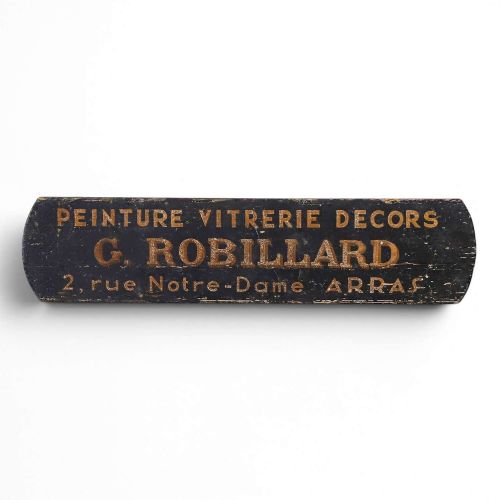


French Shop Sign
A French shop sign brings commercial history indoors, offering painted timber, sheet metal, and bold lettering designed to catch the eye of the passing Parisian public.
French Shop Sign
A French shop sign represents the commercial trades of the nineteenth and early twentieth centuries, functioning as outdoor identifiers for pharmacies, hat makers, opticians, and painters. The version most commonly encountered on this page takes the form of a hand-painted wooden board, a shaped sheet metal silhouette, or a sculptural trade display.
These objects span several distinct eras, appearing from the eighteenth century through to the Belle Époque and the early twentieth century. Trade signs often adopt whimsical or literal shapes, such as spectacles, gloves, sturgeon, or horses, denoting the specific wares sold within the establishment.
The aesthetic bridges commercial utility and French folk art, reflecting regional French provincial and industrial styles. Wall signs and advertising displays dominate the selection, utilising bold lettering and graphic symbols to communicate trade long before standardised branding.
Materials and construction methods
Makers constructed these pieces primarily from timber, solid wood, and sheet metal, frequently incorporating toleware, iron, cast iron, and paper. Painted surfaces and gold leaf provided the necessary visibility for outdoor street placement, applied directly to wooden boards or shaped metal armatures.
Traditional sign-writers utilised hand-painting techniques to render trade names, lettering, and pictorial advertisements directly onto wood or metal. Sculptural displays involved carved solid wood or beaten toleware, finished with layers of protective paint that now bear authentic weathered patinas.
A painted iron hat maker's display proudly reminds us of an era when proper headwear required an entire metal beaver.
Judging quality in trade displays
Quality rests upon the strength of the graphic design, the clarity of the original sign-writing, and the survival of untouched surface paint. Examples featuring intricate pictorial representations, such as fish, animals, or trade goods, demand greater skill than standard lettering alone.
The integrity of the material dictates value, with solid carved wood and heavy gauge toleware holding precedence over lighter substitute metals. Original surfaces bearing genuine layers of historic paint without modern overpainting define the finest specimens in this category.
The French Shop Sign Glossary
- Toleware
- Lacquered or enamelled sheet metal used for shaping into trade displays and three-dimensional objects. This material allowed makers to fashion lightweight silhouettes of items like gloves and bicorn hats.
- Gold leaf
- Beat gold applied to surfaces for lettering and decorative highlights. It provided brilliant reflection under gaslight and daylight on bustling nineteenth-century streets.
- Folk art
- Utilitarian items made by tradesmen or local artisans rather than academic sculptors. These pieces display charming irregularities and direct interpretations of everyday trade objects.
- Trade sign
- A functional exterior marker indicating the profession housed inside a building. They rely on recognizable symbols and clear lettering to inform illiterate or busy pedestrians.
- Belle Époque
- The period spanning the late nineteenth century to the First World War in France. This era produced ornate advertising displays and decorative commercial signage.
French Shop Sign: Frequently Asked Questions
What trades used these signs?
A wide variety of nineteenth and early twentieth-century merchants utilised these markers to advertise their services to the street. Common examples include pharmacies, opticians, hat makers, butchers, and painters.
Each trade often employed a specific shape or symbol to identify their shop, such as spectacles for an optician or a carved animal for a butcher.
How were exterior signs displayed?
Merchants mounted these boards and sculptural figures directly onto exterior walls, above shopfronts, or projected them perpendicularly onto the pavement. Their primary purpose was catching the attention of pedestrians and carriages moving along busy streets.
Today, interior placement requires sturdy wall fixings to support the considerable weight of solid timber boards and iron brackets.
How do I date a painted sign?
Dating relies heavily on the typography, the underlying material technology, and the style of the pictorial art. Pieces from the Belle Époque era feature distinct flowing lettering, whereas earlier eighteenth-century examples display more naive folk art characteristics.
The presence of original hand-mixed pigments and historic wear patterns also assists in confirming the period of manufacture.
Are these signs weatherproof?
While originally designed to withstand nineteenth-century outdoor conditions, surviving examples have spent decades weathering the elements. Current surfaces often exhibit stable flaking paint, rust, and patination that demand indoor environmental control.
Exposing fragile historic paint layers to modern damp or direct sunlight will accelerate deterioration.