


French Roll Top Desk
A french roll top desk combines concealed writing surfaces with cabinet-maker joinery, offering a practical workspace wrapped in period veneer.
French Roll Top Desk
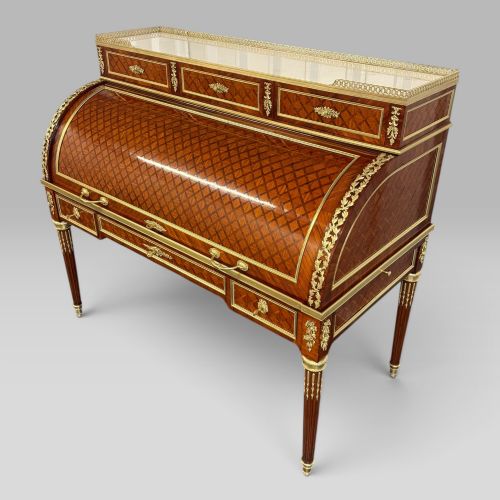
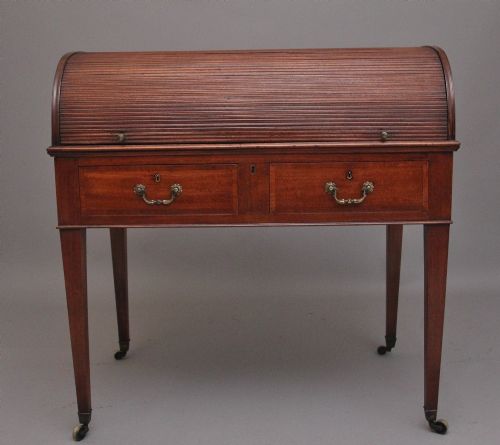
A french roll top desk is a writing cabinet featuring a curved wooden cylinder or tambour shutter that conceals the inner drawers and pigeonholes when closed. These pieces appear in forms ranging from full-sized cylinder desks to compact lady's writing cabinets and miniature versions.
The pieces on this page span several centuries and styles, dominated by nineteenth-century examples and revivals of Louis XVI and Louis XV aesthetics. Buyers encounter everything from substantial mahogany and kingwood bureaux to walnut baroque secretary desks and marble-topped writing cabinets.
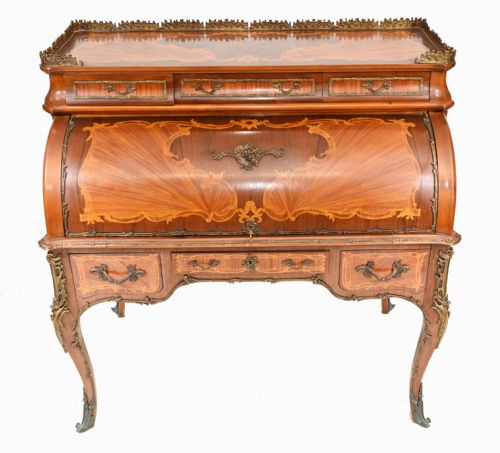
Many of these desks demonstrate continental European craftsmanship, utilising traditional cabinet-making methods alongside decorative veneers and metal mounts. The selection includes architecturalDirectoire pieces as well as ornate rococo revival cylinder desks with intricate parquetry and marquetry.
Materials and construction
Makers constructed these desks using sturdy timbers like mahogany, walnut, fruitwood, kingwood and rosewood as a structural base for decorative veneers. Parquetry and marquetry patterns required precise geometric cutting of contrasting woods to create detailed surface decoration across the cylinder fronts and writing surfaces.
Metal enrichment played a significant role in the finishing of these pieces, incorporating cast brass and ormolu mounts along drawer edges and corners. Marble tops frequently provided a durable writing surface or decorative counter-weight for upper cabinet sections.
Materials recorded across the available pieces include brass, ormolu, mahogany, kingwood, walnut, marble, fruitwood, and rosewood.
Judging quality and craftsmanship
Quality in a cylinder desk rests upon the smooth operation of the rolling mechanism and the precision of the underlying joinery. Superior examples maintain exact alignment in their tambour slats or solid wooden cylinders, allowing the shutter to glide without binding.
The fineness of the timber selection and the complexity of the parquetry or marquetry distinguish standard workshop production from finer cabinet-making. Original ormolu mounts with crisp chasing and well-preserved gilt surfaces elevate the standing of a desk compared to later replacement hardware.
The French Roll Top Desk Glossary
- Cylinder desk
- A writing desk with a quarter-cylinder shaped wooden cover that rolls back to reveal the writing surface and interior compartments. This mechanism protects the contents while offering a clean exterior profile when closed.
- Tambour
- A flexible shutter made from narrow vertical strips of wood glued to a fabric or leather backing. It slides along a tracked groove to open and close cabinets or desk roll tops.
- Parquetry
- Geometric mosaic woodwork formed by fitting small veneer blocks together into patterns like cubes or chequers. It creates durable decorative surfaces on desk lids and drawer fronts.
- Ormolu
- Gilt bronze ornamentation applied to furniture mounts, feet and handles. The technique involves coating cast bronze with a mercury and gold amalgam before heating.
French Roll Top Desk: Frequently Asked Questions
How do I maintain the roll top mechanism?
Keep the sliding tracks clean and free from dust using a soft brush. Apply a small amount of appropriate wax or lubricant to the runners only if the action becomes stiff.
Avoid placing these desks in rooms with extreme humidity changes, as wood expansion can cause the tambour slats or cylinder to stick in their grooves.
What is the difference between a cylinder desk and a tambour desk?
A cylinder desk uses a solid curved wooden panel that rotates on a pivot track to cover the desk interior. This solid shell provides a smooth, unbroken curve when closed.
A tambour desk uses multiple narrow wooden slats attached to a flexible backing fabric, allowing the cover to bend around tighter radiuses and slide into the desk body.
Where should I place a marble topped desk?
Position the desk away from direct sunlight and heat sources to protect the wooden veneers and prevent the timber from drying out and cracking. Ensure the floor is level so the heavy marble top and wooden frame distribute weight evenly.
Allow enough clearance behind and above the desk if the roll top mechanism extends slightly outward when opened.
How do I identify a Louis XVI style desk?
Look for straight tapered legs, often fluted, which replace the curving cabriole supports of earlier rococo furniture. The overall silhouette tends to be more rectilinear and classical, reflecting an eighteenth-century return to ancient architectural motifs.
Decoration often includes restrained parquetry, classical brass mounts, and symmetrical drawer arrangements rather than asymmetric scrollwork.