


French Religious Medal
A french religious medal brings devotional art into wearable form, offering tangible connection to early twentieth-century French craftsmanship.
French Religious Medal
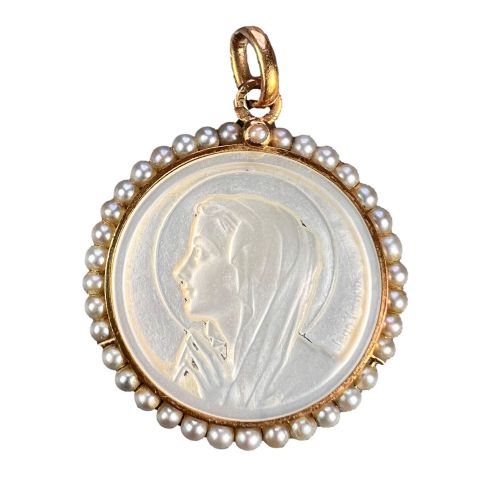
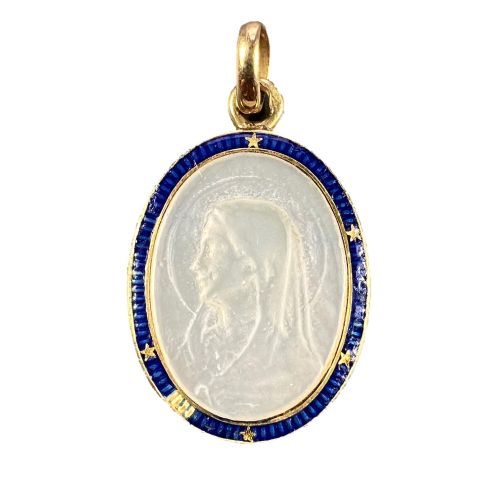
A french religious medal is a small devotional pendant worn close to the heart, featuring sacred figures such as the Virgin Mary, the Madonna and Child, Jesus Christ, or Saint John the Baptist. These pieces originate primarily from the early twentieth century, spanning the nineteen-tens, twenties, and thirties.
The forms appear most frequently as pendants, charms, and combined medal pendants. They reflect distinct aesthetic movements of their time, encompassing French antique, devotional, and Art Nouveau or Art Deco design vocabulary.
How They Were Made
Goldsmiths shaped these devotional objects using various tones of precious metal, predominantly eighteen-carat yellow gold alongside occasional eighteen-carat white gold. Artisans set delicate seed pearls and carved mother-of-pearl to enhance the sacred imagery.
French Religious Medal Retail Price Guide 2026
Typical asking prices for french religious medal among the pieces listed under this phrase on Sellingantiques today, from the lower quarter to the upper quarter. They describe what is for sale here now, not the wider market.
Listings feature items exclusively in eighteen-carat yellow and white gold, dated between nineteen-ten and nineteen-thirty.
What Varies in Quality
Excellence in these medals rests upon the precision of the goldsmith's hand and the clarity of the sculptural relief. Signed works by recognised medallists demonstrate superior artistry in the facial expressions of the figures and the crispness of the lettering.
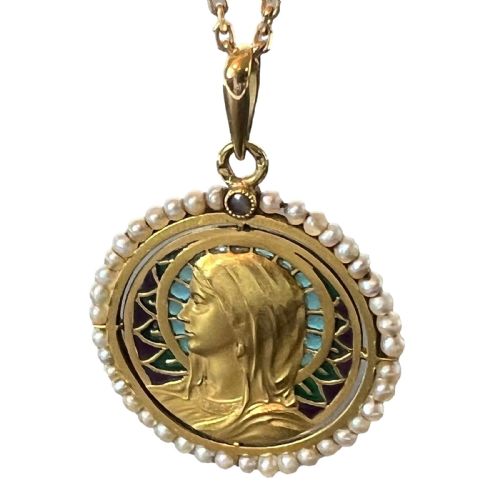
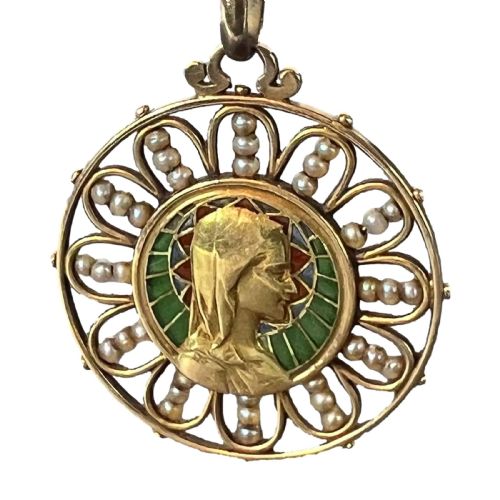
The integration of decorative elements like plique-a-jour enamel or seed pearls distinguishes finer examples from simpler stamped pieces. Preservation of the fragile enamel work and the sharpness of the original metal finish dictate the standing of an individual medal.
Monier·Emile Dropsy·Sellier·Arnault·Perriat·Tairac
The French Religious Medal Glossary
- Plique-a-jour
- An enamelling technique where the enamel is applied without a backing, allowing light to shine through the transparent or translucent coloured glass like a miniature stained-glass window.
- Vitreous Enamel
- A material made by fusing powdered glass to a metallic substrate at high temperatures, creating a smooth, durable, and brightly coloured surface.
- Seed Pearl
- Very small natural or cultured pearls, often used in closely set rows or delicate clusters to accent the borders and motifs of fine jewellery.
- Medallion
- A large medal, typically worn as a pendant or used for commemorative and devotional purposes rather than currency.
French Religious Medal: Frequently Asked Questions
What are french religious medals made of?
These devotional pieces are constructed primarily from eighteen-carat yellow gold and white gold. Artisans frequently incorporated seed pearls, mother-of-pearl, and vitreous enamel to embellish the sacred designs.
The combination of precious metal and decorative techniques gives each piece its distinctive weight and visual depth.
Who made these pendants?
Many medals are the work of specific French designers and medallists whose signatures or maker's marks appear on the metal. Notable artisans recorded on these pieces include Emile Dropsy, Monier, Sellier, Arnault, Perriat, and Tairac.
These artists brought traditional sculptural training to the creation of miniature devotional art.
How do I wear a french religious medal?
You can suspend the medal from a fine gold chain to wear it as a pendant, or attach it to a charm bracelet. Their modest size makes them suitable for daily wear either singly or layered with other small chains.
Care should be taken with enamelled or pearl-set examples to avoid impact against harder jewellery.
How are different periods told apart?
Pieces from the nineteen-tens often embrace flowing Art Nouveau curves and intricate plique-a-jour enamel work. Items from the nineteen-twenties and thirties transition towards cleaner lines influenced by Art Deco sensibilities.
Maker's marks and French hallmark stamps also provide guidance on the specific decade of manufacture.