


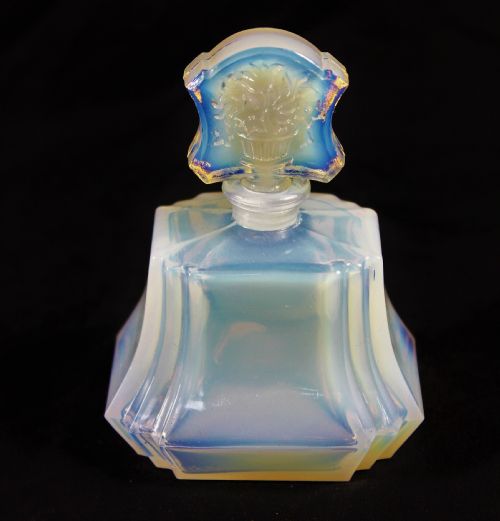


French Opalescent Vanity Bottle
These French opalescent vanity bottle pieces catch the light with milky blues and amber highlights, bringing early twentieth-century dressing tables alive.
French Opalescent Vanity Bottle
A french opalescent vanity bottle is a dressing table accessory designed to hold perfume, appearing in styles from the Art Nouveau and Art Deco periods. These vessels are formed from glass that shifts in tone from clear to milky white or pale blue depending on how the light strikes the surface. Most examples encountered here date from the nineteen tens up through the nineteen thirties.
The selection on this page centres primarily on pressed glass perfume bottles produced by established makers such as Rene Lalique and Sabino. Forms range from cylindrical bodies with moulded floral or insect stoppers to geometric Art Deco designs carrying signature marks. Each piece reflects the decorative priorities of French glassmakers working during the first half of the twentieth century.
How they were made
Makers utilised pressed glass techniques to shape molten material into intricate moulds depicting butterflies, geometric facets, and stylised flora. The characteristic opalescent effect was achieved by adding specific chemical agents to the glass batch, which scatter light and create a characteristic milky blue glow along the raised edges.
Details on these bottles often received secondary treatment, including frosted finishes or blue stained glass accents to emphasise the moulded relief. Stoppers were individually formed to fit specific bottle necks, sometimes taking the shape of insects or abstract motifs characteristic of Art Deco and Art Nouveau design.
Butterflies and geometric facets served as favourite excuses for French glassmakers to trap morning light inside a dressing table bottle.
What varies in quality
The distinction between standard production pieces and finer examples rests on the crispness of the mould and the depth of the opalescent effect. Superior pieces display sharp definition in modelled elements like butterflies or geometric facets, whereas lesser examples can exhibit softer contours where the press lost pressure.
The integration of colour and frost also dictates overall refinement, with better items showing a balanced interplay between translucent body and milky highlights. Signatures and maker marks add documentary weight, distinguishing standard commercial output from artist-designed workshop pieces.
Rene Lalique·Sabino
The French Opalescent Vanity Bottle Glossary
- Opalescent Glass
- Glass that diffuses light to create a milky, semi-translucent appearance with bluish or amber highlights along raised surfaces. This optical effect is achieved during the cooling process through specific chemical additives.
- Pressed Glass
- Glass formed by pressing molten material into a metal mould using a plunger to create detailed patterns. This technique allowed manufacturers to produce ornate decorative vessels efficiently.
- Frosted Glass
- Glass treated with acid or mechanical abrasion to create a matte, non-reflective surface texture. It contrasts sharply with polished or opalescent areas on decorative bottles.
- Art Deco
- A design style spanning the nineteen twenties and thirties characterised by symmetry, geometric lines, and streamlined forms. Perfume bottles from this era often feature stepped patterns and stylised motifs.
- Art Nouveau
- An artistic movement from the late nineteenth and early twentieth centuries inspired by natural forms, plant stems, and insect wings. Stoppers shaped like butterflies frequently draw from this aesthetic.
French Opalescent Vanity Bottle: Frequently Asked Questions
What is a french opalescent vanity bottle?
A french opalescent vanity bottle is a decorative glass container made in France during the early twentieth century to hold perfume on a dressing table. These pieces utilise specialised glass that scatters light to create milky blue and white tones.
Examples range from organic Art Nouveau designs featuring butterflies to geometric Art Deco vessels produced by prominent glassworks.
How do I date a glass perfume bottle?
Dating relies on stylistic markers such as the geometric lines of the Art Deco period or the natural curves typical of Art Nouveau design. The presence of specific maker signatures and the era of production also help establish the decade.
Most surviving pieces originate from the nineteen tens, twenties, and thirties when decorative vanity sets reached their peak popularity in France.
What causes the opalescent effect?
The opalescent effect results from specific chemical compounds added to the molten glass batch that cause light scattering. When light hits the glass, the thicker or raised areas appear milky white or pale blue while thinner sections remain clear.
This optical phenomenon gives moulded details and frosted motifs their characteristic glow.
Were these bottles meant for daily use?
These bottles were originally created to sit on boudoir dressing tables as both functional perfume containers and decorative objects. Their delicate stoppers and intricate moulded surfaces meant they were treated as luxury accessories.
Today, they are collected and displayed as examples of early twentieth-century decorative glass art.