


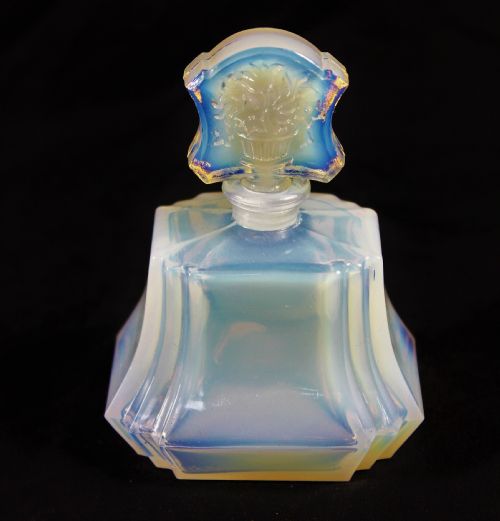

Blue Opalescent Scent Bottle
A blue opalescent scent bottle catches the light with milky, shifting hues that define the height of twentieth-century vanity design.
Blue Opalescent Scent Bottle
When you search for a blue opalescent scent bottle, you are looking at small glass vessels designed to hold perfume, characterised by a distinctive milky blue luminescence that shifts in the light. The pieces gathered here belong primarily to the early decades of the twentieth century, bridging the late Art Nouveau aesthetic and the clean geometry of Art Deco.
You are most likely to meet French examples on this page, representing the output of renowned glasshouses from the nineteen-tens through to the nineteen-thirties. These range from moulded botanical motifs to stylised insect stoppers, each designed to sit upon a dressing table.
The forms vary from cylindrical bodies to flattened flasks, frequently paired with matching stoppers that complete the sculptural silhouette of the bottle.
How they were made
These bottles are formed primarily from pressed and frosted glass, utilising specialised cooling and chemical agents within the molten batch to achieve the characteristic opalescent effect. As the glass cools, the light refraction creates the milky blue glow that defines the surface.
Moulds shape the intricate surface details, such as butterflies or ribbed panels, which are then finished with frosting to contrast against the translucent blue depths.
Listings span three distinct decades: nineteen-ten, nineteen-twenty, and nineteen-thirty, capturing the shift from Art Nouveau curves to Art Deco geometry.
What varies in quality
The distinction between standard production and exceptional work lies in the crispness of the moulded detail and the depth of the opalescence. Finer examples display a vivid blue fire within the milky areas, whereas lesser pieces appear flat and uniform in tone.
The integration of the stopper with the body, alongside clear signatures or moulded foundry marks, separates mass-market output from the premier French studio productions.
Rene Lalique·Sabino
The Blue Opalescent Scent Bottle Glossary
- Opalescent glass
- Glass that exhibits a milky, bluish turbidity when viewed by reflected light, contrasting with a warm yellowish tone by transmitted light. This optical property results from the controlled precipitation of particles during cooling.
- Art Deco
- A design style of the nineteen-twenties and nineteen-thirties characterised by stylised motifs, symmetrical geometric patterns, and streamlined forms. It succeeded the more organic curves of Art Nouveau.
- Pressed glass
- Glass shaped by pressing molten metal into a metal mould using a plunger. This technique allowed for intricate surface patterns to be produced with consistency.
- Frosted glass
- Glass rendered translucent by the acidification or sandblasting of its surface. This finish diffuses light and enhances the sculptural qualities of the vessel.
Blue Opalescent Scent Bottle: Frequently Asked Questions
How do I date a scent bottle?
Dating relies heavily on stylistic markers, such as the transition from organic Art Nouveau plant forms to geometric Art Deco shapes. Maker signatures and registry marks also provide a reliable guide to the decade of manufacture.
Techniques in glass pressing and the chemical formulation of opalescence shifted across the early twentieth century, offering further clues to the period of origin.
Are stoppers usually original?
Many bottles retain their matching original stoppers, which were often moulded as an integral part of the overall design, such as butterflies or stylised caps. Because stoppers are vulnerable to loss and damage over time, matching replacements do occur.
Examining the wear around the neck and the base of the stopper helps determine whether they have spent their lives together.
Why do they glow blue?
The blue effect is an optical phenomenon caused by the scattering of light off microscopic particles suspended within the glass matrix. Different cooling rates during the manufacturing process alter the intensity of this luminescence.
This specific chemical recipe was mastered by French glassmakers in the early twentieth century to mimic natural opals.
Where were they made?
The vast majority of these decorative bottles originated in France, produced by specialised glassworks and individual artisans during the interwar period. French ateliers led the innovation in opalescent and frosted glass techniques.
These pieces were exported internationally as luxury vanity items for fashionable dressing tables.