
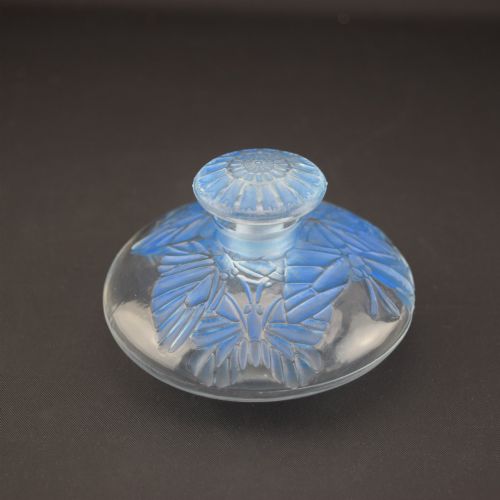


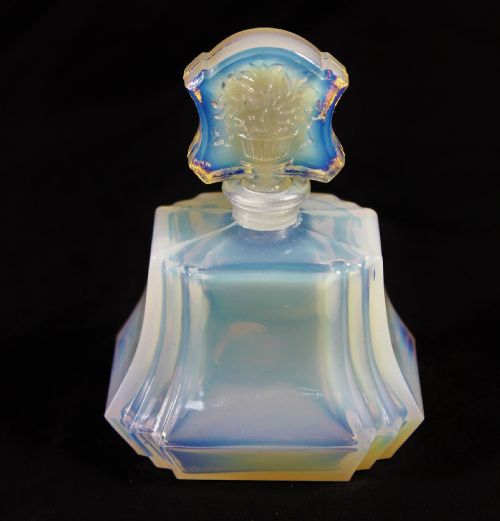


Opalescent Glass Scent Bottle
These opalescent glass scent bottle examples catch the light with milky blue and amber shifts, offering a tactile piece of dressing table history.
Identifying an opalescent glass scent bottle
An opalescent glass scent bottle combines utilitarian function with shifting translucent colours that catch the light from every angle. When you search for this phrase, you find small dressing table vessels designed to hold perfume, ranging from Victorian silver-mounted cylinders to French modernist designs. These pieces date across several decades, capturing the changing tastes of collectors.
The selections here span the Victorian era, the Art Nouveau period, and the Art Deco movement. You encounter Victorian silver-topped vessels alongside French moulded pieces from the interwar years. Each era brings distinct shapes and mounting styles to the tabletop.
Moulded glass forms dominate the later decades, whilst earlier examples often feature contrasting collars and hinged caps in precious metal. These perfume bottles serve as decorative containers that transform simple glass into an optical display. They represent miniature sculpture intended for daily use.
Materials and construction methods
Makers utilised specialised glass recipes containing bone ash or chemical agents to achieve the characteristic milky blue milk-glass effect that glows when illuminated from the side. Workers shaped these materials using pressed glass techniques or blew them into moulds to create intricate surface relief. Some pieces incorporated blue stained glass or vaseline glass to enhance the optical depth.
Metal mounts in sterling silver provide secure closures for the volatile perfumes stored within. Artisans fitted hinged caps and collars directly to the glass necks, often incorporating internal stoppers to prevent evaporation. The union of metalwork and glass requires precise fitting to ensure durability.
Retail Price Guide 2026
Typical UK retail prices for opalescent glass scent bottle, calculated from the Sellingantiques database of over a million retail prices indexed since 2003. This retail price guide relies exclusively on Sellingantiques data; no external sources or auction records are used, so the figures do not describe the wider market.
Listings feature opalescent glass scent bottle examples from the Victorian era through to the Art Deco period, incorporating sterling silver and frosted glass.
Evaluating quality and execution
The distinction between standard production and superior work lies in the crispness of the moulded relief and the intensity of the opalescent fire within the glass. Finer pieces display sharp detailing across motifs like butterflies or geometric facets, whilst lesser examples exhibit soft contours and muted colour play. The weight and clarity of the metal mounts also indicate the level of craftsmanship invested in the object.
Design coherence separates notable studio output from commercial glassware. When the glass body and the metal cap form a unified aesthetic, the piece succeeds as a cohesive decorative object. The distribution of the milky opalescence across the body dictates the visual success of the piece.
Rene Lalique·Sabino·Salviati
The Opalescent Glass Scent Bottle Glossary
- Opalescent Glass
- Glass that diffuses light so that it appears milky or bluish when viewed by transmitted light and yellowish or brownish by reflected light. This optical property creates the characteristic glow seen on these dressing table items.
- Vaseline Glass
- Pressed or blown glass containing uranium dioxide, which produces a distinct yellowish-green hue and glows under ultraviolet light. It appears frequently in nineteenth-century decorative pieces.
- Pressed Glass
- Glass formed by pressing molten material into a metal mould with a plunger. This mechanical process allows for complex surface patterns and repetitive production.
- Art Deco
- The design style of the 1920s and 1930s characterised by streamlined geometric shapes and stylised motifs. It strongly influences the French opalescent bottles from this era.
- Art Nouveau
- The decorative arts movement of the late nineteenth and early twentieth centuries inspired by natural forms and flowing organic lines. It informs the butterfly and plant motifs found on earlier perfume containers.
Frequently Asked Questions
What is an opalescent glass scent bottle?
These items are small personal containers designed to hold perfume, made from translucent glass that scatters light to create milky blue or amber highlights. They sit upon dressing tables as both functional accessories and decorative cabinet pieces.
Craftsmen produced them in various forms, incorporating metal collars and stoppers to preserve precious fragrances. Collectors prize them for their distinct optical properties and the miniature artistry displayed on their surfaces.
How do I date an opalescent glass scent bottle?
Dating relies on stylistic markers such as the geometric lines of Art Deco or the organic curves typical of Art Nouveau. Examining the metal mounts, such as Victorian sterling silver collars, also helps establish the era of manufacture.
Signatures or moulded factory marks on the base provide definitive attribution to specific glassworks. Comparing the moulding technique against known periods narrows down the decade of production.
How were these perfume bottles used?
Victorian and twentieth-century owners filled these vessels with liquid scents for daily grooming at the dressing table. The secure metal caps and stoppers prevented the fragrance from evaporating into the air.
They also functioned as travel accessories for wealthy patrons who required portable scent containers. Displaying them on mirrored trays added to the visual glamour of a domestic interior.
How do I care for my opalescent glass?
Clean these delicate items gently using lukewarm water and a mild detergent, avoiding harsh scrubbing that might damage the surface. Keep metal mounts dry to prevent tarnish and corrosion from affecting the surrounding glass.
Store them securely away from shelf edges where accidental knocks might chip the rims or stoppers. Handle them by the body rather than the fragile decorative protrusions.