


French Nested Tables
French nested tables are space-saving stacking sets designed for entertaining, offering multiple surfaces that tuck neatly away when not in use.
French Nested Tables
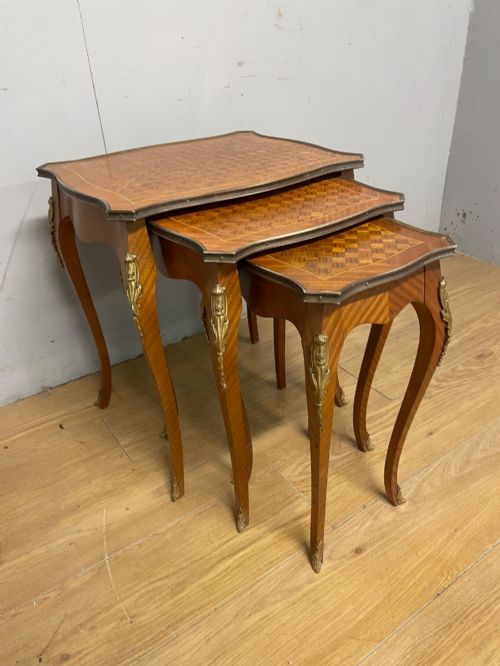
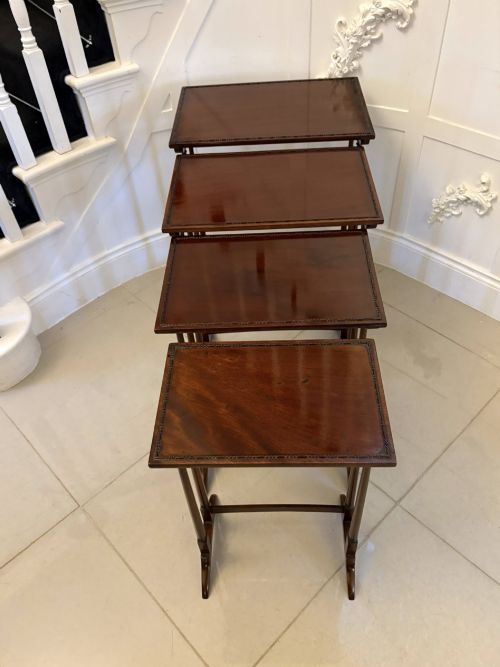
French nested tables comprise sets of three or four graduated occasional tables designed to slide one beneath another. When investigating french nested tables, buyers encounter forms ranging from Edwardian mahogany quartetto sets to early twentieth-century examples in walnut and kingwood.
The selection includes pieces spanning the nineteenth century through to the nineteen forties, embracing Art Nouveau, Art Deco, and French provincial aesthetics. Workshops utilised various configurations, creating sets that function as lamp, coffee, or wine tables while occupying minimal floor space.
The physical form relies on precise sizing so that each smaller table fits entirely under the one preceding it in the sequence. These suites appear in both sets of three and sets of four, finished with painted floral details, brass mounts, or parquetry surfaces.
How they were made
Makers constructed these tables using timber frames of mahogany, walnut, rosewood, and kingwood, frequently applying wood veneer and parquetry geometric patterns to the top surfaces. Brass inlay, ormolu mounts, and painted floral decoration provide surface embellishment across the periods represented.
Techniques varied from floral painting directly onto timber to intricate parquetry layouts incorporating boxwood and diverse specimen woods. Workshops employed glazing and protective finishes over delicate veneers to preserve the decorative surfaces during daily use.
Materials recorded across the selection include brass, walnut, glass, mahogany, paint, boxwood, rosewood, and decorative wood veneer.
What varies in quality
Quality in these stacking sets rests upon the precision of the joinery and how smoothly the smaller tables slide into the primary frame without binding. Superior examples display consistent timber selection and refined parquetry or inlay work across every tier.
Artisanal signature marks and identifiable workshop attribution elevate certain pieces significantly above standard commercial production. The integration of bronze ormolu mounts and specialist brass work also distinguishes finer studio output from simpler provincial pieces.
Émile Gallé·Maison Baguès·E.Daligny
The French Nested Tables Glossary
- Quartetto
- A matched set of four stacking tables designed to nest together. The term originates from nineteenth-century nomenclature for four-part nesting furniture.
- Parquetry
- Geometric mosaic woodwork formed by fitting small wooden veneers together in patterns. This technique frequently decorates the table tops in this category.
- Ormolu
- Gilt-bronze mounts applied as decorative ornaments to furniture frames. It provides metallic contrast against dark timbers like mahogany and kingwood.
- Specimen wood
- Various decorative timbers selected for their contrasting natural grain and colour. Collectors prize sets utilising multiple distinct woods for pictorial or geometric table tops.
- Art Nouveau
- A decorative style characterised by organic, flowing plant-inspired lines. Pieces from this movement often feature asymmetrical floral marquetry.
French Nested Tables: Frequently Asked Questions
How were French nested tables used historically?
These tables served as versatile occasional furniture in nineteenth and twentieth-century salons and drawing rooms. Hostesses deployed the individual tiers around a room to hold drinks, books, or lamps when guests arrived.
Once the gathering concluded, the smaller tables slid back beneath the largest one to clear the floor space. This practical stacking design made them indispensable for entertaining in fashionable homes.
What is the difference between sets of three and four?
Sets of four tables are frequently termed quartetto suites and offer a greater height range across the graduated tiers. They require more complex carpentry to ensure all four pieces clear each other smoothly.
Sets of three provide a slightly more compact footprint while maintaining adequate surface area for daily use. Both configurations appear across Edwardian and twentieth-century French styles.
How do I identify Art Nouveau nested tables?
Art Nouveau examples display characteristic whiplash lines, asymmetrical floral marquetry, and naturalistic motifs inspired by plant forms. Makers such as Émile Gallé utilised diverse specimen woods to create pictorial table tops.
These pieces typically date from the turn of the twentieth century and feature handcrafted joinery that prioritises organic curves over rigid geometry.
Are these tables suitable for modern daily use?
The sturdy timber construction and practical stacking format make these tables well-suited as side, coffee, or lamp tables in contemporary interiors. Their compact dimensions allow them to fit easily beside sofas or chairs.
Care should be taken with antique polished surfaces and delicate parquetry when placing hot drinks or unProtected items directly onto the wood.