



French Neoclassical Bedside Tables
French neoclassical bedside tables bring classical restraint and refined metalwork to a room, offering both surface space and storage beside a bed.
French Neoclassical Bedside Tables
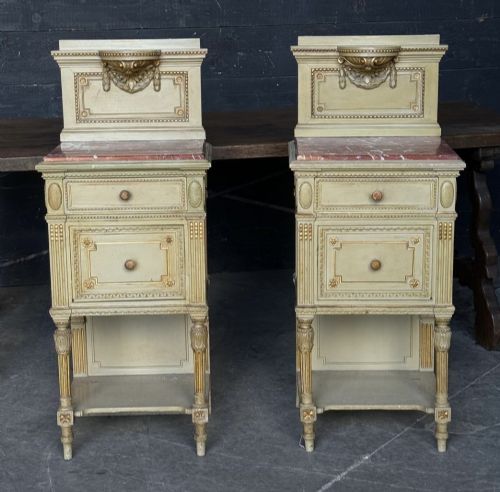
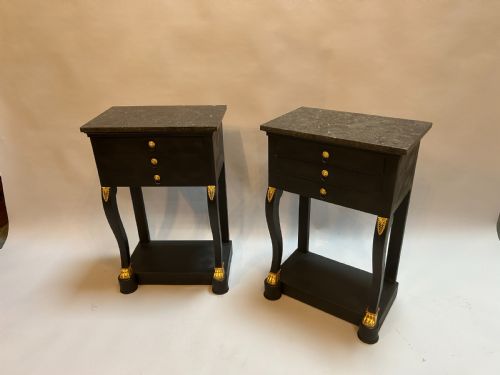
Cabinets typically present compact footprints with enclosed storage, while open side tables and demi-lune consoles provide display surfaces. These items combine practical bedside utility with the architectural proportions characteristic of Louis XVI and Empire styling.
Materials and construction methods
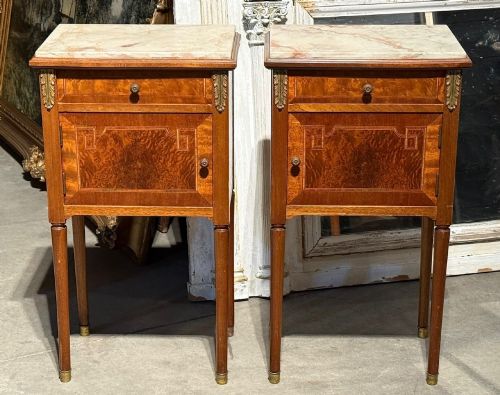
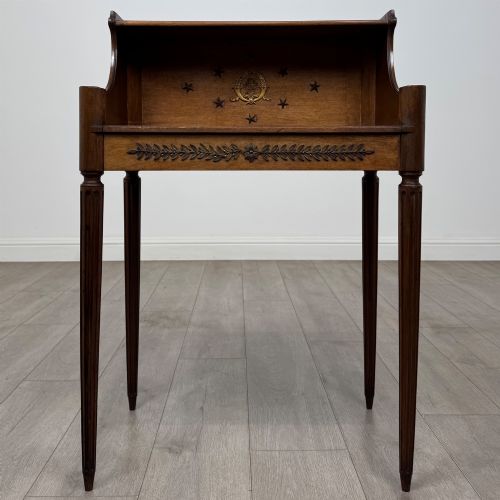
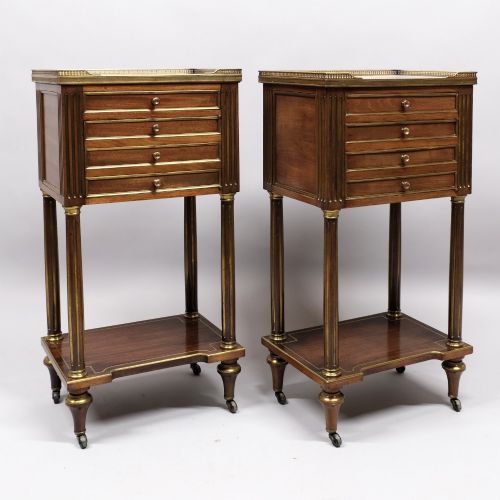
Cabinet makers utilised mahogany as a primary timber foundation, frequently pairing the wood with marble tops and cast metal mounts. Ormolu and gilt bronze provide decorative highlights along corners, friezes, and feet.
Metalwork relies on precise casting and gilding techniques to achieve crisp classical motifs. Marble surfaces, including rouge and Siena varieties, are cut and polished to fit the rectilinear and curved contours of the furniture.
Listings span the nineteenth and early twentieth centuries, featuring mahogany cabinets mounted with ormolu and topped with marble.
Distinctions in craftsmanship
The refinement of the ormolu or gilt bronze mounts dictates the visual success of a piece, separating sharp, hand-chiseled metalwork from softer secondary castings. The quality of the underlying mahogany and the precise fit of the marble insert further mark out superior examples.
Proportion and structural integrity define the maker's success, particularly where curved components like demi-lune fronts or turned columns meet straight architectural lines.
Dugourc
The French Neoclassical Bedside Tables Glossary
- Ormolu
- Gilded bronze applied as a decorative mount on furniture. The technique involves mercury gilding to bond gold to a bronze base.
- Louis XVI Style
- A neoclassical design movement reviving eighteenth-century French symmetry, straight lines, and classical antiquity. It favours restraint over the preceding rococo exuberance.
- Empire
- A nineteenth-century design style inspired by the classical architecture of Greece and Rome. It employs heavier proportions and martial motifs.
- Demi-lune
- A half-moon shape used for console tables and bedside pieces designed to sit flat against a wall.
- Siena marble
- A yellow decorative marble with dark veining originating from Italy. It appears frequently in high-status neoclassical mounts.
French Neoclassical Bedside Tables: Frequently Asked Questions
What defines French neoclassical bedside tables?
These pieces display architectural symmetry, straight tapered legs, and classical decorative motifs such as acanthus leaves and fluting. They draw directly upon the design vocabulary of eighteenth-century France.
Cabinet versions offer enclosed storage with marble tops, while open formats serve as compact side tables for a bedroom.
How do I identify Louis XVI style pieces?
Louis XVI style items rely on rectilinear geometry, unlike the curved asymmetry of earlier rococo furniture. Look for fluted column supports and restrained bronze or ormolu mounts.
Many examples date from nineteenth-century revival periods while faithfully adhering to these earlier proportions.
Are these tables suitable for modern bedrooms?
Their compact dimensions allow them to function effectively beside modern bed frames while supplying a durable marble surface for lighting and personal items. Enclosed cupboards conceal small bedside essentials.
The combination of warm mahogany and polished stone integrates easily into contemporary interior schemes.
What materials are typical for these tables?
Solid mahogany provides the structural carcase for most cabinet variants, paired frequently with imported marble tops in shades of white, rouge, or yellow. Gilded bronze and ormolu supply the decorative mounts.
Brass accents and painted finishes also appear across the nineteenth and early twentieth-century examples.