


Gilt Mounted Nightstands
These gilt mounted nightstands bring French revival elegance and practical bedside storage into a room.
Gilt Mounted Nightstands
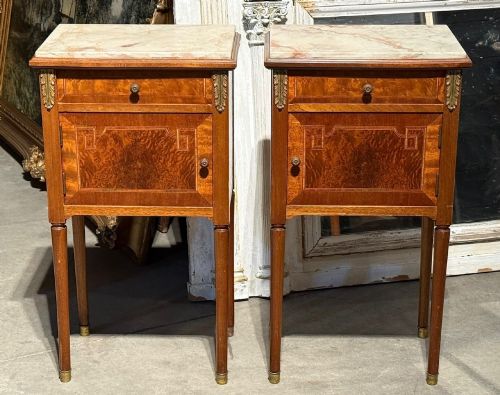
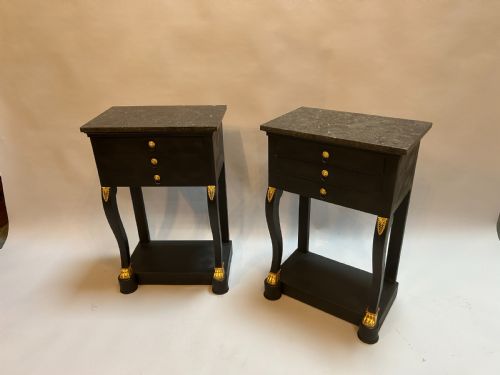
Gilt mounted nightstands are compact bedroom and occasional tables that draw on nineteenth century French design vocabularies. Buyers seeking these pieces encounter bedside cabinets, commodes, and lamp tables associated with Louis XV, Louis XVI, and Empire styles. The examples presented here span the nineteenth century and the early twentieth century.
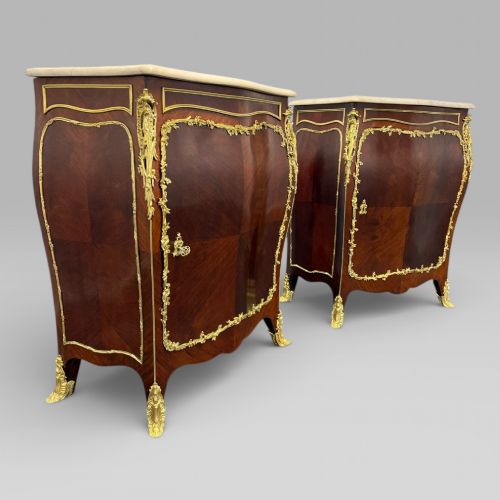
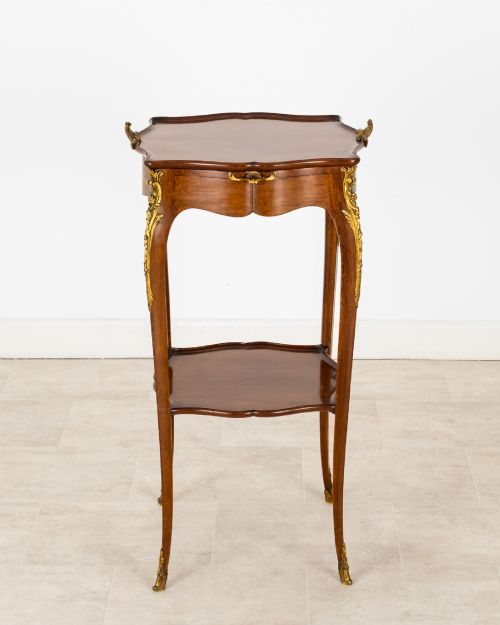
The commonest forms on this page are pairs of bedside cabinets and lamp tables constructed in kingwood, mahogany, walnut, or rosewood. Many pieces incorporate marble tops and elaborate gilt metal mounts alongside marquetry inlay or bombe silhouettes. Such furniture functions effectively as functional bedside storage or as decorative accent tables in reception rooms.
Materials and Construction
Cabinet makers utilised dense hardwoods such as kingwood, mahogany, walnut, and rosewood as foundational carcases for these tables and cabinets. Veneers were frequently arranged in geometric marquetry patterns across the surfaces to create visual depth and texture. Marble slabs, including breche d'alep varieties, were fitted to the tops of commodes and bedside cabinets for durable utility.
Ornate cast ormolu and gilt metal mounts were applied to corners, aprons, and legs to accentuate the French revival aesthetic. These cast bronze or brass elements highlight the structural lines of side tables, étagères, and cabinets. The integration of fine joinery with decorative metalwork defines the construction standards of the period.
Several bedside cabinets arrive ready for midnight reading duties, quietly holding up lamps while sporting full nineteenth century regalia.
Assessing Quality
Quality in these pieces rests upon the crispness of the gilt metal mounts and the precision of the underlying timber veneers. Finer specimens display deeply chased ormolu details and carefully matched kingwood or marquetry grain patterns across curved bombe surfaces. Lesser examples often feature simpler brass fittings and plainer timber construction without elaborate inlay.
The integration of heavy marble tops and structurally sound carcases further separates standard production from workshop pieces attributed to known makers. Superior items maintain balanced proportions and harmonious mounts that complement the chosen wood veneer. Attention to interior drawer construction and original hardware finish indicates higher atelier standards.
E. Kahn·François Linke
The Gilt Mounted Nightstands Glossary
- Ormolu
- Gilded bronze used for decorative mounts on furniture. It provides a bright gold appearance that highlights structural details.
- Bombe
- An outward swelling contour seen on the sides of commodes and cabinets. This curved form requires advanced veneer shaping.
- Marquetry
- Inlaid wood patterns arranged to form decorative motifs on furniture surfaces. Craftsmen use contrasting timbers to achieve this effect.
- Breche d'alep
- A type of quarried marble with a brecciated pattern featuring multi-coloured fragments. It frequently tops French commodes and cabinets.
- Étagere
- An open tiered piece of furniture used for displaying small objects. These light side stands often feature multiple shelves.
Gilt Mounted Nightstands: Frequently Asked Questions
How do I spot Louis XV style?
Louis XV style pieces are characterised by asymmetrical curves, cabriole legs, and naturalistic scrollwork. The overall silhouette tends to be flowing rather than straight-lined.
These designs often incorporate floral marquetry and delicate ormolu mounts that trace the organic contours of the timber carcase.
Are these nightstands purely decorative?
While highly decorative, these cabinets and tables were built for functional bedside or salon use. Many feature enclosed cupboards or drawers for storage.
Fitted marble tops also provided durable surfaces for holding lamps and personal items in nineteenth century bedrooms.
How do I care for marble tops?
Marble tops require simple dusting and prompt wiping of any liquid spills to prevent staining. Acidic substances can etch the polished stone surface over time.
Using coasters and placing felt pads under heavy objects will protect both the marble and the underlying timber frame.
What is the difference between empire and louis style?
Empire style draws inspiration from ancient Roman, Greek, and Egyptian motifs, favouring symmetry and military emblems. The lines are generally heavier and more monumental than earlier French periods.
In contrast, Louis styles lean towards lighter proportions, curved cabriole legs, and playful rococo or neoclassical ornamentation.