






French Marquetry Console Desk
These french marquetry console desk pieces combine rich cabinetwork with ornate mounts, bringing continental elegance to a room.
French Marquetry Console Desk
A french marquetry console desk brings together decorative wood veneers and functional writing surfaces, often taking the form of centre tables, side tables, and writing desks. These pieces originate primarily from the nineteenth century, spanning periods such as the Victorian era, Napoleon III, and the early twentieth century.
Makers and workshops working in the Louis XV and Louis XVI styles produced these tables using intricate floral and geometric inlays. Buyers commonly encounter designs influenced by makers like Millet and Francois Linke, reflecting revivalist tastes of the period.
How they were made
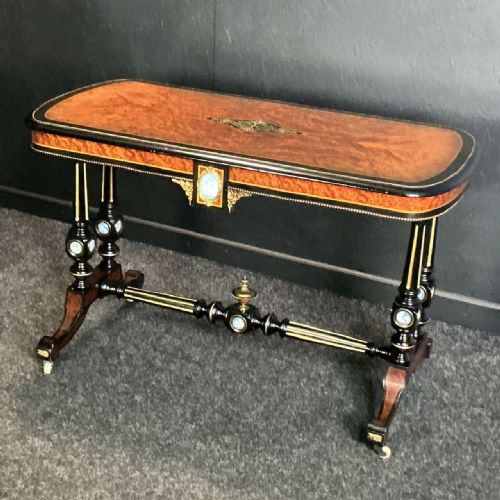
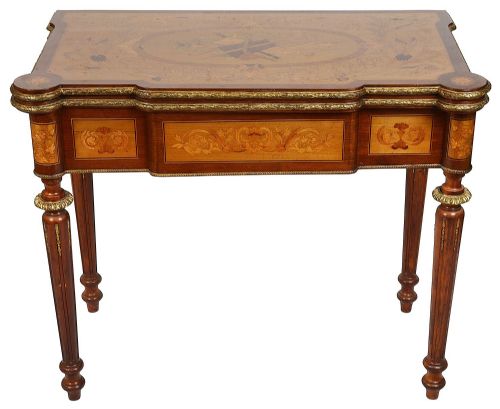
Cabinetmakers constructed these pieces using a carcase of woods such as walnut, mahogany, rosewood, and kingwood, upon which detailed marquetry and parquetry veneers were applied. Floral patterns and geometric arrangements required precise hand-cutting of diverse timber species to achieve seamless surface designs.
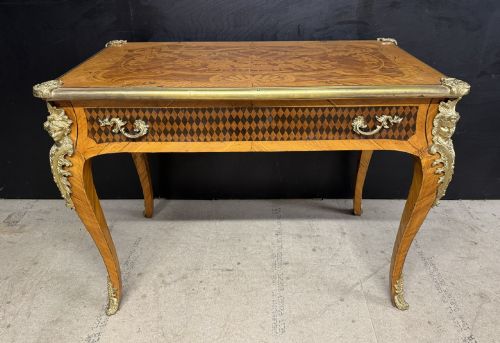
Gilt bronze and ormolu mounts were cast and chased to embellish the edges, corners, and legs, while brass inlays appeared in Boulle work interpretations. These metal elements were fastened to the wooden structures to highlight the curves of the revival styles.
Listings feature pieces spanning the nineteenth century up to 1920, incorporating kingwood, walnut, rosewood, and mahogany.
What varies in quality
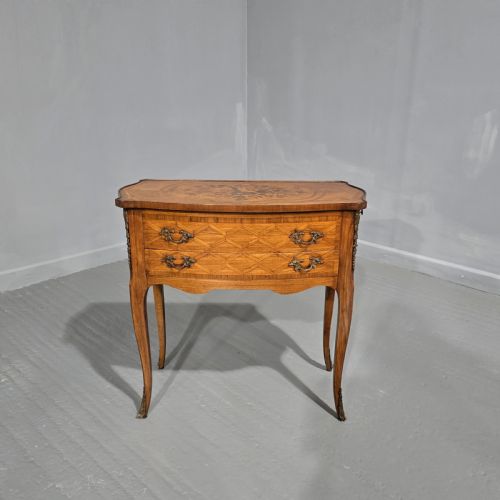
The sophistication of the marquetry design and the choice of underlying timber determine the standard of a piece. Finer examples display meticulously shaded woods forming complex floral sprays, whereas simpler versions rely on basic geometric parquetry patterns.
The weight, crispness, and finishing of the ormolu mounts separate standard production from exceptional craftsmanship. Well-chased bronze mounts integrate harmoniously with the wood veneers, showing sharp detail in the cast ornament.
Millet·Francois Linke
The French Marquetry Console Desk Glossary
- Marquetry
- Decorative veneer work forming pictures or patterns using various woods. Craftsmen cut thin slices of timber to fit together within a prepared ground.
- Ormolu
- Gilt bronze ornamentation applied to furniture. This gilded metal finish was cast and chased by hand to create rich highlights.
- Boulle
- A style of marquetry using tortoiseshell and brass inlay. Named after a French cabinetmaker, it defines contrasting metallic and dark panels.
- Parquetry
- Geometric wood inlay patterns such as cubes or chequers. It creates a structured mosaic effect across table tops and panels.
- Bureau Plat
- A flat-topped freestanding writing desk. These tables feature a finished back and typically incorporate drawers along the frieze.
French Marquetry Console Desk: Frequently Asked Questions
How do I use a console desk?
These tables function well as writing surfaces or decorative display pieces in reception rooms. Their finished backs allow them to stand freestanding in the middle of a room.
Position them against a wall or beneath a mirror to showcase the detailed marquetry tops and ormolu mounts.
How do I care for wood veneers?
Keep these pieces away from direct sunlight and steady heat sources to prevent the timber from drying out. Consistent indoor humidity protects both the delicate veneers and the underlying carcase.
Dust gently with a soft dry cloth and avoid harsh chemical polishes that can damage the French polish surface.
What is the difference between parquetry and marquetry?
Parquetry uses geometric shapes such as cubes, diamonds, or squares to create repeating patterns across a surface. It relies on architectural symmetry and regular angles.
Marquetry employs pictorial designs, often depicting floral sprays or natural scenes using varied timber species and grain directions.