
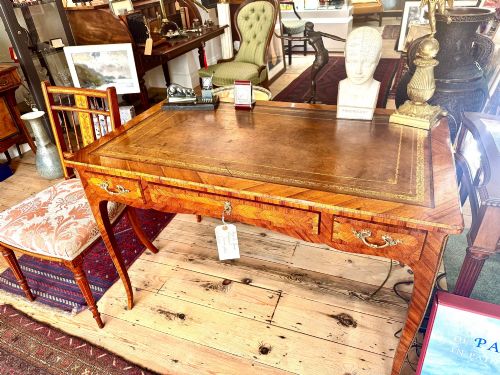


French Flat Top Desk
A french flat top desk is an exemplary writing table designed for central room placement, offering refined elegance and practical writing space.
French Flat Top Desk
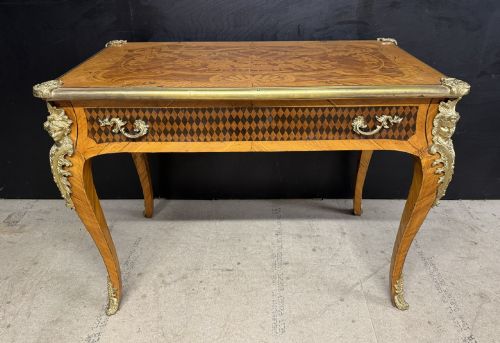
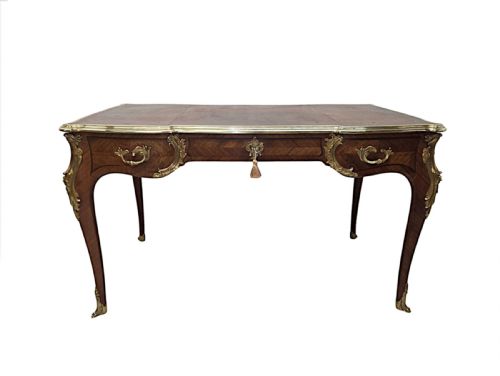
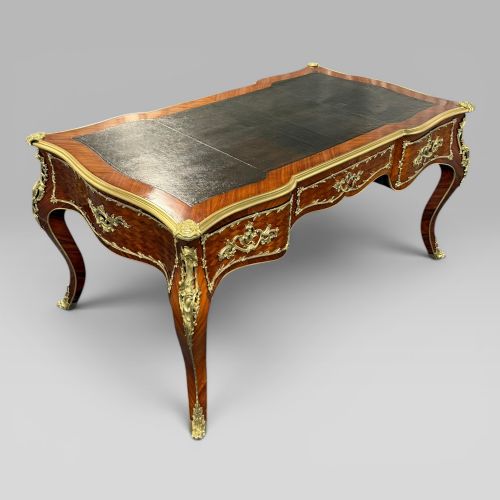
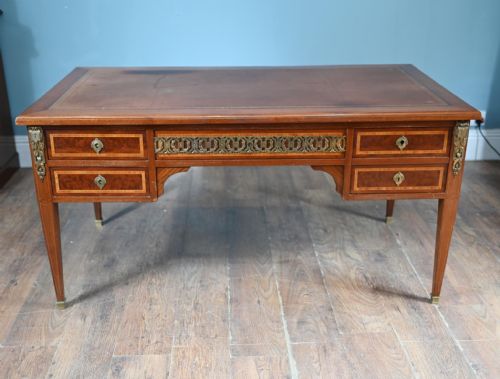
When you search for a french flat top desk, you encounter pieces designed primarily as free-standing writing tables rather than traditional wall-facing desks. These tables typically feature a rectangular top lined with leather, supported by cabriole or tapered legs.
The pieces listed here span the nineteenth century up to nineteen forty, with nineteenth-century examples dominating the selection. You will find forms drawing heavily upon Louis XV style, Louis XVI style, and Directoire aesthetic vocabularies.
Makers and workshops utilised specific period revivals, incorporating either curved Rococo outlines or the straighter, neoclassical proportions associated with the Directoire and Louis XVI periods. Most examples function as grand centre tables for studies and libraries.
Materials and construction
Cabinetmakers constructed these desks using solid hardwoods like mahogany and overlaid them with decorative veneers such as kingwood and tulipwood. Marquetry and parquetry patterns demonstrate meticulous geometric or floral arrangements across the wooden surfaces.
Ormolu and gilt bronze mounts embellish the corners, legs, and drawer edges, fastened securely to highlight the structural lines. Leather writing inserts, often tooled with gold leaf, provide a durable and contrasting surface for correspondence.
French Flat Top Desk Retail Price Guide 2026
Typical asking prices for french flat top desk among the pieces listed under this phrase on Sellingantiques today, from the lower quarter to the upper quarter. They describe what is for sale here now, not the wider market.
Several desks include secret drawers hidden behind carved frieze mouldings for storing private correspondence.
Distinguishing fine craftsmanship
Quality reveals itself in the precision of the veneer work and the crispness of the gilt bronze mounts. Finer examples display hand-chased ormolu details where the metalwork is sharply defined rather than cast simply and left smooth.
The timber selection also dictates the grade of the piece, with rich kingwood parquetry and intricate marquetry representing higher workshop standards. Internal drawer construction using dovetailed joints and secondary woods indicates careful, traditional assembly.
Henry Dasson
The French Flat Top Desk Glossary
- Bureau plat
- A freestanding writing table, typically with drawers along the frieze and a leather-lined top. This term is synonymous with the french flat top desk.
- Ormolu
- Gilded bronze mounts applied to furniture for decorative accent and edge protection. The technique involves applying a gold amalgam to heated bronze.
- Kingwood
- A dense, richly figured Brazilian timber utilised extensively for high-end French veneer work. It displays striking dark and light brown grain contrasts.
- Parquetry
- Geometric wood-mosaic work used to create repeating patterns on furniture surfaces. Craftsmen arrange small veneer tiles with exact precision.
- Marquetry
- Inlaid woodwork forming pictorial or floral designs using various coloured veneers. It distinguishes elaborate cabinetwork from simple veneered pieces.
French Flat Top Desk: Frequently Asked Questions
How do I date a French desk?
Dating relies on examining the timber species, construction methods, and stylistic revival cues. Nineteenth-century pieces frequently emulate earlier reigns such as Louis XV or Louis XVI.
Hardware styles, secondary woods inside the drawers, and the sharpness of the ormolu mounts provide further clues to chronological origin. Machine-cut dovetails indicate a later nineteenth or twentieth-century date.
Where should I place it?
These desks are designed as centrepieces, making them ideal for the middle of a study, library, or large living space. Because the back is finished with the same care as the front, they look correct viewed from any angle.
Ensure adequate clearance around the table so the cabriole or tapered legs and gilt bronze mounts remain visible. Pairing the desk with a low, open-backed chair preserves the proportions.
How do I care for leather?
The leather writing surface benefits from gentle dusting and occasional treatment with appropriate leather dressings to prevent cracking. Avoid placing hot cups or moisture directly onto the leather insert.
Keep the desk away from direct sunlight and radiators to protect both the leather and the underlying wood veneers from drying out.