

French Mahogany Writing Desk
A french mahogany writing desk brings refined continental utility to a study, uniting rich timber with classical brass and leather fittings.
French Mahogany Writing Desk
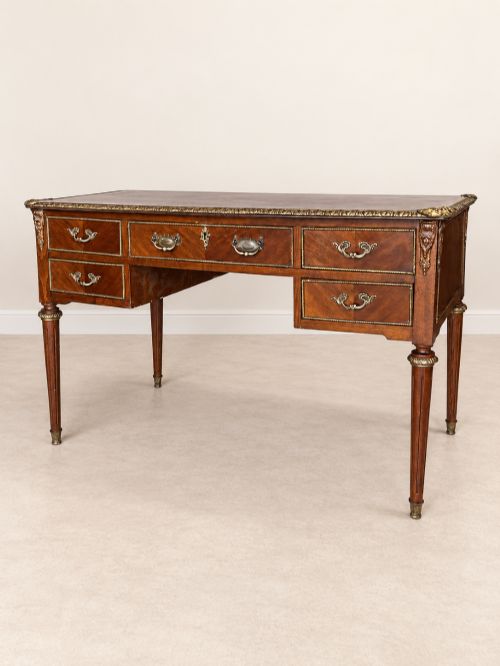
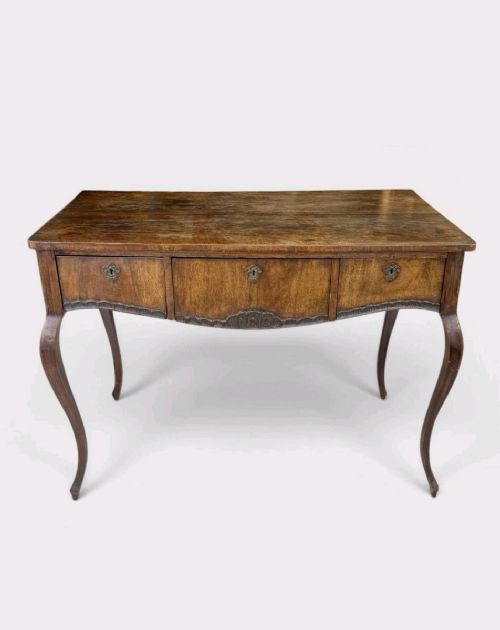
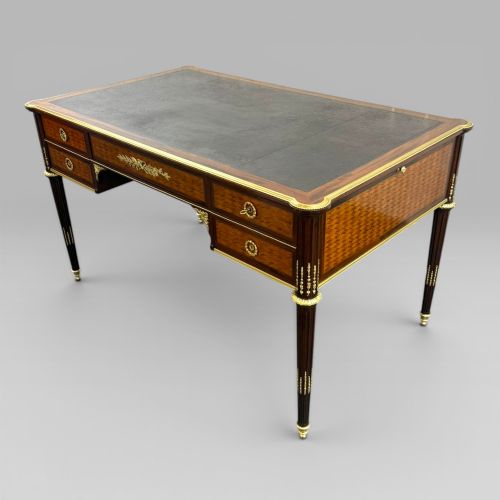
A french mahogany writing desk encompasses a diverse group of nineteenth and early twentieth-century library and salon forms, ranging from flat-topped bureau plat tables to vertical secretaire abattant cabinets. These pieces derive their character from continental cabinet-making traditions, appearing in styles from French Empire and Directoire to Louis XVI revival and Victorian adaptations.
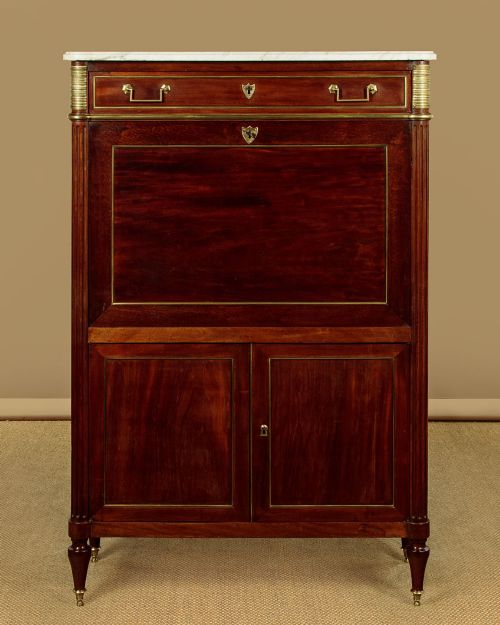
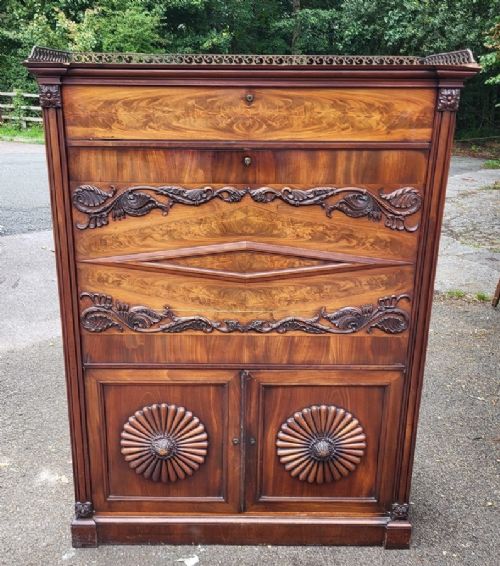
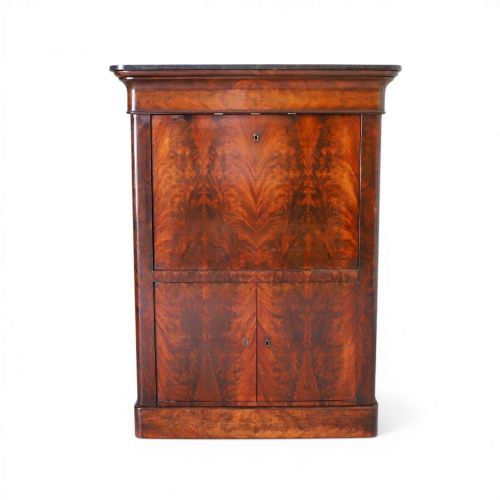
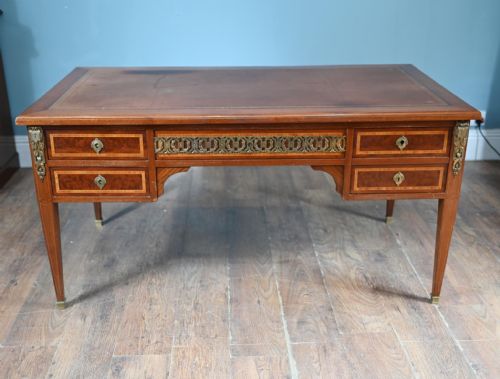
The version most commonly met on this page is the freestanding bureau plat or the drop-front secretaire cabinet, constructed from rich mahogany timber and frequently accented with marble slabs, brass inlay, or gilded bronze mounts. Makers often integrated leather writing surfaces and internal secret drawers to balance domestic elegance with practical correspondence needs.
Materials and construction
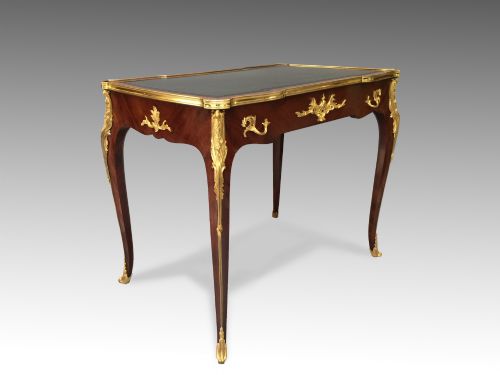
Makers utilised solid mahogany and striking flame mahogany veneers over secondary timbers, often pairing the dark wood with contrasting satinwood, kingwood, or parquetry inlay. Structural strength was combined with decorative flair through the application of cast ormolu mounts, brass banding, and inset tooled leather writing surfaces.
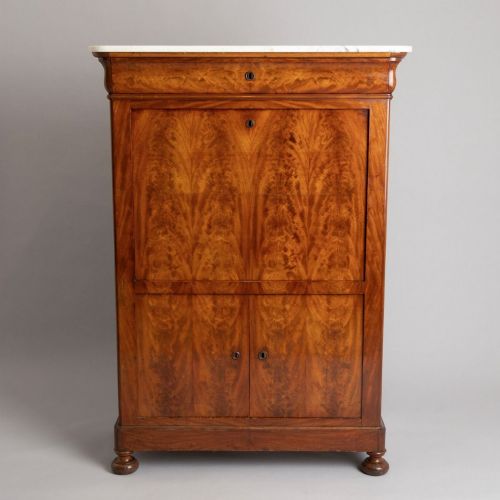
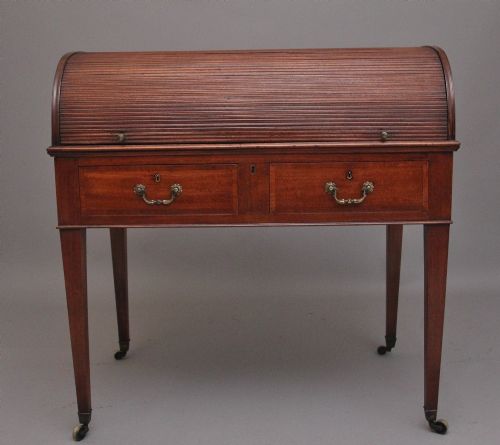
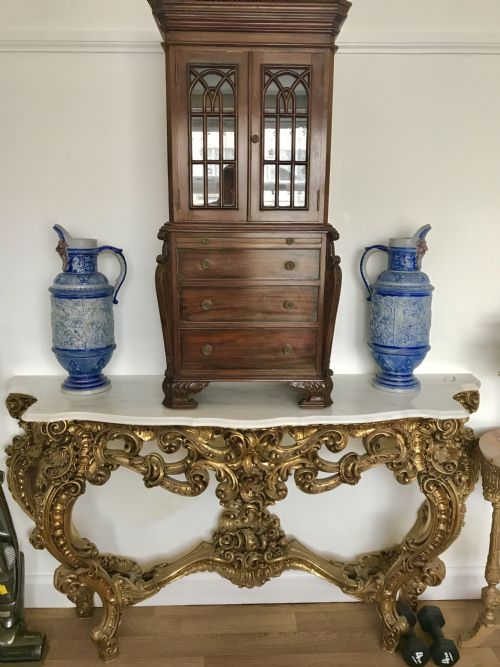
Cabinetmakers employed traditional joinery techniques to accommodate complex forms like cylinder desks, tambour shutters, and drop-front secretaire cabinets with fitted interior compartments. Marble tops, frequently in white or contrasting shades, were added to upper surfaces on specific upright cabinet styles for durability and visual weight.
Listings feature mahogany, flame mahogany, kingwood, and satinwood paired with marble tops and ormolu mounts across Victorian, Edwardian, and nineteenth-century periods.
Distinctions in quality
The distinction between standard commercial items and exceptional pieces rests upon the precision of the cabinetwork and the crispness of the bronze or ormolu mounts. Finer examples display carefully chosen flame mahogany veneer patterns that mirror across drawers and panels, alongside meticulously hand-chased gilt bronze rather than cast-replicated metalwork.
François Linke·Edwards & Roberts·Alphonse Tahan·Jean-Joseph Chapuis
The French Mahogany Writing Desk Glossary
- Bureau plat
- A freestanding writing table, typically featuring multiple drawers along the frieze and designed to be viewed from all sides in the centre of a room.
- Secretaire abattant
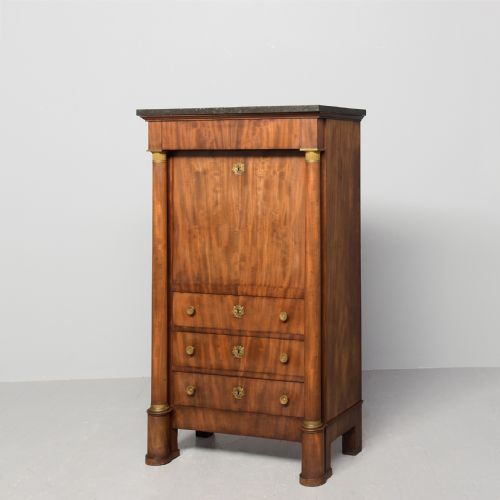
- A tall upright cabinet with a hinged vertical drop-front panel that conceals a fitted interior of small drawers and pigeonholes for correspondence.
- Ormolu
- Gilded bronze used for decorative mounts, feet, and handles, cast and hand-chased to accent the architectural lines of the furniture.
- Bonheur du jour
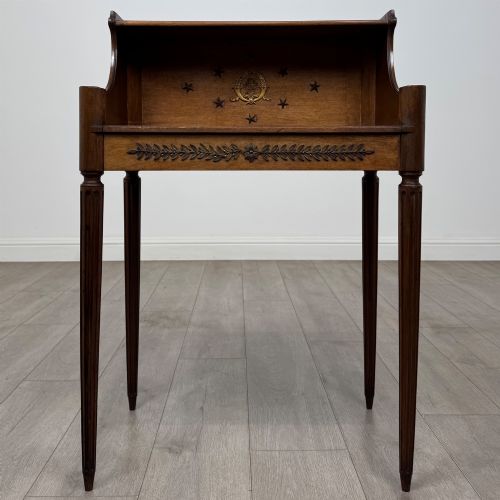
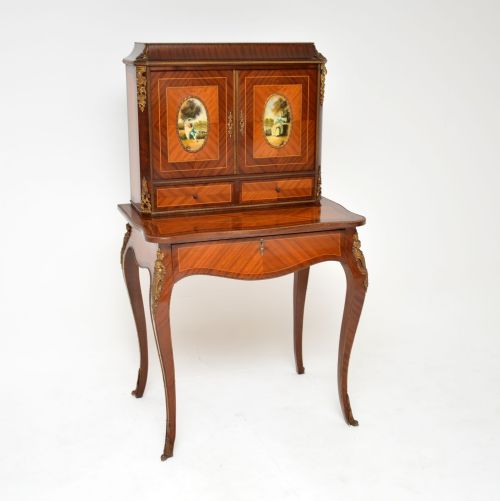
- A light lady's writing desk featuring a small superstructure of drawers, shelves, or a cabinet on top of the main writing surface.
- Parquetry
- Geometric wood inlay work arranged in patterns such as cubes or chequers across the surface of the timber.
French Mahogany Writing Desk: Frequently Asked Questions
Where should a bureau plat sit?
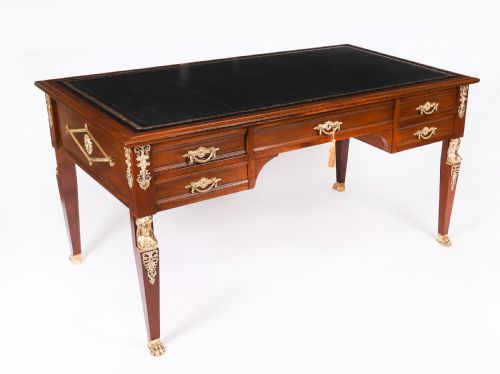
A bureau plat is traditionally designed as a freestanding centre table, meaning it possesses a finished back and looks correct when placed away from walls in the middle of a room.
Positioning it in the centre of a study or library allows the brass mounts and mahogany grain to be appreciated from every angle.
How do I use a secretaire abattant?
The drop-front panel unlocks and lowers to create a horizontal writing surface covered in leather or wood, revealing internal compartments and small drawers behind it.
When correspondence is finished, the panel lifts back to the vertical position, concealing the workspace and any papers stored inside.
What is a bonheur du jour used for?
A bonheur du jour functions as a light, compact lady's writing desk featuring a raised superstructure with small drawers or a cabinet for stationery.
Historically utilised in the boudoir or salon for writing brief letters, it serves today as a delicate writing surface or display table.
How do I distinguish Empire style?
Empire style furniture is characterised by heavy classical proportions, dark mahogany surfaces, and symmetrical architectural lines often highlighted with bold ormolu mounts.
Look for motifs drawn from ancient Roman and Greek design, including classical busts, paw feet, and applied gilt bronze wreaths.