





French Vanity Writing Desk
A french vanity writing desk brings together the dual arts of correspondence and grooming, offering hidden compartments and drop-down surfaces for the boudoir.
French Vanity Writing Desk
A french vanity writing desk encompasses versatile hybrid furniture designed for both personal correspondence and morning toilette. These pieces frequently emerge as bonheur du jour writing desks, poudreuse dressing tables, or compact ladies desks spanning the Victorian era and the nineteenth century.
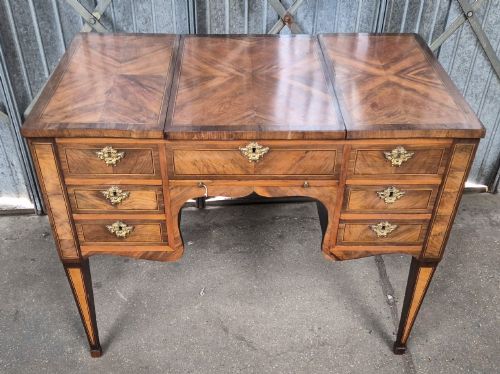
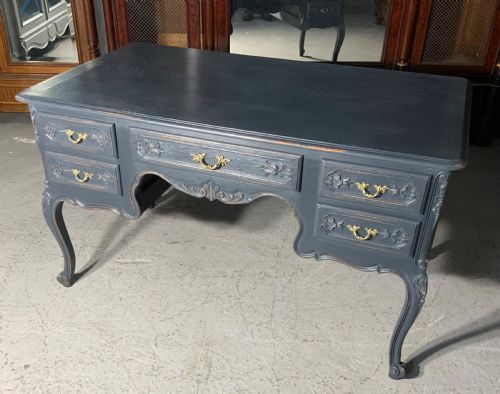
Makers drew heavily upon historical French idioms, resulting in revived Louis XV, Louis XVI, and Rococo styles alongside provincial expressions. Walnut, burr walnut, and kingwood dominate the forms seen on this page, often supplemented by mahogany, tulipwood, oak, and painted finishes.
Buyers will encounter kidney-shaped table desks alongside traditional rectangular writing tables fitted with superstructure compartments. These hybrid items served elite domestic interiors where multipurpose furniture was prized for private chambers.
Materials and Technique
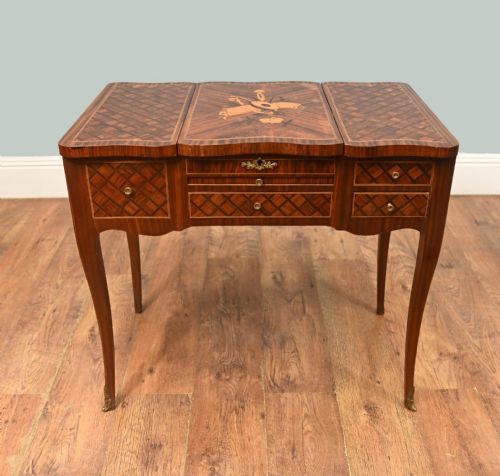
Cabinetmakers utilised rich decorative veneers such as burr walnut, kingwood, and tulipwood over stable secondary timbers to achieve striking grain patterns. Marquetry inlay frequently adorns the primary display surfaces, demonstrating precise cutting and fitting of contrasting wood species.
Mounts in cast and chased ormolu highlight structural contours, accompanied by brass hardware and leather writing surfaces inset into the top. Glass elements appear within related dressing components, while certain nineteenth-century examples feature painted wooden surfaces.
Listings feature periods from the nineteenth century and Victorian era alongside 1860, 1880, and 1920 dates.
Judging Quality
The division between standard output and top-tier pieces rests on the choice of veneer and the crispness of marquetry work. Elaborate kingwood or burr walnut surfaces matched with finely cast ormolu mounts signal superior workshop production.
Complexity of internal arrangement distinguishes better bonheur du jour tables, where pigeonholes, small drawers, and fitted writing flaps demonstrate careful joinery. The integrity of the timber framing and the subtlety of painted or carved details further separate exceptional desks from ordinary variants.
The French Vanity Writing Desk Glossary
- Bonheur du jour
- A small ladies writing desk featuring a raised superstructure of shelves, drawers, or a small cabinet above the main writing surface. This form gained immense popularity during the eighteenth century and saw robust revivals in the Victorian period.
- Poudreuse
- A specialised French dressing table equipped with folding lids that conceal a mirror and compartments for cosmetics and powders. These dual-purpose tables combine vanity functions with a compact writing surface.
- Kingwood
- A dense, richly grained tropical timber prized for marquetry and veneering in fine cabinetmaking. It displays deep brown and violet tones that made it a favourite for luxury French-style furniture.
- Ormolu
- Gilded bronze mounts applied to the angles, feet, and friezes of fine furniture. The technique involves coating cast bronze with a mercury-gold amalgam before heating.
- Marquetry
- The art of applying decorative veneer pieces to a structural panel to form pictorial or geometric designs. Craftsmen select contrasting timbers such as tulipwood and satinwood to create shaded visual depth.
French Vanity Writing Desk: Frequently Asked Questions
What is a bonheur du jour?
A bonheur du jour is a light ladies desk featuring a raised cabinet or shelf section mounted on the main writing surface. These pieces were designed for reading, letter writing, and keeping small personal items close at hand in private rooms.
First appearing in mid-eighteenth-century France, the form enjoyed widespread revival during the Victorian era. They remain prized for their compact proportions and intricate internal compartments.
How do I use a vanity desk today?
These desks function effectively as compact home office stations or bedroom dressing tables. The surface accommodates a laptop or writing materials, while the integrated drawers and compartments store cosmetics, stationery, or jewellery.
Placing the desk against a well-lit wall preserves the decorative back and top while providing a practical surface for daily correspondence or grooming.
How do I identify French revival styles?
Revival pieces incorporate decorative vocabulary from earlier French royal reigns, notably the curved cabriole legs of Louis XV and the neoclassical straight tapered legs of Louis XVI. Look for characteristic details such as Ormolu mounts, marquetry, and kidney-shaped tops.
Nineteenth-century cabinetmakers reinterpreted these historical motifs to satisfy Victorian demands for ornate, romantic bedroom and boudoir furniture.
What woods were used on these desks?
Cabinetmakers employed a foundation of solid timber veneered with highly figured decorative woods. Burr walnut, kingwood, tulipwood, and mahogany provide the primary visual surfaces across these examples.
Secondary woods support the internal framing of drawers and carcases, while specific provincial pieces utilise solid oak or painted finishes rather than exotic veneers.