



French Mahogany Clock
A french mahogany clock brings together rich cabinet timber and precise continental movement, offering a striking functional centrepiece for any room.
French Mahogany Clock
A french mahogany clock is a horological piece housed in a timber case, spanning mantel, wall, portico, and grandfather formats. Buyers searching this phrase will find an abundance of mantel clocks alongside occasional wall clocks and portico regulators.
The most common form encountered on this page is the mantel clock dating from the nineteenth century or the Edwardian era. These pieces frequently exhibit styles ranging from Belle Epoque and Art Nouveau to Empire and Louis Philippe.
Origins vary across French workshops and makers, with many examples imported or retailed through British houses. The timber case provides the primary visual structure, framing dials of enamel or silvered metal.
How They Were Made
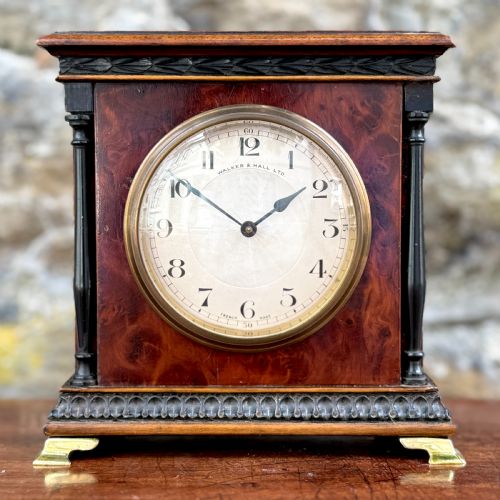
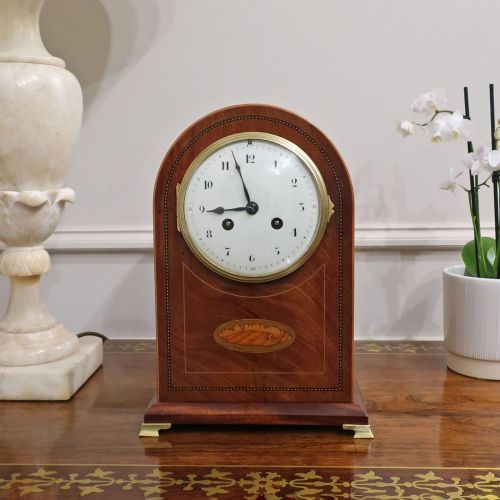
Cases utilise solid or veneered mahogany, sometimes inlaid with marquetry or accented with burr walnut and ebonised wood. Brass and ormolu mounts, mounts in gilt bronze, and bevelled glass components complete the exterior architecture.
Internal movements rely on brass wheel trains, escapements such as pinwheel or knife edge suspension, and striking mechanisms driven by springs or weights. Dials combine white enamel chapters with fine hand-painted numerals and delicate metallic hands.
French Mahogany Clock Retail Price Guide 2026
Typical asking prices for french mahogany clock among the pieces listed under this phrase on Sellingantiques today, from the lower quarter to the upper quarter. They describe what is for sale here now, not the wider market.
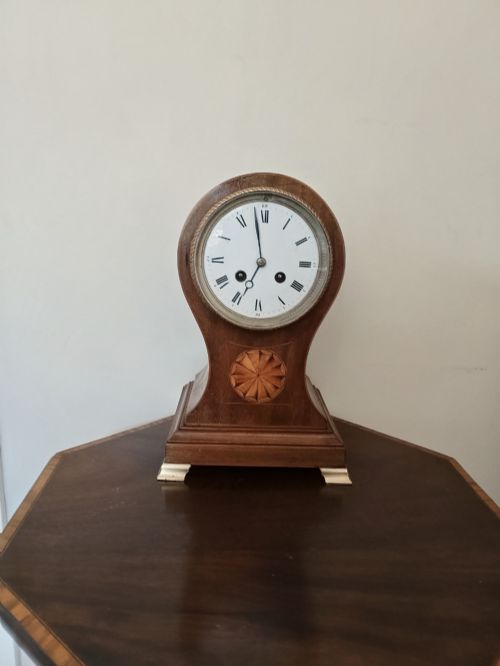
Some mantel clocks take the shape of a plump balloon, offering a cheerful domestic silhouette alongside precise horological engineering.
What Varies in Quality
The standard of a french mahogany clock rests upon the crispness of the cabinetwork and the finesse of the brass or ormolu mountings. Finer models display intricate hand carving, precise marquetry inlay, and heavy fire-gilded bronze rather than stamped brass.
Movement execution dictates horological worth, distinguishing standard mass-produced calibres from signed works by established makers with sophisticated escapements. The integration of the dial, glass panels, and case proportions determines the overall harmony of the piece.
Walker and Hall·Maurice and Marcel Moulin Favre Bulle·Valiant Paris·French Royal Exchange·Maple and Co Paris·Malecot of Paris·Vincenti·Japy Freres·Couaillet·Samuel Marti·Drocourt·Planchon A Paris
The French Mahogany Clock Glossary
- Ormolu
- Gilt bronze mounted onto the furniture case. This technique involves applying a gold-mercury amalgam to shaped bronze before firing.
- Portico Clock
- A clock featuring a architectural frame supported by four pillars. These architectural pieces often house a swinging pendulum suspended centrally within the structure.
- Lyre Clock
- A timekeeper shaped in the musical form of a lyre. The strings are represented by brass rods or gilt mounts flanking the dial.
- Pinwheel Escapement
- A precise mechanical linkage regulating the drop of the teeth on the escape wheel. It permits high accuracy in timekeeping across finer movements.
- Marquetry
- Decorative patterns formed from contrasting veneers laid into the timber surface. Craftsmen utilise floral or geometric motifs to enrich the mahogany body.
French Mahogany Clock: Frequently Asked Questions
Where should I place a mantel clock?
Position the piece on a flat, stable surface away from direct sunlight and damp environments. A mantelpiece or heavy sideboard provides an ideal setting.
Ensure the surface does not suffer from floor vibrations that might interfere with the pendulum swing. Level placement is essential for the escapement to beat evenly.
How do I identify the period of the clock?
Examine the stylistic cues of the mahogany case alongside the dial design and backplate signatures. Belle Epoque and Art Nouveau forms point toward the turn of the twentieth century.
Earlier nineteenth century pieces often display Empire or Louis Philippe architectural lines. Maker stamps on the movement backplate provide a reliable guide to the date of manufacture.
What is an electric skeleton clock?
An electric skeleton clock combines exposed mechanical gear trains with early electrical battery technology. These twentieth-century pieces display the moving parts without a concealing wooden case.
The mahogany housing acts as a support frame or base rather than a traditional box enclosure. They represent a fascinating bridge between traditional craftsmanship and modern power.