
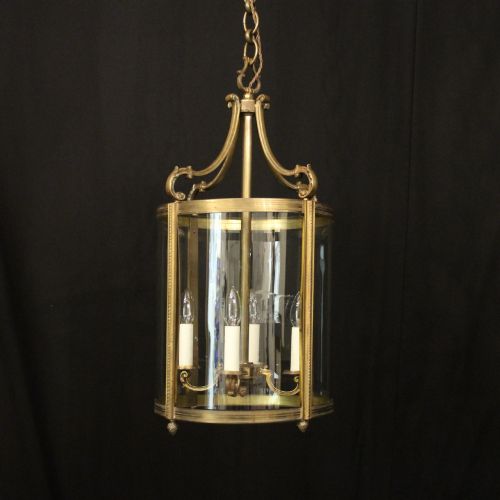
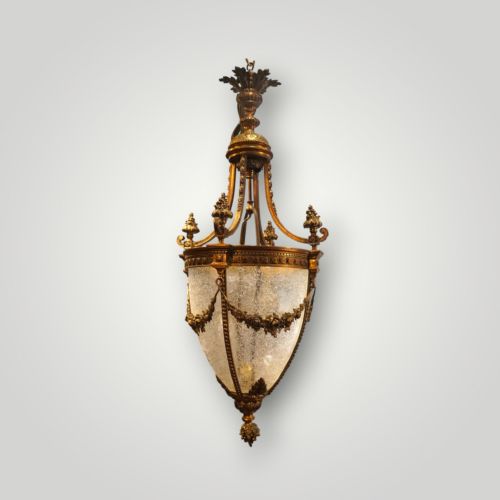
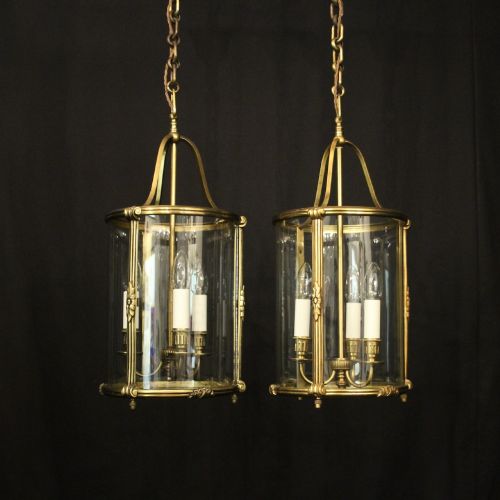
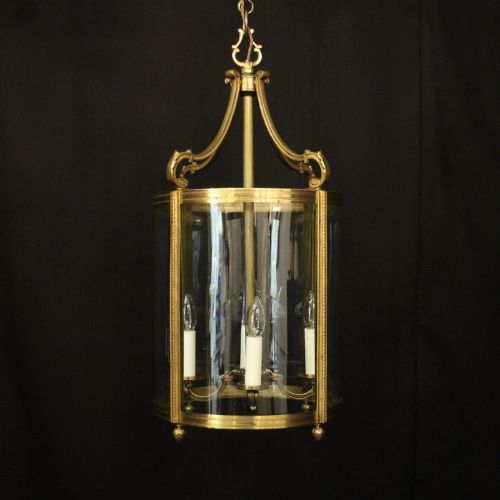


French Louis XVI Lantern
These French Louis XVI lantern examples bring neoclassical symmetry and warm metallic glow to entrance halls, drawing the eye upwards with formal grace.
French Louis XVI Lantern
A french louis xvi lantern combines strict neoclassical geometry with delicate classical ornamentation designed to illuminate grand entrances and high-ceilinged corridors. These hanging fixtures appear most frequently in nineteenth-century and early twentieth-century interpretations, drawing heavily on the vocabulary of French chateaux and the Palace of Versailles.
Buyers encounter forms ranging from simple hexagonal brass frames to large, multi-light gilt bronze creations fitted with curved convex glass panels. Ceiling lighting in this specific style relies on straight lines, urn motifs, laurel wreaths, and restrained proportions rather than heavy baroque curves.
Materials and construction
Metalwork forms the structural backbone of every piece, executed primarily in cast bronze, brass, or ormolu, which then receives a rich layer of gilding. Makers constructed these frames to hold transparent, frosted, or cut glass panels that soften the internal light source.
Internal candle arms or electrical conversions utilise solid metal casting techniques, where individual components screw or pin together to support the weight of the glass and metal assembly.
Listings feature periods spanning from the nineteenth century through the 1930s, utilising brass, gilt bronze, and various forms of cut and frosted glass.
Markers of distinction
Superior execution shows in the crispness of the chased ornamentation upon the gilt bronze and the thickness of the metal cast. Lesser pieces rely on simpler stamped brass components with minimal surface detail.
The integration of the glass panels dictates the overall visual refinement, where bent convex or heavily cut glass demands greater technical skill than flat, plain panes.
The French Louis XVI Lantern Glossary
- Ormolu
- Gilded bronze, where a layer of gold is applied to a bronze base using mercury amalgamation or modern electroplating. This technique creates a durable, warm metallic surface that resists tarnishing.
- Convex glass
- Curved glass panels shaped outward to give the lantern a rounded profile. This curvature magnifies the internal light and creates distorted, pleasing reflections.
- Neoclassical
- A style reviving classical Roman and Greek architectural motifs. It emphasises symmetry, straight lines, and restrained decorative elements such as acanthus leaves and urns.
- Hall lantern
- A ceiling-hung lighting fixture designed specifically for transitional spaces like corridors and vestibules. These fixtures provide vertical illumination in narrow architectural areas.
- Gilt bronze
- Copper alloy coated with a thin layer of gold. The material combines structural strength with a bright, decorative finish.
French Louis XVI Lantern: Frequently Asked Questions
Where should I hang a french louis xvi lantern?
These fixtures suit high-ceilinged entrance halls, stairwells, and formal dining rooms where their vertical proportions command attention. Their design works best when suspended centrally to allow unobstructed clearance underneath.
Because they project light downward and outward through glass panels, they function effectively as primary illumination sources in transitional spaces.
How do I distinguish nineteenth-century examples from later pieces?
Nineteenth-century models typically feature heavier hand-chased bronze castings and older fixing screws, whereas 1920s reproductions often show slight standardisation in their brass components.
Examining the wiring canals and the method used to secure the glass panels provides further clues regarding the manufacturing period.
Are these lanterns wired for modern electricity?
Most surviving examples have undergone conversion to electricity at some point in their history to comply with modern safety standards. Many retain internal cluster fittings designed to hold multiple candelabra bulbs.
Buyers should inspect the internal wiring channels to ensure the setup accommodates contemporary electrical requirements without altering the historic frame.
What glass types appear in these lanterns?
Common variants include plain flat glass, curved convex panels, and cut or frosted glass that diffuses the bulb glare. Cut glass additions often feature star or geometric patterns that refract the internal light.
Clear glass maximises light output, while frosted or patterned panels offer a softer, more ambient glow.