
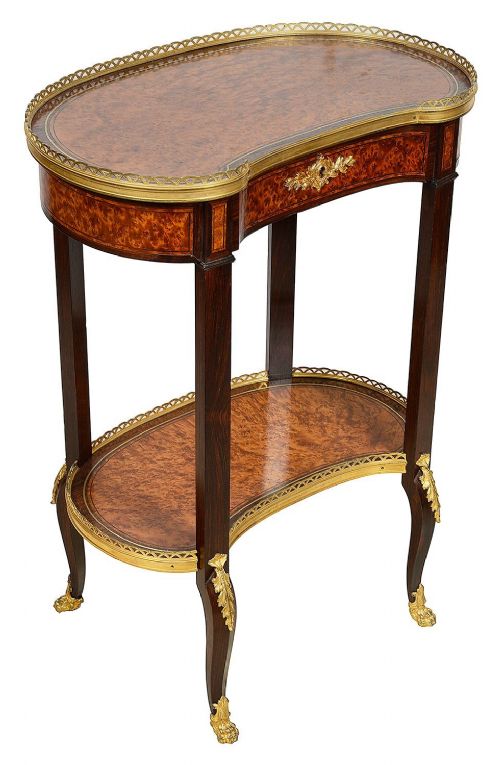
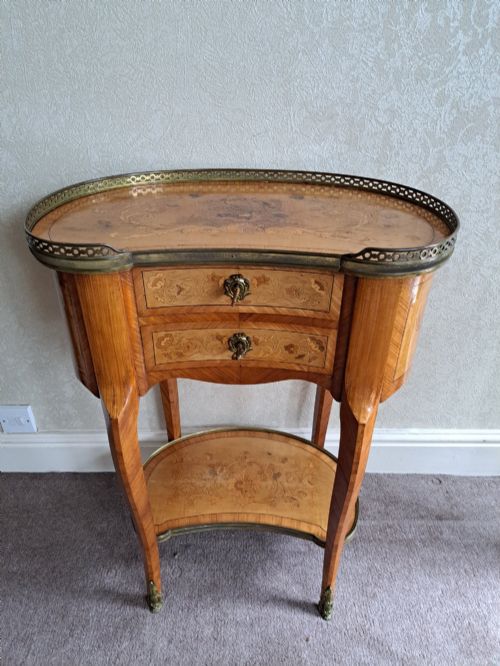


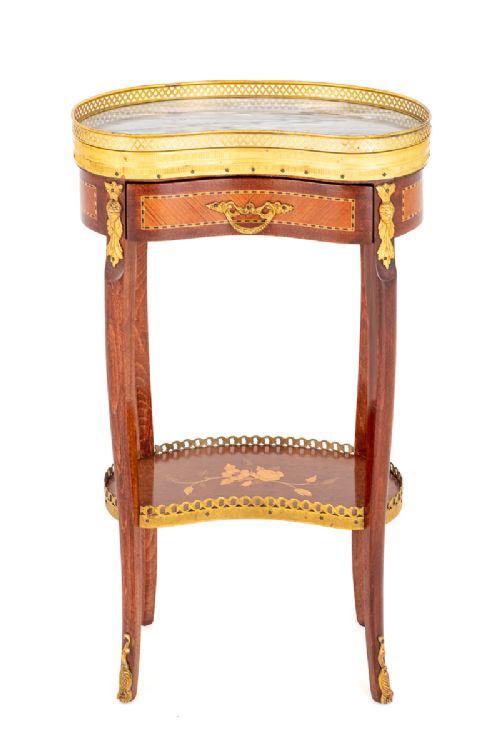


French Kidney Side Tables
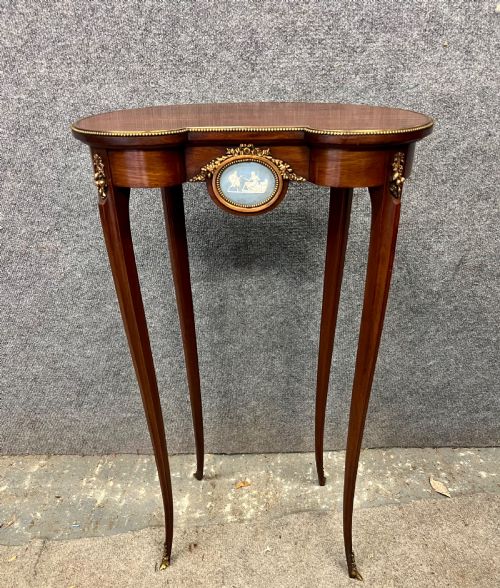
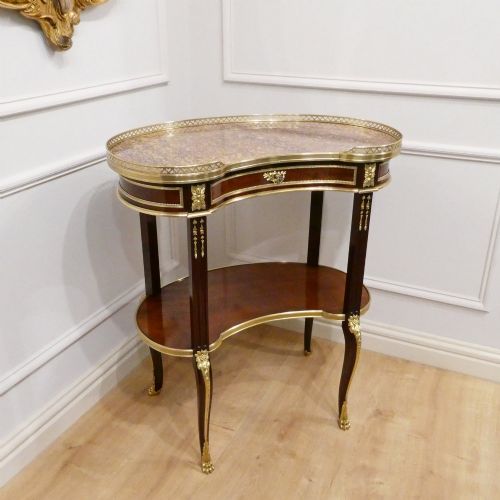
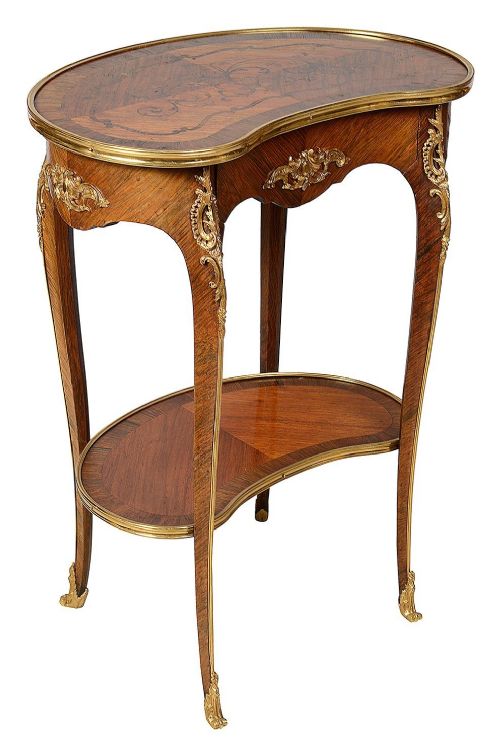
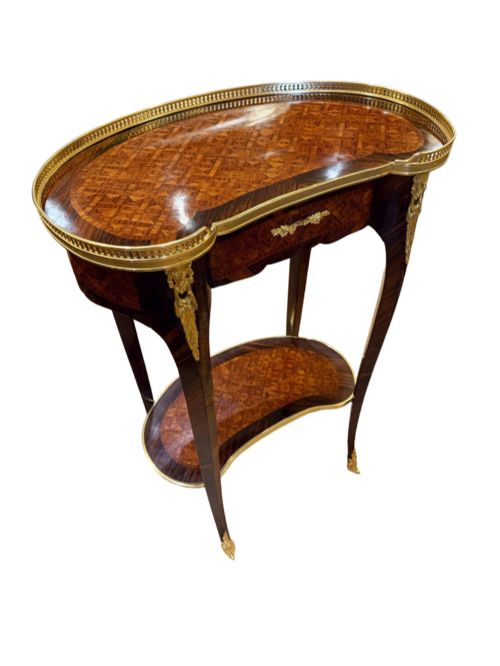
These French kidney side tables bring serpentine elegance and curved surfaces to a room, offering a neat silhouette designed to hug a chair or bed.
French Kidney Side Tables
When you search for french kidney side tables, you are looking at small tables defined by their characteristic concave front and convex back curve, echoing the shape of a kidney bean. These pieces emerge primarily in nineteenth-century and early twentieth-century formats, spanning periods from eighteen-sixty through the nineteen-thirties and encompassing Edwardian examples.
You are most likely to meet two-tier side tables, bedside tables, and occasional tables on this page. Makers often constructed them in Louis XV revival and Louis XVI styles, incorporating marble tops, brass galleries, and lower shelves or drawers.
The form adapts easily to different domestic functions, serving beside a bed, next to a library chair, or as a lamp end table. Marquetry inlay and fine veneers frequently decorate the tops and sides, making them as much decorative objects as functional furniture.
How they were made
Cabinetmakers built these tables using hardwoods such as mahogany, walnut, burr walnut, kingwood, and rosewood as a structural base for decorative veneers. Parquetry and marquetry geometric patterns or floral designs were carefully cut and laid into the surface, often framed by contrasting stringing.
Ormolu mounts, brass galleries, and sabots were cast and applied to accentuate the curved outlines and protect the legs. White or coloured marble tops, frequently encircled by pierced brass railings, provided a durable, cool surface for daily use.
The listings on this page span the nineteenth century through the nineteen-thirties, featuring mahogany, walnut, and burr walnut alongside marble and ormolu.
What varies in quality
The distinction between standard production and the highest grade rests on the crispness of the marquetry and the weight of the cast ormolu mounts. Finer examples display tight, seamless veneer work across the difficult concave and convex curves without lifting or shrinkage.
Makers known for exceptional execution, such as Maison Millet or François Linke, integrated superior bronze mounts and signed their work directly onto the bronze or wood framework. The thickness and figuring of the selected mahogany, walnut, or kingwood veneers also dictate the overall sophistication of the piece.
Maison Millet·Tehan·F. Linke
The French Kidney Side Tables Glossary
- Kidney shaped
- A curved furniture top resembling a kidney bean, featuring an inward-curving front edge designed to sit close to the user.
- Ormolu
- Gilded bronze mounts and ornaments applied to furniture, popular in French nineteenth-century cabinetmaking.
- Marquetry
- Decorative patterns formed by fitting together thin slices of various coloured woods and veneers onto a solid ground.
- Étagère
- A small open shelving unit or side table with multiple tiers for display.
- Gallery
- A raised ornamental border, often pierced brass, fitted around the edge of a marble or wooden table top.
French Kidney Side Tables: Frequently Asked Questions
What were french kidney side tables used for?
These tables served primarily as intimate occasional pieces in salons, boudoirs, and libraries, holding reading materials, small lamps, or decorative objects. Bedside versions provided a convenient surface next to low nineteenth-century beds for night-time essentials.
Their curved silhouette allowed them to sit snugly against upholstery or walls without blocking narrow pathways in crowded nineteenth-century rooms.
How do I identify Louis XV style?
Louis XV revival pieces rely heavily on asymmetry, sweeping serpentine curves, and naturalistic floral marquetry. You will notice cabriole legs that curve outward and taper gracefully down to subtle feet.
Ormolu mounts on these pieces often feature acanthus leaves, scrolls, and rococo motifs rather than the strict symmetry found in later neoclassical revivals.
Are marble tops original to these tables?
Many nineteenth-century and Edwardian bedside and side tables were manufactured specifically with inset marble slabs to provide a stain-resistant surface. These slabs usually rest within a rebated wooden frame surrounded by a brass gallery.
White and veined marble varieties appear frequently, though plain wooden veneered tops are equally common depending on the specific model and maker.
How do I care for inlaid veneer?
Keep inlaid tables away from direct sunlight and heat sources to prevent the natural glues from drying and the delicate wood veneers from shrinking or cracking. Dust them gently with a dry, soft cloth and avoid chemical polishes that can seep into the grain.
Applying a traditional beeswax sparingly will help maintain the natural lustre of mahogany, walnut, and rosewood surfaces without building up heavy residue.