
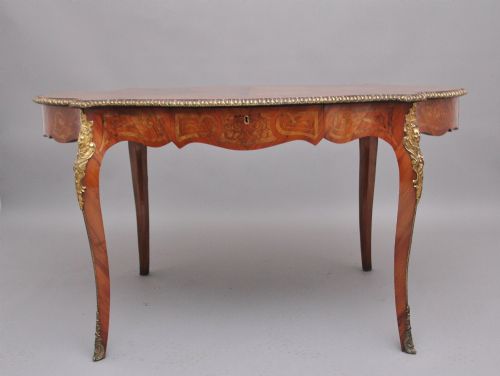


French Inlaid Sofa Table
A french inlaid sofa table brings nineteenth-century cabinet-making into a room with rich marquetry and refined proportions.
French Inlaid Sofa Table
A french inlaid sofa table is a nineteenth-century form designed for domestic interiors, appearing across periods from eighteen fifty to eighteen ninety. These pieces emerge in walnut, mahogany, rosewood, and amboyna, often incorporating drop leaves and marquetry inlay.
Buyers encounter side tables, console tables, and centre tables alongside dedicated sofa tables reflecting French Empire, Napoleon III, and various revival styles. The construction frequently utilises ebonised wood, boxwood, and birds eye maple to create detailed surface patterns.
How they were made
Cabinet-makers built these tables using foundational timbers like walnut and mahogany, applying intricate marquetry inlay in contrasting woods such as boxwood and rosewood. The surface decoration relies on precise hand-cutting to form geometric or floral motifs across the top.
Mounts in ormolu and brass provide structural accents and decorative borders, while ebonised wood often frames the primary grain. Drop-leaf mechanisms and extending frames required careful joinery to ensure stability when expanded.
Some drop leaves hide secret mechanisms designed simply to hold a book steady while the room grows dim.
What varies in quality
Quality rests upon the intricacy of the marquetry inlay and the precision with which contrasting timbers meet across the surface. Finer examples display meticulous hand-cutting and a harmonious selection of woods like kingwood, amboyna, and birds eye maple.
The integration of metal mounts, including cast brass and ormolu, distinguishes superior pieces through crisp detailing and secure fitting to the timber. Structural execution in the frame and drawer construction also dictates the overall standard of the table.
The French Inlaid Sofa Table Glossary
- Marquetry Inlay
- Decorative technique applying small pieces of veneer to form pictorial or geometric designs on a wooden surface. This method defines the primary ornamentation of many nineteenth-century surfaces.
- Ormolu
- Gilded bronze used for decorative mounts and accents on furniture. It provides a bright metallic contrast against dark woods such as walnut and ebonised timber.
- Drop Leaf
- Hinged flap on the side of a table that folds down or lifts up to extend the surface area. This mechanism allows the furniture to adapt to different spaces.
- Ebonised Wood
- Timber treated to resemble ebony through staining or painting dark. It serves as a contrasting border or structural element in revival pieces.
- Kingwood
- Dense tropical timber featuring rich brown and violet colouring, frequently used in nineteenth-century veneer work. Its grain adds depth to patterned tabletops.
French Inlaid Sofa Table: Frequently Asked Questions
What periods do these tables come from?
The available pieces span the nineteenth century, with specific dates recorded between eighteen fifty and eighteen ninety. These decades cover several distinct design phases.
Craftsmen working during these years drew on French Empire, Napoleon III, and revival styles to shape each table.
How were these tables used originally?
These tables served various domestic functions in nineteenth-century drawing rooms and libraries, acting as surfaces for lamps, writing, or display. Drop leaves provided flexibility for different occasions.
Their forms included dedicated sofa tables, console tables, and centre tables designed to sit centrally within a room or against a wall.
What materials are most common?
Walnut, mahogany, and rosewood form the primary body of these pieces, often enhanced with amboyna and birds eye maple veneers. Decorative accents frequently incorporate boxwood and marquetry inlay.
Metal elements in brass and ormolu provide structural mounts and edge trim, complementing the dark timbers.
How do revival styles affect the design?
Revival aesthetics draw directly on earlier French decorative traditions, incorporating Louis XVI, Rococo, and Empire motifs into nineteenth-century forms. These interpretations emphasise ornate mounts and contrasting veneers.
Maker choices during this period reflected a renewed interest in historical cabinet-making techniques adapted for contemporary Victorian interiors.