
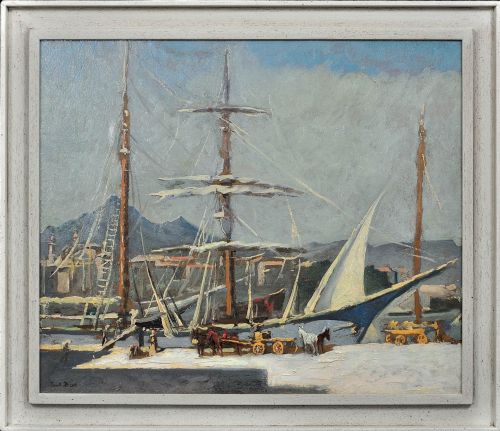
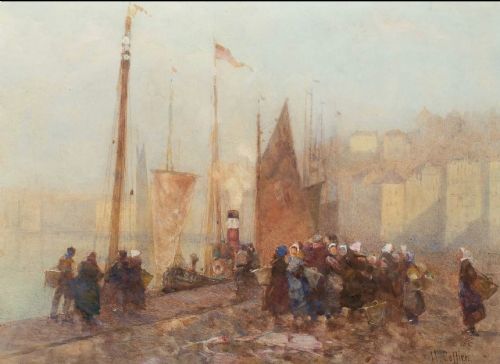


French Impressionist Coastal Scene
A french impressionist coastal scene captures the shifting light and maritime life of ports, beaches, and harbours across decades of painting.
French Impressionist Coastal Scene
When you search for a french impressionist coastal scene, you encounter works that record harbours, fishing ports, and sea breezes from the late nineteenth century through the mid-twentieth century. The selection spans oils on canvas and watercolours on paper, capturing coastal life from Normandy to the Mediterranean.
You are most likely to meet framed oil paintings on canvas depicting Breton harbours, southern ports, and seaside gatherings. These works employ loose brushwork and vibrant palettes characteristic of impressionist and post-impressionist traditions.
Materials and technique
Artists painted primarily with oil paint on canvas or watercolour on paper, mounted within wooden frames. The application relies on visible brushstrokes to render water, sky, and coastal atmosphere rather than tight academic precision.
Supports range from stretched canvas to paper sheets, paired with period wooden framing that complements the maritime subject matter.
Salt air and seaweed gatherers populate these canvases, proving that artists willingly braved windswept cliffs just to chase the right shade of blue.
Assessing quality and execution
Quality rests in the handling of light and the vigour of the brushwork, where confident application brings movement to water and air. The integration of colour to describe atmosphere separates works of lasting impact from purely formulaic views.
The sensitivity of the composition and the preservation of the painted surface dictate the standing of a piece within its period.
Paul Bret·Hector Caffieri·Raymond Picque·William Lee Hankey·Henri Ottman·Augustus William Enness
The French Impressionist Coastal Scene Glossary
- Impressionism
- A nineteenth-century painting style focusing on transient effects of light and ordinary subject matter. Artists prioritized open-air observation over studio convention.
- Post-Impressionism
- A subsequent development that extended impressionist techniques with greater emphasis on geometric forms and expressive colour. It forms a bridge to twentieth-century modernism.
- Provenance
- The documented history of ownership of an artwork. It provides essential context for authenticity and attribution.
- Seascape
- A work of art depicting the sea, coastal views, or maritime activity. These subjects allowed painters to explore expansive horizons and shifting coastal light.
French Impressionist Coastal Scene: Frequently Asked Questions
What defines a french impressionist coastal scene?
These works focus on maritime subjects such as harbours, cliffs, and fishing boats rendered through the loose brushwork and atmospheric colour of the impressionist tradition.
They capture specific coastal locations across France, ranging from the northern shores of Normandy to southern Mediterranean ports.
How were these coastal paintings created?
Artists typically applied oil paint onto canvas or worked with watercolour on paper, capturing the shifting light of the seaside.
Many of the surviving works remain housed in their original wooden frames from the period.
Where do these maritime scenes originate?
The pieces originate from various coastal regions in France, including Brittany, Normandy, Boulogne, and the French Riviera.
Some works also document Mediterranean harbours further south, such as ports in Sicily.
How do I date a coastal painting?
Dating relies on recorded artist lifespans, stylistic shifts from nineteenth-century realism into mid-century abstraction, and framing materials.
The listings span from the late nineteenth century through the 1960s, reflecting changing modernist approaches to landscape.