


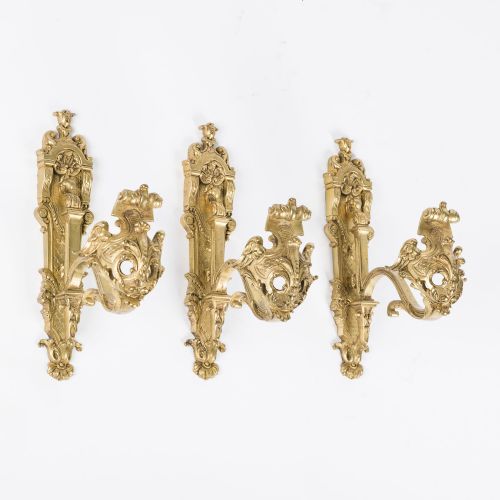


French Gilt Tiebacks
French gilt tiebacks are decorative curtain hardware that elevate a window dressing with period detail.
French Gilt Tiebacks
When you search for french gilt tiebacks, you are looking at hardware designed to hold heavy window drapery back in style. The pieces appearing here span from the 18th century through the Victorian era, including the 1870 and 1880 decades. You will most frequently meet pairs formed from ormolu, gilt brass, and gilt bronze, often styled after French Rococo Revival or Louis XVI designs.
The objects themselves take the form of curtain tie backs, curtain tiebacks, and wall hooks. Many examples survive as pairs or larger sets, intended to frame a window symmetrically. Their origins trace back to French workshops, bringing ornamental metalwork directly into domestic interiors.
How they were made
The foundational construction relies on cast metals such as ormolu, gilt bronze, brass, and copper. These metals are shaped into decorative forms, including scrolling leaves, architectural mounts, and figural elements. Some pieces incorporate enamel details alongside the gilded surfaces.
Gilding techniques applied to bronze, brass, and metal provide the characteristic golden finish seen across these examples. The casting process allows for the intricate relief work typical of French Rococo and Empire Revival styles.
Materials across these listings include ormolu, gilt bronze, brass, gilded brass, enamel, gilt metal, copper, and gilt brass.
What varies in quality
The refinement of the casting separates standard production hardware from exceptional work. Sharper relief in the chasing and greater depth in the ornamentation indicate superior execution by the maker.
The preservation of the original gilt surface affects the visual impact of each piece. Intact ormolu and consistent gilding across a matching pair represent the higher tier of these decorative items.
Henri Picard
The French Gilt Tiebacks Glossary
- Ormolu
- Gilded bronze produced by applying a finely ground high-carat gold-mercury amalgam to a bronze object. This technique creates a rich, enduring metallic surface characteristic of fine French decorative arts.
- Gilt Bronze
- Bronze metal that has been coated with a thin layer of gold leaf or gold wash. It provides the lustrous golden appearance seen on many period hardware pieces.
- Rococo Revival
- A design style drawing on 18th-century asymmetric scrolls, naturalistic foliage, and C-scroll motifs. It gained renewed popularity during the 19th century across European decorative objects.
- Louis XVI
- A neoclassical style defined by straight lines, symmetry, classical urns, and acanthus leaves. It represents the restrained aesthetic popular in late 18th-century French design.
French Gilt Tiebacks: Frequently Asked Questions
How were french gilt tiebacks used?
These hardware pieces were mounted directly to the window frame or adjacent wall to hold heavy fabric drapes open. They allowed daylight into the room while framing the window drapery in a decorative arrangement.
Pairs were positioned at matching heights on either side of the window to maintain symmetry. The curtain cord or fabric was looped over or tucked behind the protruding arm of the hook.
What periods do these tiebacks come from?
The listings span from the 18th century, represented by pieces around 1780, through the 19th century and the Victorian era. Many examples date specifically to the 1870 and 1880 decades during the height of revivalist interior decoration.
Earlier pieces often align with Georgian or Louis XVI aesthetics, while later 19th-century items frequently exhibit French Rococo Revival or Gothic Revival influences.
Are these tiebacks sold in pairs?
Many of the entries are offered as pairs or sets of four to accommodate standard window dressings. Single items and smaller groupings also appear depending on what survives from the original set.
Matching pairs are particularly useful for symmetrical window arrangements. Sets allow for uniform hardware across multiple windows in a room.
What metals are used in these pieces?
The primary metals include ormolu, gilt bronze, brass, gilded brass, and gilt metal, occasionally supplemented by copper and enamel. Ormolu and gilt bronze provide the most characteristic golden finish for French decorative hardware.
Different base metals and gilding methods influence the weight and surface texture of each hook. Some items feature enamel accents set within the metal framework.