






French Gilt Metal Clock
A French gilt metal clock brings the exuberant ornament of the nineteenth century into a room, blending metallic lustre with enamelled dials and sculptural figures.
French Gilt Metal Clock
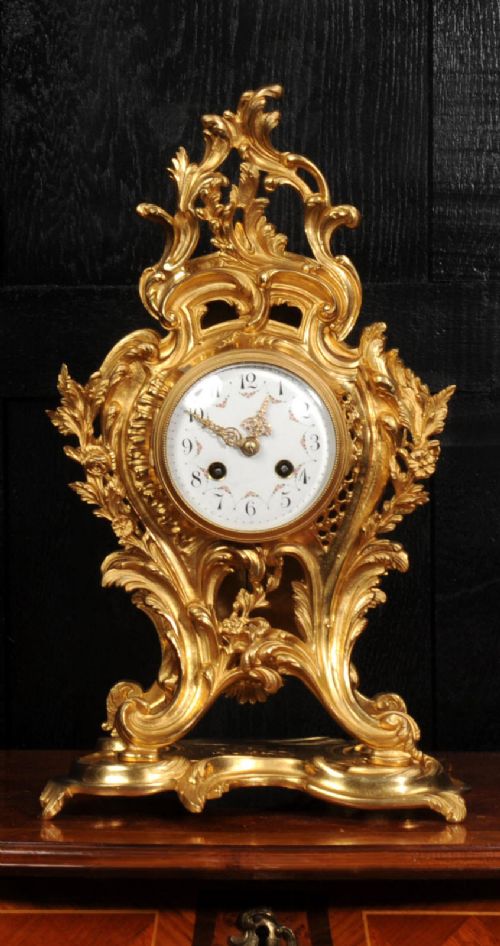
A french gilt metal clock sits at the heart of nineteenth-century domestic interior design, frequently appearing as a mantel clock or part of a larger garniture set alongside matching candelabra or urns. These pieces span periods from the late eighteenth century through the Victorian era, drawing on Revival styles such as Rococo, Louis XVI, and Napoleon III.
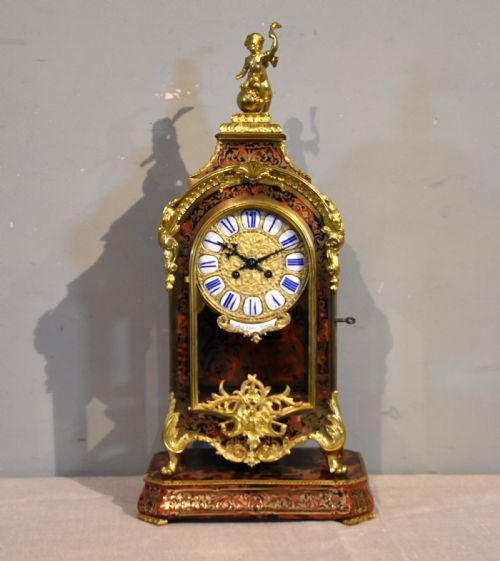
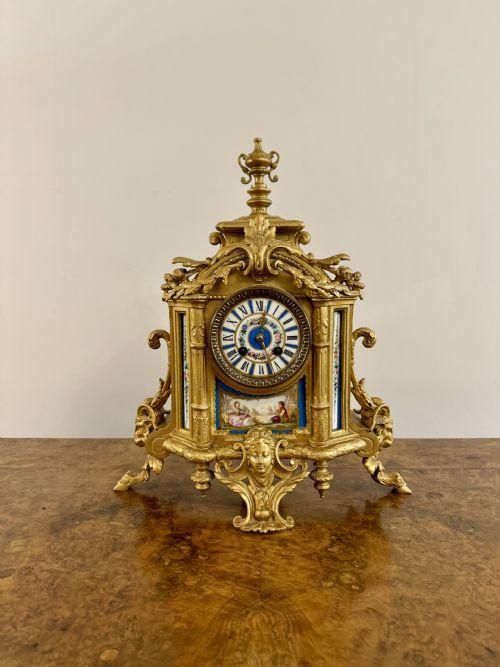
Buyers encounter substantial mantel pieces featuring cast metal cases, often combined with porcelain panels, glass domes, or marble bases. The most common manifestations on this page date from the mid to late nineteenth century, displaying ornate foliage, putti, or classical figures.
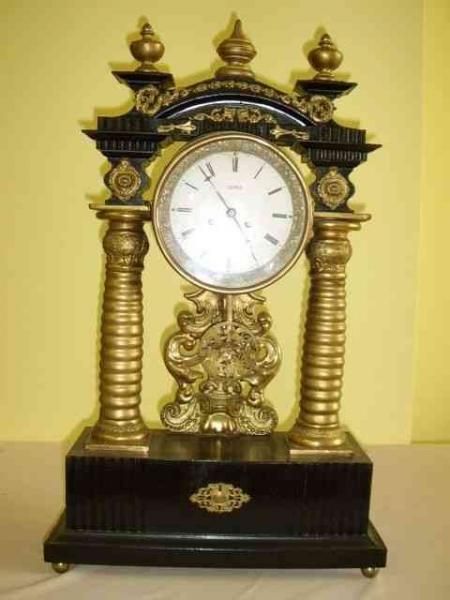
Beyond standalone mantel timepieces, the selection includes wall-mounted cartel clocks, miniature carriage clocks, and monumental portico designs. Each form utilises gilded finishes to catch the light, reflecting the prevailing tastes of French and Victorian salons.
Materials and construction
Makers constructed these clocks using a foundation of cast brass or bronze, subsequently applying fire-gilding or ormolu to achieve a bright golden surface. Ormolu involves coating base metal with a mercury and gold amalgam, which is then heated to leave a rich, durable metallic layer.
Many examples incorporate hand-painted porcelain plaques and dial faces, frequently styled after Sèvres factories, protected beneath curved glass bezels. Auxiliary materials such as white or pink marble, onyx, and slate frequently form the heavy architectural bases supporting the metalwork.
Movements inside these cases typically operate on an eight-day mechanism, sometimes featuring striking trains or musical components by notable French mechanists. Enamel chapters on the clock faces display Roman or Arabic numerals, applied with precision by specialist artisans.
Listings feature works spanning the eighteenth to twentieth centuries, utilising gilt metal, ormolu, porcelain, onyx, and marble across diverse revival styles.
Judging quality in gilded timepieces
Quality rests heavily on the crispness of the metal chasing and the depth of the original gilding. Finer castings exhibit sharp relief in scrollwork and figures, whereas lesser pieces show softened details and uniform, modern plating.
The integration of secondary materials defines the upper tier of production, seen in hand-painted porcelain panels depicting pastoral scenes without fading or hairline cracks. Heavier marble or onyx plinths and fully stamped, original clock movements further elevate a piece above standard commercial output.
Japy Freres·Leon Message·Jollet et Cie·PH Mourey·Andre Guilmet·Brunfaut·Leroy et Fils·Bourdin Paris
The French Gilt Metal Clock Glossary
- Ormolu
- A technique of applying finely ground gold mercury amalgam to bronze or brass, creating a rich golden finish. This process was largely superseded by safer electroplating methods in the nineteenth century.
- Garniture
- A set of matching decorative objects designed to be displayed together on a mantelpiece, usually comprising a central clock flanked by urns or candelabra. These sets created a balanced decorative scheme in period interiors.
- Portico Clock
- A clock featuring a architectural case supported by four columns, resembling a classical portico. These often incorporate a swinging pendulum visible within the central opening.
- Cartel Clock
- A wall-mounted clock with an ornamental frame made of gilt metal or carved wood. They gained popularity during the Rococo and Louis XV periods.
- Japy Frères
- A prominent French clockmaking dynasty operating through the nineteenth century. Their factory movements are widely found in quality mantel clocks of the period.
French Gilt Metal Clock: Frequently Asked Questions
How do I wind an antique clock?
Most mechanical clocks use a winding key inserted into the dial face to tension the mainsprings. Care must be taken not to overwind the mechanism.
Consulting a professional horologist ensures the proper tension is applied without damaging the delicate gear train inside the antique movement.
What is a clock garniture?
A clock garniture consists of a central timepieces accompanied by matching side pieces such as vases, candelabra, or urns. They were designed to create a symmetrical display on mantelpieces.
These matching sets unified the decorative scheme of nineteenth-century drawing rooms and salons.
How do I identify a Louis XVI style clock?
Louis XVI style pieces display neoclassical restraint, featuring straight architectural lines, symmetrical urns, ribbons, and classical figures. The gilt metal mounts often incorporate acanthus leaves and laurel wreaths.
This aesthetic contrasts sharply with the earlier asymmetrical curves and flowing forms of the Rococo Revival period.
Are these clocks suitable for daily use?
Many antique clocks remain fully functional and keep accurate time when properly serviced and set on a level surface. Regular cleaning by a clockmaker keeps the brass gears running smoothly.
Placing them away from direct sunlight and drafts preserves both the delicate enamel dials and the gilded surface finish.