







French Gilt Desk Set
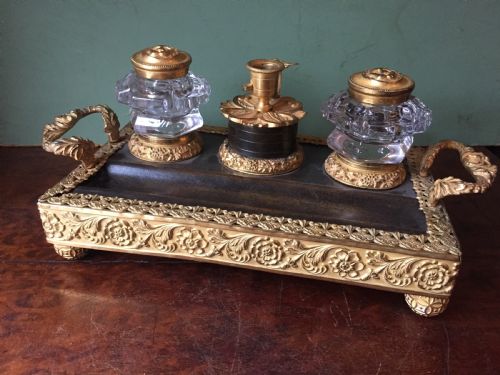
A french gilt desk set brings heavy cast metal and polished stone together on the writing table.
French Gilt Desk Set
A french gilt desk set gathers inkstands, inkwells, letter holders and pen trays into a matching arrangement for the writing table. These pieces span the eighteenth, nineteenth and early twentieth centuries, drawing on Neoclassical, French Empire, Louis XVI and Art Nouveau designs.
Most examples rely on a heavy stone base of Sienna marble, vert marble or onyx, mounted with cast metal. Alongside standalone inkstands, many sets include clock garnitures and matching candlestands or candelabras.
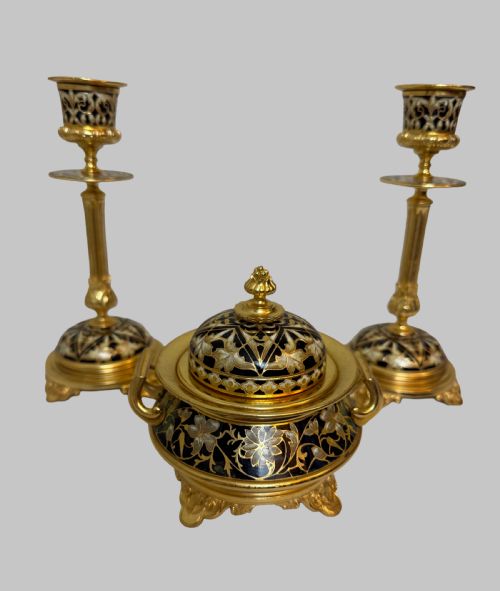
Makers utilised patinated and gilded bronze, ormolu, brass and champleve enamel to construct detailed figural studies and architectural stands. The combination of polished marble and bright metal defines the visual character of these desks.
Distinctions in craftsmanship
The crispness of the bronze chasing separates standard production from superior work. Finer sets retain sharp edges on acanthus leaves and animal pelts, whereas lesser pieces show softened details from worn moulds.
The quality of the marble plinth also marks the tier of an object, visible in the depth of the polish and the complexity of the mineral veining. Matching sets that retain all their original components demonstrate higher integrity than pieced-together groups.
French Gilt Desk Set Retail Price Guide 2026
Typical asking prices for french gilt desk set among the pieces listed under this phrase on Sellingantiques today, from the lower quarter to the upper quarter. They describe what is for sale here now, not the wider market.
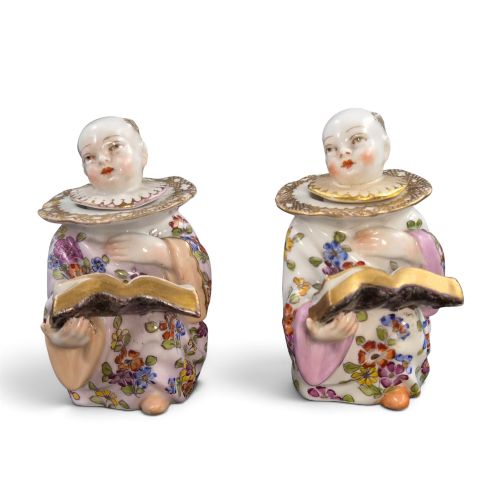
Desk sets occasionally capture playful domestic scenes, including singing birds, playing kittens and greyhounds.
Albert Marionnet·Raingo Fres Paris·Ferdinand Berthoud·Japy Freres
The French Gilt Desk Set Glossary
- Ormolu
- Gilded bronze produced by applying a mercury and gold amalgam to a bronze base and heating it until the mercury vaporised. This historic fire-gilding method creates a deep, warm lustre.
- Encrier
- A French term for an inkstand or inkwell. These desk accessories often incorporate sanders, pen holders and lidded glass wells.
- Champleve enamel
- A technique where troughs are dug into a metal surface and filled with vitreous enamel powder before firing. The metal partitions remain visible between the coloured areas.
- Garniture
- A set of matching ornamental objects for a mantelpiece or desk, typically consisting of a central clock flanked by two matching vases, candelabras or urns.
- Japy Freres
- A prominent nineteenth-century French clockmaking firm known for producing movements used in ornate garniture sets.
French Gilt Desk Set: Frequently Asked Questions
What is included in a desk set?
A typical ensemble contains an inkstand with lidded wells for ink and sand, frequently accompanied by matching letter racks, pen trays or candlestands. Larger garniture groupings add a matching clock to the writing table.
Materials combine heavy stone bases with gilded bronze mountings. The matched pieces create a unified appearance across the desktop.
How do I identify nineteenth-century pieces?
Nineteenth-century items often display Neoclassical, Louis XVI revival or Art Nouveau styling executed in ormolu, champleve enamel and marble. Maker signatures and foundry stamps on the bronze or clock movements help confirm the date of production.
Stylistic cues such as cast figural animals or classical busts point directly to Victorian and nineteenth-century manufacturing trends.
How should I care for marble and ormolu?
Dust bronze and ormolu gently with a soft dry cloth, avoiding abrasive cleaners that can strip the historic gilding. Marble bases respond well to occasional wiping with a damp cloth and immediate drying.
Keep these objects away from direct heat sources and moisture to protect the stone polish and metal finishes.
What distinguishes an encrier?
An encrier is the traditional French term for an inkstand, holding glass or ceramic ink pots within a decorative metal and stone tray. These units frequently feature built-in slots for dip pens and small compartments for blotting sand.
They range from simple bronze trays to elaborate architectural marble monuments.